Goethe Monument may refer to:
Goethe Monument (Berlin), Berlin, Germany
Goethe–Schiller Monument, Germany
Goethe–Schiller Monument (Milwaukee) in Milwaukee, Wisconsin, United States
The Goethe Monument: A Romantic Reverie
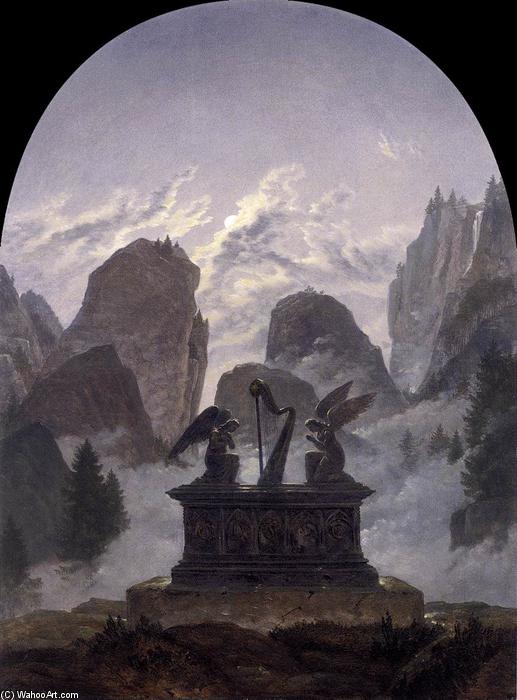
Carl Gustav Carus’s “Goethe Monument,” completed in 1832, stands as an emblem of German Romanticism—a movement characterized by fervent emotion, idealized landscapes, and a profound engagement with the sublime. More than just a depiction of scenery, it's a carefully crafted meditation on memory, artistic inspiration, and the enduring legacy of Johann Wolfgang von Goethe himself.
The monument’s setting is undeniably Alpine—a rugged mountain range dominates the composition, conveying both grandeur and vulnerability. Mist swirls around the base of the stone pedestal, creating an atmosphere of ethereal stillness that mirrors the contemplative spirit of Romantic art. The artist meticulously captures the interplay between light and shadow, utilizing diffused illumination to bathe the landscape in a soft glow.
- Composition: Vertical orientation emphasizes the monumental structure’s height against the expansive mountain backdrop.
- Color Palette: Earth tones—grays, browns, muted greens—predominate, fostering a sense of tranquility and grounding the scene in natural reality. Subtle blues appear in the sky, adding coolness and enhancing depth.
- Lines: Architectural lines define the monument’s contours with precision, contrasting with the flowing curves of clouds and vegetation.
At the heart of the artwork is a striking juxtaposition of figures—two winged angels kneeling before a stone pedestal supporting a harp and holding a book. These symbols resonate deeply within Romantic thought: the harp represents musical inspiration and artistic creativity, while the book embodies intellectual contemplation and erudition. Goethe himself, depicted as a solitary figure amidst the mountains, embodies the Romantic ideal of the artist as a conduit to transcendent beauty.
Carus’s masterful technique—oil paint on canvas—allows for nuanced tonal gradations and textural detail. He employs layering and blending brushstrokes to achieve smooth transitions and convincingly render the rough surface of the stone pedestal and the delicate texture of the angelic wings. The artist's dedication to capturing atmospheric perspective contributes significantly to the monument’s immersive quality.
“Goethe Monument” resides in the Hamburger Kunsthalle, where it continues to inspire viewers with its evocative portrayal of Romantic ideals. Its enduring appeal lies not merely in its aesthetic beauty but also in its profound exploration of themes—memory, nature, and artistic reverence—themes that continue to resonate across generations.
Additional Research:
The monument’s original conception reflects Carus's profound admiration for Goethe, who championed the fusion of reason and emotion—a cornerstone of Romantic philosophy.