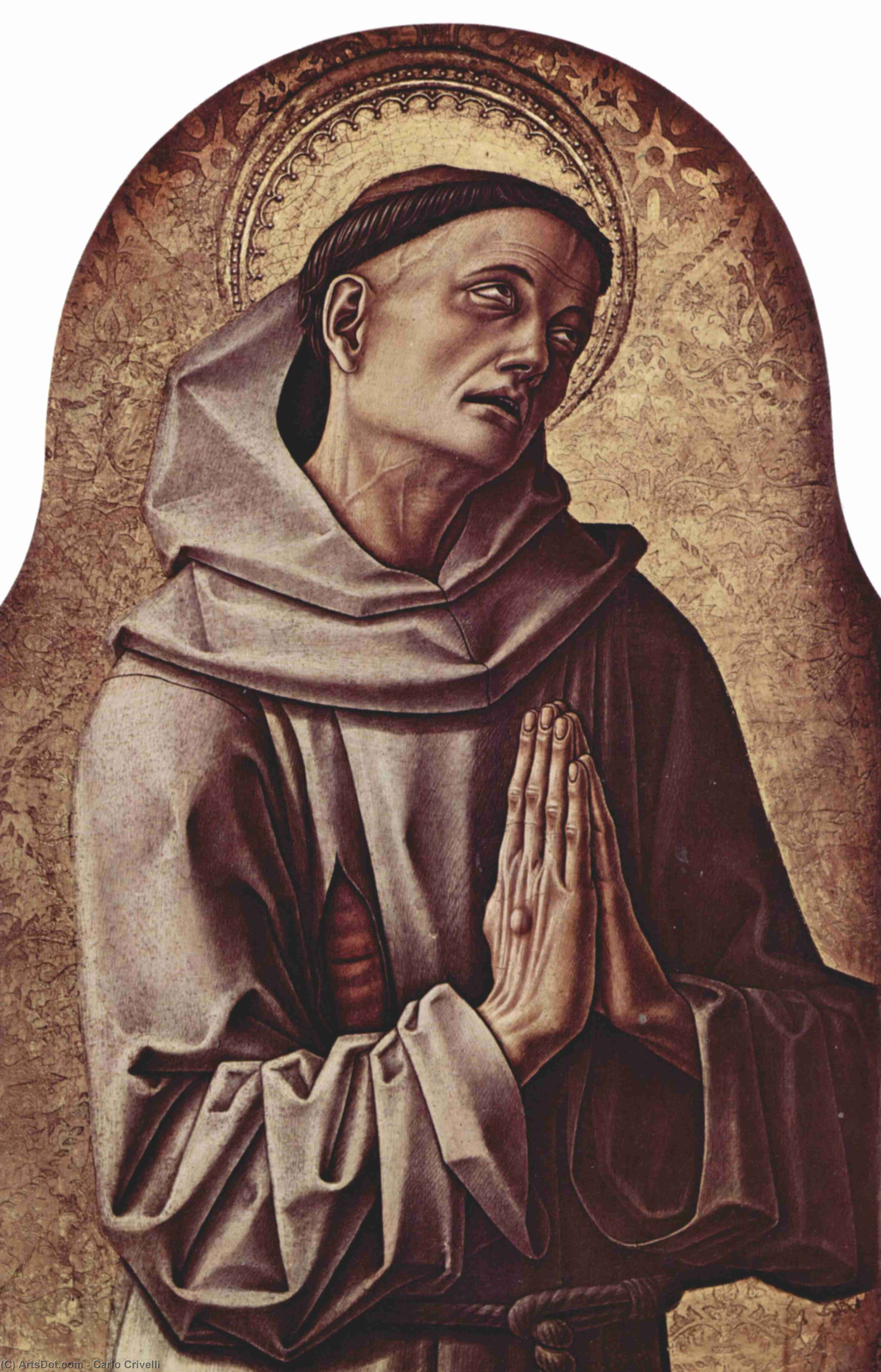
The painting
Saint Francis by
Carlo Crivelli is a stunning example of Early Renaissance art. Created in 1470, this tempera on panel piece measures 74 x 54 cm and showcases the artist's exceptional skill in capturing dramatic scenes.
The Artist and His Style
Carlo Crivelli was an Italian Renaissance painter known for his conservative Late Gothic decorative sensibility. He spent his early years in the Veneto, where he absorbed influences from the Vivarini, Squarcione, and Mantegna. His unique style combines emotional expression with a degree of realism unusual in Italian fifteenth-century painting.
The Painting
The
Saint Francis painting depicts the saint in a praying position, with his eyes uplifted and lips parted in passionate prayer. The marks of the stigmata – the wounds of the Crucifixion – are visible on his hands and through the tear in the side of his habit. The austere grey of his habit forms a striking contrast to the glittering damask patterns tooled into the gilded background.
Key Features: - The painting's use of gold surfaces creates an optical effect that would have flickered and shone in the candlelight of a medieval church.
- The artist's attention to detail is evident in the sinews standing out on Francis's hands, veins pulsating in his throat and forehead, and every hair in his eyebrows.
Availability and Reproduction
The original
Saint Francis painting can be found in the
National Gallery in London. However,
ArtsDot.com offers handmade oil painting reproductions of this masterpiece. For a little more than a print, you can own a hand-painted reproduction of
Carlo Crivelli's
Saint Francis.
To learn more about
Carlo Crivelli and his works, visit
ArtsDot.com's artist page. For information on the painting's history and significance, see
Wikipedia's article on Carlo Crivelli.