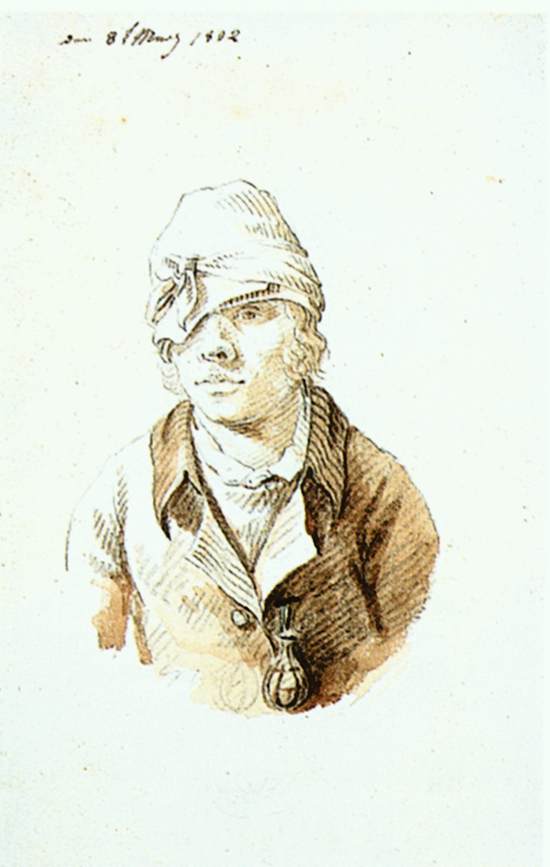
A Portrait of Quiet Intensity: Caspar David Friedrich’s ‘Self-Portrait with Cap and Sighting Eye-Shield’
Caspar David Friedrich's 1802 self-portrait, “Self-Portrait with Cap and Sighting Eye-Shield,” is not merely a likeness; it’s a profound meditation on the artist’s own psyche, rendered in the intensely personal style that would come to define his legacy. This work, measuring a substantial 175 x 105 cm, immediately draws the viewer into a world of contemplative solitude – a characteristic deeply rooted in Friedrich's life and artistic sensibility. The charcoal drawing, executed with remarkable detail, captures a man seemingly lost in introspection, his gaze directed outwards yet undeniably inward.
The subject himself is presented with an arresting directness. He wears a simple, dark suit, the fabric rendered with subtle gradations of tone that hint at the artist’s mastery of shading and texture. A cap obscures part of his forehead, adding to the air of reserve, while a bandage – a tangible reminder of a past injury or perhaps a metaphor for the wounds of life – is visible on his head. But it's the sighting eye-shield held in his hand that commands immediate attention. This device, used by surveyors and military personnel to accurately measure distances, becomes an unexpected symbol within this portrait. It suggests a desire for precision, for understanding, perhaps even a yearning to impose order onto the chaotic landscape of the self.
The Romantic Soul: Friedrich’s Artistic Language
Friedrich's style during this period is quintessential Romanticism – a movement that prioritized emotion, individualism, and the sublime power of nature. Unlike the Neoclassical emphasis on reason and classical ideals, Friedrich sought to capture the subjective experience of the world, particularly its emotional resonance. His use of light and shadow is dramatic, creating a sense of depth and atmosphere that transcends mere representation. The stark contrasts between dark areas – suggesting introspection and perhaps melancholy – and lighter patches illuminate key features of the subject’s face, drawing our attention to his thoughtful expression.
The meticulous detail evident in the rendering of clothing and facial features is not simply a technical exercise; it's an attempt to imbue the portrait with a sense of realism that amplifies its emotional impact. Friedrich was known for his painstaking preparation – often sketching extensively before committing a work to paper. This dedication to observation, combined with his expressive use of line and tone, creates a powerful synergy between subject and artist.
Symbolism and the Burden of Vision
The sighting eye-shield is arguably the most potent symbol within this portrait. It speaks to Friedrich’s own artistic practice – a relentless pursuit of accurate observation and representation. However, it also carries a deeper weight. The act of ‘seeing,’ particularly with such precision, can be demanding, even painful. Some art historians interpret the shield as representing the artist's struggle to reconcile his subjective vision with the objective reality he attempts to capture on canvas. It’s a visual metaphor for the burden of artistic creation – the constant need to analyze, dissect, and ultimately translate experience into form.
Furthermore, the bandage on the head subtly alludes to Friedrich's own personal tragedies: the loss of his mother and siblings in his youth. This early trauma undoubtedly shaped his worldview, fostering a sensitivity to mortality and a preoccupation with themes of solitude and transience that permeate much of his work. The self-portrait becomes a poignant reflection on this enduring emotional landscape.
A Timeless Masterpiece: Reproduction and Beyond
ArtsDot offers meticulously crafted hand-painted reproductions of “Self-Portrait with Cap and Sighting Eye-Shield,” allowing you to experience the profound beauty and intellectual depth of this iconic work in your own space. Our artists replicate Friedrich’s nuanced techniques, capturing not just the visual likeness but also the emotional atmosphere that defines the painting. Whether adorning a study, a gallery wall, or a private residence, this reproduction serves as a powerful reminder of the enduring legacy of Caspar David Friedrich – a solitary visionary who dared to explore the depths of the human spirit through the language of art.