A Poignant Still Life of Penury and Perseverance
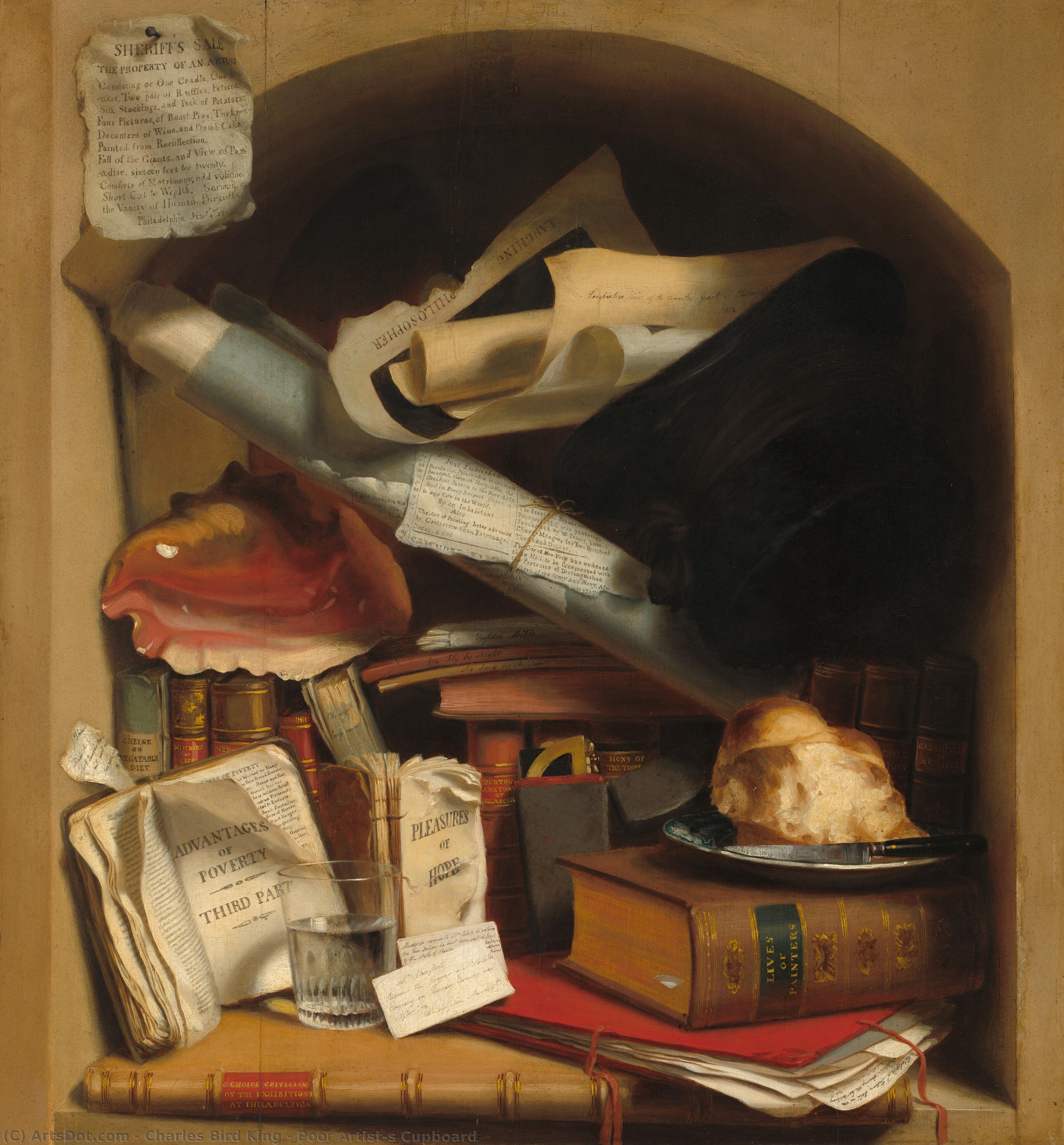
In the quiet, shadowed alcove of Charles Bird King’s 1815 masterpiece, Poor Artist's Cupboard, we are invited into a deeply intimate and melancholic corner of a creative life. This nearly square still life is far more than a mere collection of objects; it is a profound narrative of struggle, intellectual hunger, and the heavy weight of financial instability. At first glance, the viewer encounters a cluttered niche, an arched space crammed with the remnants of a life lived on the edge of necessity. A crusty piece of bread sits alongside a short glass of water, symbols of the most basic sustenance, yet they are surrounded by a dense, almost overwhelming accumulation of books and papers that suggest a mind far richer than the hands that hold them.
The composition is masterfully arranged to guide the eye through a labyrinth of symbolic details. King utilizes a tight, claustrophobic arrangement to evoke the feeling of being trapped by circumstance. To the right, a red portfolio holds a sheaf of loose papers beneath the heavy weight of Lives of the Painters, a title that serves as a poignant reminder of the artist's own vocation and perhaps his precarious standing within it. The light catches the edges of a pink conch shell and the gold lettering on various spines, creating small flickers of beauty amidst the gloom. There is a tactile quality to the work; one can almost feel the rough texture of the bread, the cold smoothness of the glass, and the brittle, aging parchment of the many books that line the back of the alcove.
The Language of Symbolism and Hidden Narratives
Every object within this cupboard acts as a silent protagonist in a drama of survival. King employs a sophisticated layer of literary and social symbolism to communicate the artist's internal state. The titles found on the book spines are particularly devastating: Miseries of Life, Calamities of Author, and Unpaid Bills whisper of a reality where debt is as constant as the hunger for knowledge. Even more heartbreaking is the sight of a book titled Pleasures of Hope, where the very word "hope" has been physically ripped through by a torn page, suggesting a loss of optimism or the fragility of such a sentiment in the face of poverty.
The inclusion of calling cards addressed to "Palette," mentioning a debt of five dollars, grounds the painting in a specific, relatable human struggle. This is not an idealized, classical still life of abundance; it is a gritty, autobiographical reflection on the cost of an artistic life. The presence of a protractor and various instructional texts suggests that despite the lack of material wealth, there remains a rigorous commitment to the craft and the pursuit of technical mastery. It is this tension between the physical deprivation of the body and the intellectual expansion of the spirit that gives the painting its enduring emotional resonance.
A Timeless Addition for Discerning Collectors
For the art lover or interior designer, Poor Artist's Cupboard offers a unique opportunity to introduce a piece of profound historical depth into a contemporary space. The muted palette of browns, deep reds, and soft greens, punctuated by the rosy glow of the conch shell, provides a sophisticated tonal anchor for a room. As a high-quality reproduction, this work serves as a conversation starter, inviting guests to lean in closer and decipher the many layers of meaning hidden within its shadows.
Whether placed in a study, a library, or a curated gallery wall, this painting brings with it an atmosphere of contemplative quietude. It celebrates the resilience of the human spirit and the enduring power of art to find beauty within the most humble of circumstances. Owning a reproduction of this work is not merely about decorating a wall; it is about preserving a moment of historical empathy and honoring the complex, often difficult journey of the creative soul.