A Glimpse into Danish Aristocracy: Eckersberg’s “Mendel Levin Nathanson’s Elder Daughters”
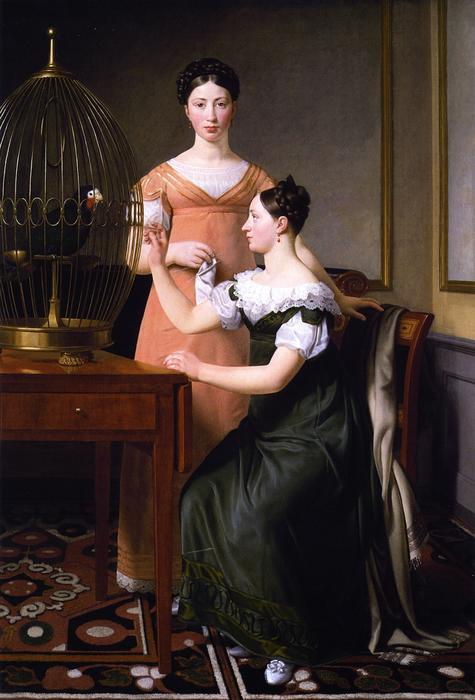
Christoffer Wilhelm Eckersberg's 1820 painting, "Mendel Levin Nathanson’s Elder Daughters, Bella and Hanna," offers a remarkably intimate portrait of two young women from Copenhagen’s affluent merchant class. More than just a likeness, the work is a carefully constructed tableau, brimming with subtle symbolism and reflecting the social dynamics of early 19th-century Denmark. Eckersberg, considered the “Father of Danish Painting,” masterfully employed his signature style – characterized by luminous light, delicate brushwork, and an acute awareness of atmospheric perspective – to capture not just their physical appearance but also a sense of poised elegance and quiet contemplation.
The scene unfolds within a modestly furnished room, its muted palette dominated by soft greens, pinks, and creams. The girls are seated at a simple dining table, bathed in the diffused light filtering through an unseen window. Eckersberg’s meticulous attention to detail is immediately apparent; from the intricate folds of their dresses to the delicate arrangement of flowers on the table, every element contributes to a sense of realism and quiet sophistication. The choice of colors—particularly the blush tones of Bella's gown—evokes a feeling of youthful innocence and refinement, while Hanna’s green dress subtly suggests a connection to nature, perhaps hinting at aspirations beyond the confines of their domestic life.
Eckersberg’s Neoclassical Approach and the Influence of Rome
Eckersberg's artistic journey profoundly shaped this painting. Following his extended sojourn in Rome between 1813 and 1816, he embraced the principles of neoclassical art – a movement that emphasized clarity, order, and a return to classical ideals. This influence is evident in the balanced composition, the idealized portrayal of the figures, and the careful rendering of light and shadow. His time amongst fellow artists like Bertel Thorvaldsen further honed his skills, particularly in capturing the human form with remarkable accuracy and sensitivity. The painting’s overall effect is one of restrained elegance, a hallmark of Eckersberg's mature style.
The composition itself is deliberately controlled. Both girls face the viewer directly, engaging them with their gaze – a technique that was considered particularly important in portraiture during this period. Their postures are formal yet relaxed, conveying an air of self-possession and quiet dignity. The inclusion of the birdcage, a prominent feature in the background, is laden with symbolic weight. Birds, especially parrots, were often associated with intelligence, beauty, and even good breeding – qualities highly valued within Danish society at the time. The cage itself subtly suggests a contained existence, hinting at the constraints placed upon women of their social standing.
Symbolism and Social Commentary
Beyond its aesthetic merits, “Mendel Levin Nathanson’s Elder Daughters” offers a subtle commentary on the social realities of 19th-century Denmark. The painting reflects the burgeoning prosperity of the merchant class – exemplified by Nathanson's wealth and patronage – but also hints at the limited opportunities available to women within that sphere. The girls’ elegant attire and refined demeanor suggest a life of privilege, yet their confinement within the domestic setting underscores the societal expectations placed upon them.
Eckersberg’s masterful use of light further enhances the painting's emotional impact. The soft, diffused illumination creates a sense of intimacy and warmth, drawing the viewer into the scene. The subtle gradations of tone contribute to a feeling of depth and realism, while also conveying a sense of melancholy – perhaps reflecting the quiet longing for freedom and fulfillment that may have characterized the lives of women like Bella and Hanna. This painting is not merely a portrait; it’s a poignant glimpse into a specific moment in time, offering a window onto the social and cultural landscape of Denmark during its Golden Age.
A Timeless Masterpiece – Reproduction Possibilities
Eckersberg's "Mendel Levin Nathanson’s Elder Daughters" remains a captivating work of art, appreciated for its technical brilliance, evocative atmosphere, and subtle social commentary. High-quality reproductions capture the painting’s luminous quality and intricate details, making it an ideal choice for interior design projects seeking to evoke a sense of refined elegance and historical charm. Whether adorning a formal salon or a sophisticated study, this iconic image continues to resonate with viewers today, offering a timeless reflection on beauty, social status, and the complexities of human experience.