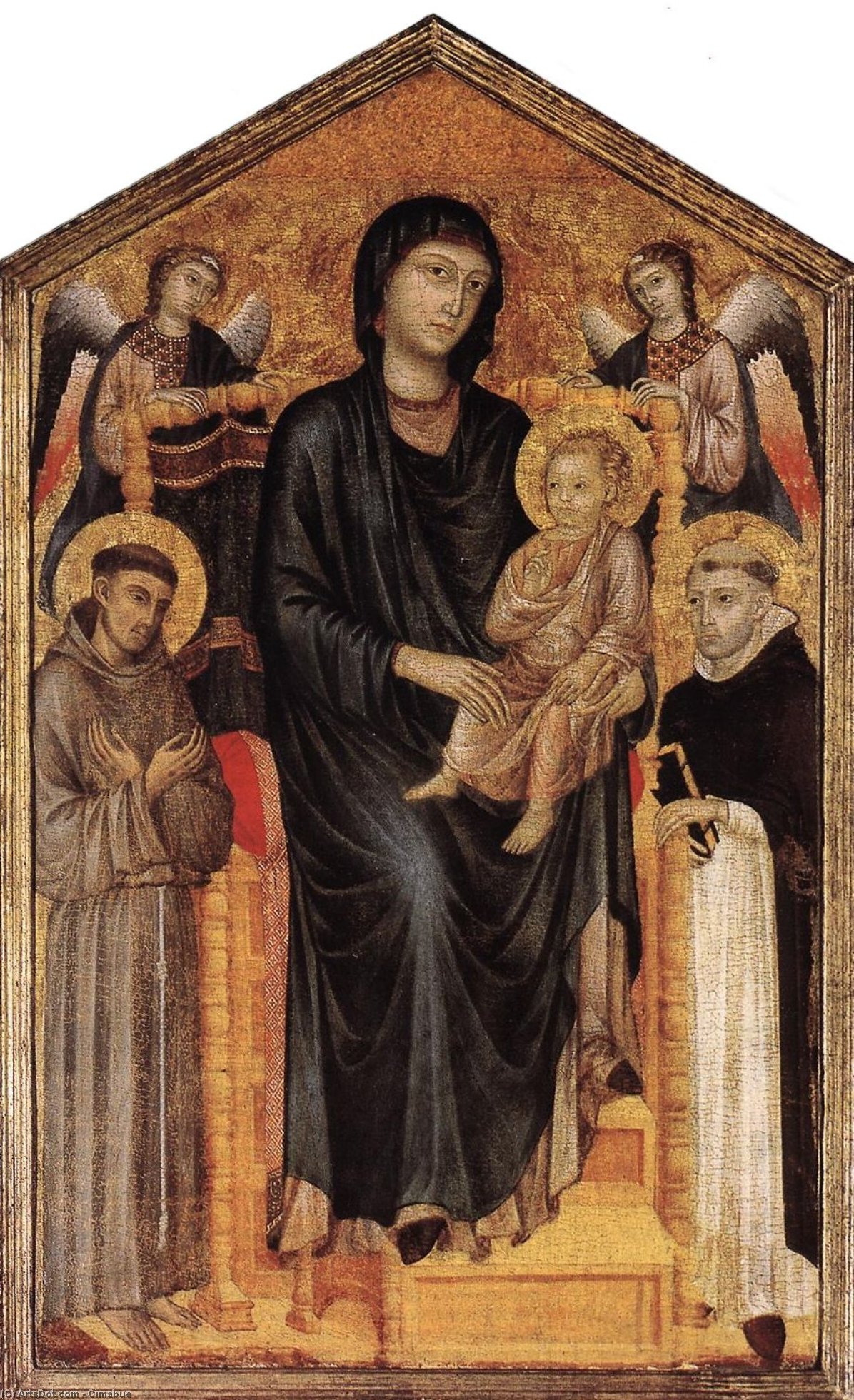
A Dawn of Naturalism: Cimabue’s Madonna Enthroned
Giovanni Cimabue (c. 1240 – 1302), born Cenni di Pepo in Florence, stands as a pivotal figure—a bridge between the solemn grandeur of Byzantine art and the nascent stirrings of artistic innovation that would herald the Renaissance. While his life remains shrouded in legend, embellished by accounts like those penned centuries later by Giorgio Vasari, Cimabue undeniably marks an irreversible shift in Western artistic consciousness: a courageous assertion of stylistic experimentation that laid the groundwork for transformative change. Even his moniker—believed to signify “bull-headed”—captures a resolute spirit, one demonstrably evident in his willingness to challenge established conventions and embrace more lifelike representations. He embodies this crucial juncture where art began to transcend mere devotional iconography towards a richer engagement with human experience.
- Subject Matter: The painting depicts the Virgin Mary holding her infant Jesus amidst a serene ecclesiastical setting, accompanied by St. Francis of Assisi, St. Dominic de Guzmán, and two angelic figures.
- Style & Technique: Cimabue’s approach represents a decisive departure from Byzantine tradition. Unlike the stylized forms characteristic of Byzantium, his works exhibit greater anatomical accuracy—a subtle but profound advancement toward naturalism—enhanced by masterful shading to convey volume and depth. This technique reflects Cimabue's influence from Eastern art, particularly the mosaics of Constantinople.
Historical Context: Byzantine Legacy & Florentine Transformation
Cimabue’s artistic vision emerged during a period of significant cultural flux in Florence. While deeply rooted in Byzantine aesthetics—evident in the elongated proportions of his figures and the luminous gold leaf adorning the throne—he simultaneously championed stylistic developments that would soon define the Renaissance. Cimabue's work foreshadowed the humanist ideals emerging from Italy, prioritizing human form and emotion over purely spiritual abstraction. The painting’s creation coincided with a growing interest in classical art forms and philosophical concepts, signaling an intellectual awakening that would reshape European culture. Vasari famously described Cimabue as “the father of Florentine painting,” recognizing his role in initiating a new artistic trajectory.
Symbolism & Composition: Hierarchy & Divine Grace
The composition itself is laden with symbolic significance. Mary occupies the central position on the throne, signifying her supreme dignity and holiness—a deliberate echo of Byzantine iconography where the Virgin was venerated as the embodiment of divine grace. The placement of St. Francis and St. Dominic underscores the importance of Franciscan and Dominican spirituality within Florentine society. Furthermore, Cimabue’s use of oblique projection—a technique borrowed from Eastern art—creates an illusion of three-dimensionality, emphasizing the grandeur of the scene and conveying a sense of solemn reverence. The angels flanking Mary serve as guardians of the Virgin and Child, reinforcing their spiritual protection.
Emotional Impact & Legacy
“Madonna Enthroned with the Child,” St Francis, St Dominic and two Angels” transcends mere visual representation; it communicates profound emotional resonance. Cimabue’s masterful rendering of human form—particularly Mary's serene countenance—captures a moment of contemplative beauty, inviting viewers to contemplate themes of faith, humility, and divine compassion. This painting stands as an undeniable cornerstone of Florentine art history, inspiring generations of artists who would follow in Cimabue’s footsteps toward greater naturalism and expressive depth. Its enduring appeal testifies to the power of art to evoke emotion and illuminate spiritual truths—a legacy that continues to resonate with audiences today.