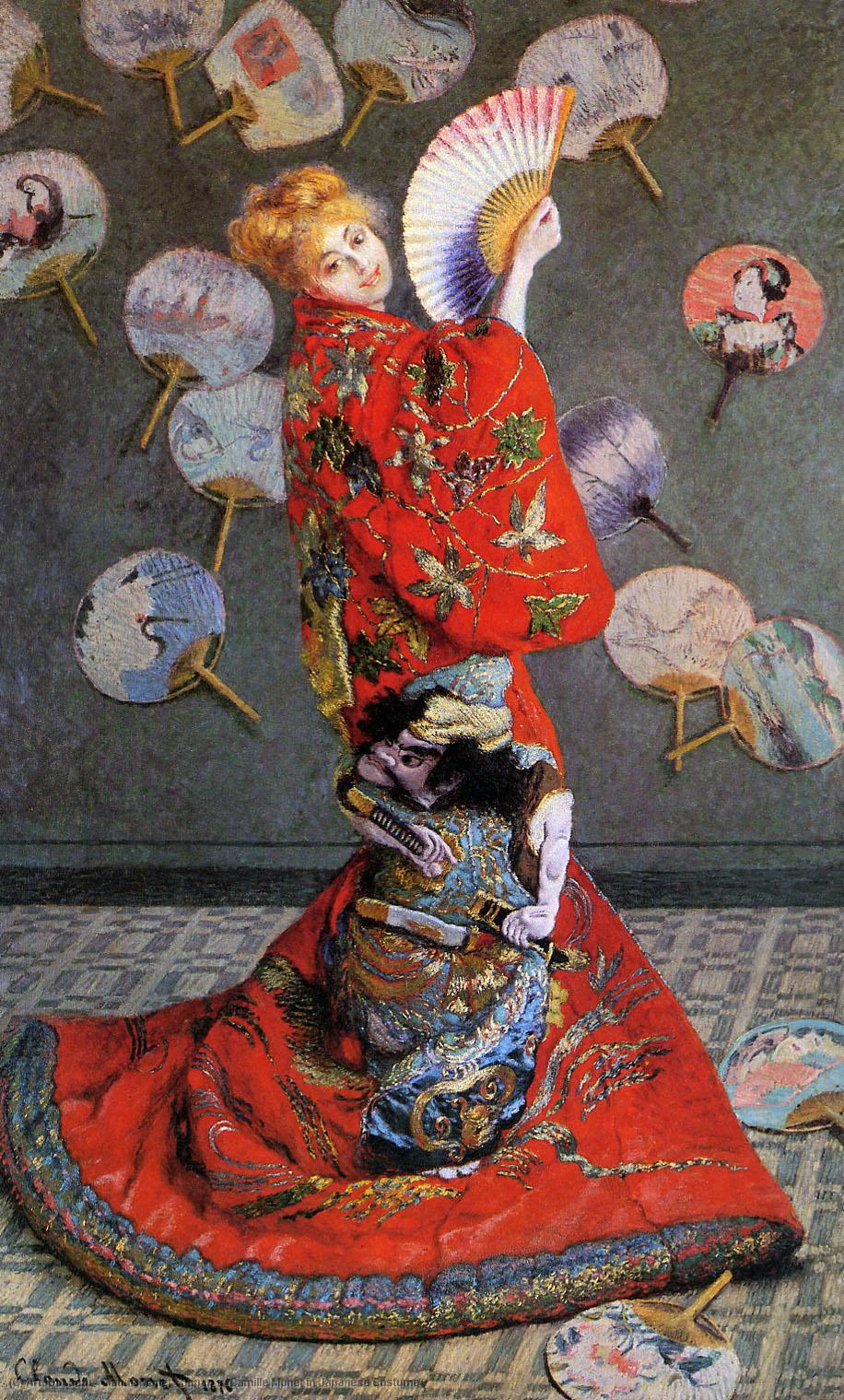
Japan's (Camille Monet in Japanese Costume)
Claude Monet, one of the most celebrated artists of the Impressionist movement, created a captivating piece titled “Japan’s (Camille Monet in Japanese Costume)”. This painting, dated 1876, showcases Monet’s fascination with Japanese culture and his ability to blend it seamlessly into his artistic style.
Context and Inspiration
During the late 19th century, there was a significant interest in Japanese art and culture among European artists. This phenomenon, known as Japonism, influenced many prominent artists of the time, including Monet. The painting reflects this influence, with Camille Monet, Claude’s first wife, depicted wearing a traditional Japanese kimono and holding a fan. This fascination stemmed from accounts of Japan's opulent rituals and artistic achievements that had begun to circulate in Europe, sparking imaginations and inspiring new aesthetic ideas. Artists like Degas and Whistler were equally captivated by the exotic beauty of Japanese prints and ceramics—a visual language radically different from Western conventions. Monet’s decision to portray Camille in this costume wasn’t merely decorative; it symbolized a deliberate engagement with Japonism's core principles: harmony, simplicity, and an appreciation for natural beauty.
Composition and Technique
The composition of the painting is characterized by its vibrant colors and delicate brushstrokes. The background features two chairs, suggesting that the scene might be set in a performance or gathering where people have come together to watch or participate in an artistic display. These chairs are positioned strategically to create depth and guide the viewer’s eye across the canvas. The fans scattered throughout the scene add depth and detail to the composition. Monet's use of oil on canvas allows for a rich texture and luminosity, enhancing the overall visual appeal of the painting. His technique, typical of Impressionist artists, involves capturing light and color through short, broken brushstrokes—a method he perfected during his explorations of Giverny’s gardens. These strokes aren’t blended smoothly; instead, they overlap to create an illusion of shimmering light, mirroring the way sunlight dances on water lilies or dappled through trees. This technique is particularly evident in the depiction of Camille's kimono and fan—the artist meticulously renders subtle variations in hue and tone to convey a sense of movement and atmosphere.
Artistic Significance
“Japan’s (Camille Monet in Japanese Costume)” is housed at the Museum of Fine Arts (Boston, United States). This piece is significant not only for its representation of Japonism but also for its contribution to the broader Impressionist movement. It demonstrates Monet's ability to incorporate diverse cultural elements into his work while maintaining his unique artistic style—a hallmark of Impressionism’s ambition to transcend academic conventions and capture subjective experience. The painting embodies the spirit of *plein air* painting, prioritizing direct observation of nature over studio reproductions. Monet’s meticulous attention to detail—the folds of Camille's kimono, the delicate tracery of the fan—reflects a desire to convey not just what he saw but also how it felt. It stands as a testament to Monet’s enduring legacy as one of the foremost innovators of modern art.
Relevance and Legacy
Monet’s influence on modern art is profound, much like that of other notable artists such as Paul Cézanne—who bridged the gap between Impressionism and Cubism. Cézanne's exploration of form and structure paved the way for subsequent artistic movements, demonstrating how Impressionist principles could be adapted to express new ideas. The legacy of these artists can be seen in various movements throughout the 20th century. For those interested in exploring more works by Claude Monet, ArtsDot offers high-quality, handmade oil painting reproductions. Visit
Claude Monet:Camille Monet in Japanese Costume to learn more about this captivating piece and other works by the artist. In conclusion, “Japan’s (Camille Monet in Japanese Costume)” is a testament to Claude Monet's innovative approach to art and his ability to blend different cultural influences into his work—a masterpiece that continues to inspire artists and captivate audiences worldwide.
For more information on Claude Monet and other artists, visit
Paula Modersohn-Becker: Portrait of a young woman with red hat and
Claude Monet: The Tuileries (study).