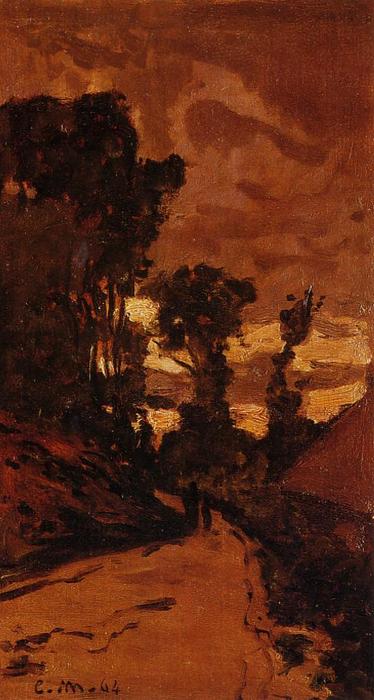
A serene winter landscape of a snow-covered road winds through dense trees in this Impressionist masterpiece by Claude Monet that invites you to bring the tranquil beauty of the French countryside into your home.
パリ
フランス
クロード・モネ
オスカー=クロード・モネ、クロード・オスカール・モネ
印象派の巨匠クロード・モネ。光と色彩を捉え、睡蓮や干し草など、移りゆく風景を描き出しました。自然を観察し、独自の技法で表現した作品は、美術史に大きな影響を与えました。
印象派
現代美術
エウジェーヌ・ブーダン
1840年11月14日
1926年12月5日
オスカー=クロード・モネ
フランス人
印象、日の出
フランス、パリ
大理石の彫刻
2
クロード・モネに、エウジェーヌ・ブーダンが教えてくれた重要な技法は何ですか?
A Moment Frozen in Light: Exploring Monet’s “The Road Toward the Farm Saint Simeon”
Claude Monet's "The Road Toward the Farm Saint Simeon," painted in 1867, stands as a cornerstone of Impressionism—a movement that fundamentally challenged artistic conventions and ushered in an era of unprecedented sensitivity to visual perception. More than just a depiction of a winter landscape, this artwork embodies Monet’s revolutionary approach to painting: *plein air*, or working outdoors directly from nature. This decision wasn't merely practical; it represented a profound philosophical shift—a belief that capturing the fleeting effects of light and atmosphere was paramount to conveying artistic truth.
The scene itself is deceptively simple. A snow-covered road winds its way through a dense forest, dominated by towering trees laden with snow – a stark contrast against the muted blues and grays characteristic of Impressionist palettes. Two figures—presumably travelers—are rendered in hazy outlines, their clothing blending seamlessly into the surrounding environment. This deliberate blurring of form is crucial to Monet’s technique; he eschewed meticulous detail in favor of capturing the *impression* of light and color as it danced across the snow-covered surface. Notice how Monet utilizes short, broken brushstrokes—a hallmark of Impressionism—to create a shimmering texture that mimics the way sunlight refracts through snowflakes. The artist skillfully employs complementary colors – blues and oranges – to heighten visual impact and convey a sense of warmth amidst the wintry chill.
Historical Context: Challenging Academic Tradition
Monet’s artistic journey began in Paris, where he briefly studied at the Académie Suisse before enrolling under Charles Gleyre. However, it was his mentorship by Eugène Boudin that truly ignited his passion for *plein air* painting. Boudin championed Monet's belief that art should strive to mirror reality as perceived by the senses—a radical departure from the dominant academic style of the time, which prioritized idealized representations and meticulous realism. Academies demanded precise anatomical accuracy and polished surfaces; Monet rejected these constraints, prioritizing spontaneity and capturing the ephemeral beauty of nature. This defiance resonated with a burgeoning artistic community eager for new expressive possibilities.
Symbolism Beyond Landscape
Beyond its visual splendor, “The Road Toward the Farm Saint Simeon” carries symbolic weight. The road itself represents progress—albeit a slow, arduous journey—while the forest symbolizes solitude and contemplation. The two figures embody humanity's connection to the natural world, highlighting our vulnerability and dependence on its rhythms. Monet’s masterful use of color isn’t merely decorative; it communicates emotion – conveying both the stillness of winter and the subtle warmth of human presence. Consider how the triangular mound in the background—a compositional device frequently employed by Monet—suggests stability amidst the dynamism of the landscape, reinforcing the painting's overarching theme of resilience and beauty.
Emotional Impact: Capturing Transient Beauty
Ultimately, “The Road Toward the Farm Saint Simeon” succeeds in transporting viewers to a moment frozen in time—a sensory experience that captures the essence of Impressionism’s core philosophy. Monet invites us to contemplate the sublime grandeur of nature while simultaneously acknowledging our own insignificance within its vastness. The painting's luminous colors and textured brushstrokes evoke feelings of serenity, melancholy, and wonder – qualities that continue to captivate audiences today. It serves as a powerful reminder that true artistic achievement lies in capturing not just what we *see*, but how we *feel*.