A Glimpse into 17th-Century Amsterdam: "The Jewish Quarter"
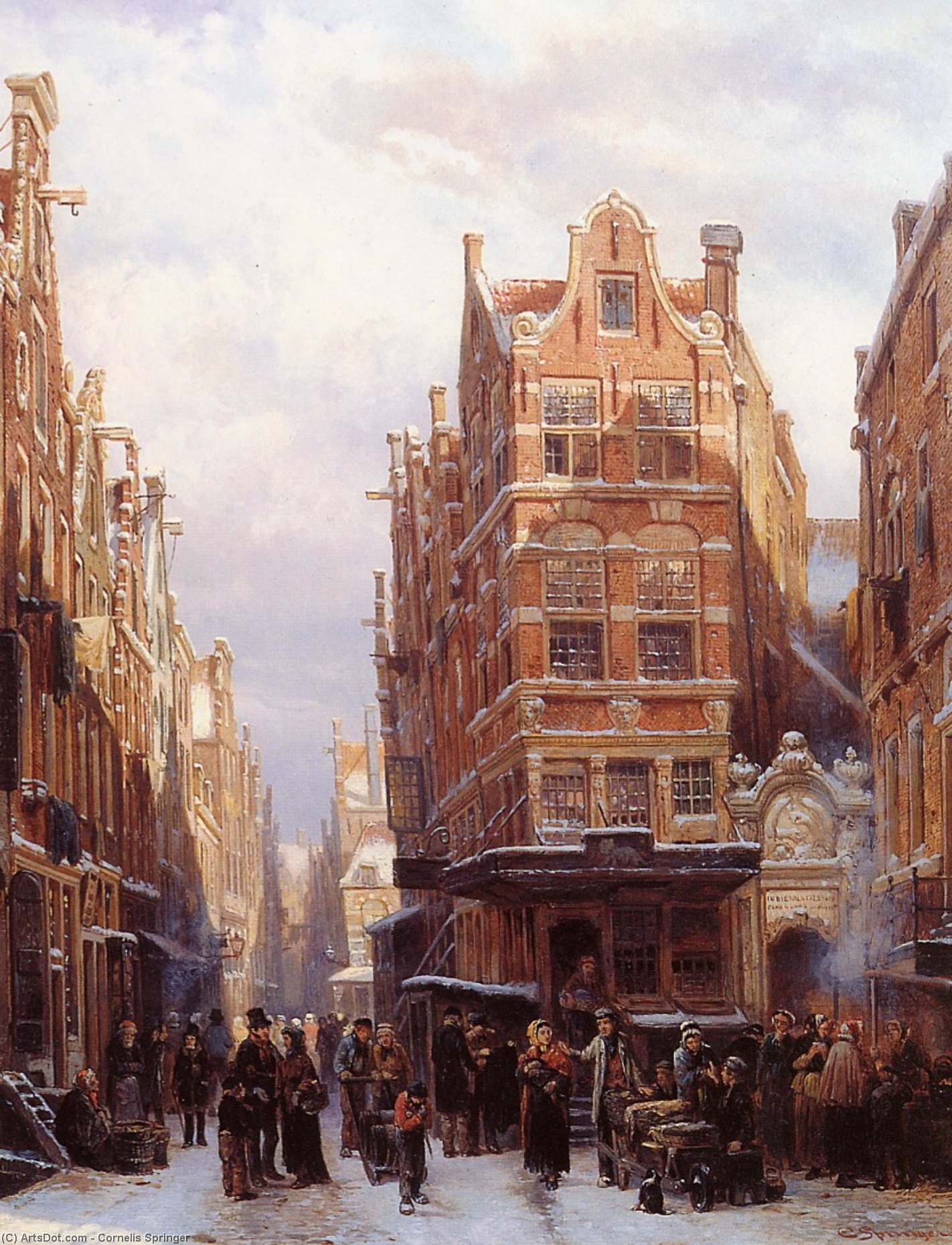
Cornelis Springer’s “The Jewish Quarter in Amsterdam” offers a captivating window into daily life during the Dutch Golden Age. This meticulously rendered oil painting transports viewers to a snow-covered street scene, likely within the historic Jewish quarter of Amsterdam itself. The artwork's strength lies in its remarkable realism and depth, achieved through skillful perspective and detailed observation – hallmarks of Springer’s signature style.
Style & Technique: Dutch Golden Age Realism
Springer firmly belongs to the tradition of Dutch Golden Age painting, a period renowned for its realistic depictions of everyday scenes. Unlike some contemporaries who focused on grand historical narratives or dramatic religious subjects, Springer dedicated himself to capturing the beauty and detail of urban landscapes. The painting’s style is characterized by:
- Linear Precision: Sharp lines define the architecture, creating a sense of order and structure within the bustling streetscape.
- Geometric Composition: Buildings are constructed from recognizable geometric shapes – squares, rectangles, and triangles – lending a sense of stability to the scene.
- Textural Richness: The snow is not merely a white blanket; Springer masterfully depicts its texture through layered brushstrokes, creating a palpable sense of cold and depth. The weathered surfaces of the buildings are equally well-observed.
- Soft Lighting: The diffused light suggests an overcast day, bathing the scene in a gentle glow that emphasizes the subtle nuances of color and shadow.
Historical Context & Subject Matter
Painted around the mid-19th century (though depicting a 17th-century scene), Springer’s work reflects a renewed interest in Dutch history and heritage during his time. The Jewish quarter, with its distinctive architecture and vibrant community, provided a compelling subject for an artist seeking to document a specific aspect of Amsterdam's past. The painting isn't just about buildings; it's about the people who inhabited them. The small group of figures in the foreground adds scale and life to the scene, hinting at the social fabric of this historic neighborhood.
Symbolism & Emotional Resonance
Beyond its documentary value, “The Jewish Quarter” carries symbolic weight. The snow, while visually striking, can be interpreted as representing a sense of coldness or isolation. However, the presence of people moving through the scene suggests resilience and community spirit – a testament to the enduring strength of human connection even in challenging circumstances. The overall emotional tone is one of quiet contemplation; Springer invites viewers to pause and reflect on a bygone era, appreciating the beauty and complexity of everyday life in 17th-century Amsterdam. It’s a snapshot frozen in time, offering a poignant glimpse into history.