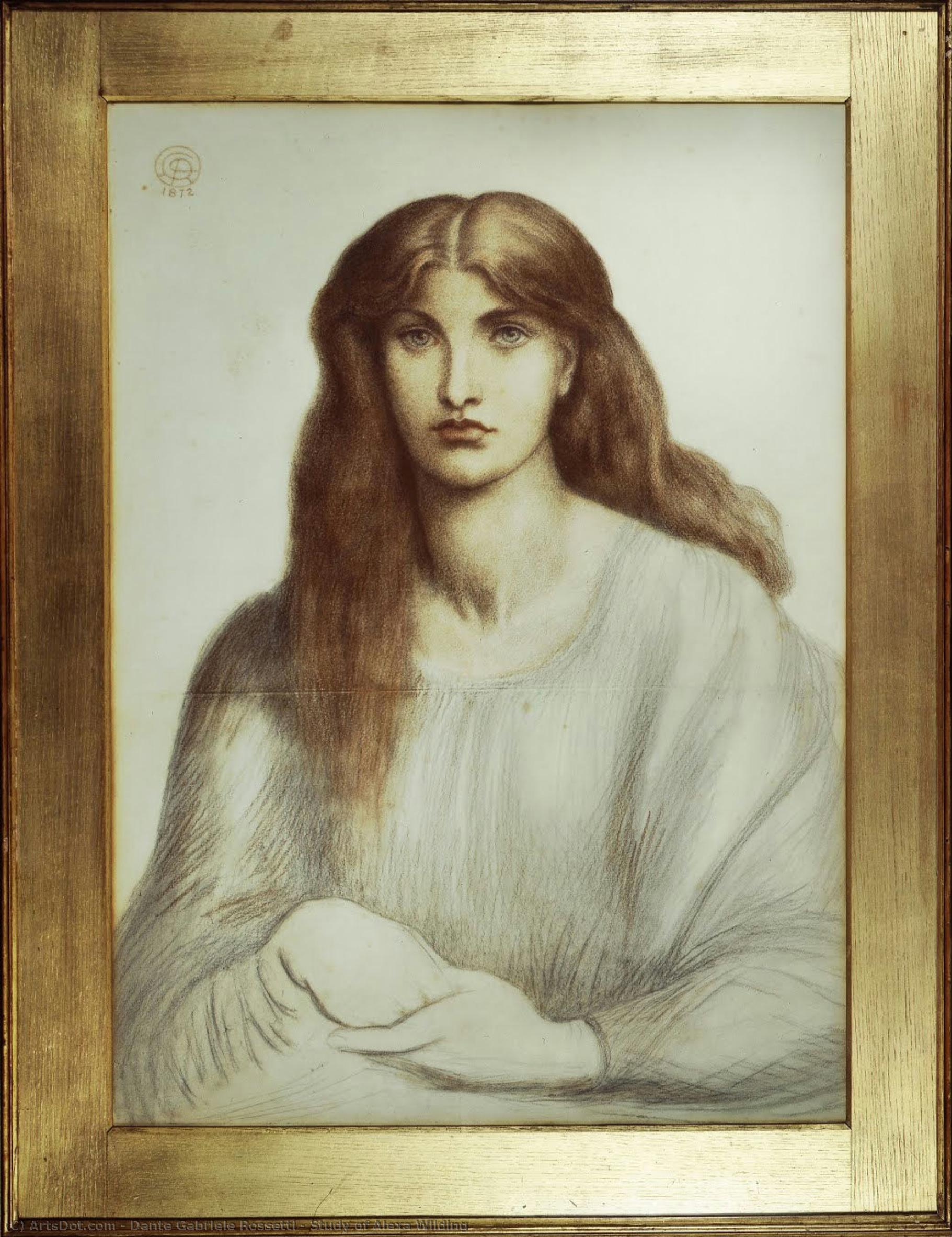
A Vision of Pre-Raphaelite Grace
In the quiet, luminous depths of Dante Gabriel Rossetti’s “Study of Alexa Wilding,” we encounter more than a mere portrait; we step into a sanctuary of Romantic idealism. Completed in 1877, this work serves as a breathtaking testament to the Pre-Raphaelite Brotherhood’s enduring mission to revive the sincerity and vibrant clarity of early Renaissance art. The painting captures Alexa Wilding, one of Rossetti’s most cherished muses, not through the lens of dramatic action, but through a profound, stillness that invites the viewer into a state of quiet contemplation. Her serene gaze and delicate posture create an atmosphere of ethereal beauty, making the piece an essential cornerstone for any collection dedicated to the soulful elegance of the Victorian era.
The technical mastery on display in this study is nothing short of mesmerizing. Rossetti, a true polymath of the arts, eschewed the heavy-handed academic conventions of his day in favor of a luminous, jewel-like palette. Through the painstaking application of translucent glazes, he achieved a subtle interplay of muted greens and shimmering golds that seem to glow from within the canvas itself. This meticulous layering technique allows light to dance across the subject's features, recreating the soft, naturalistic tonal variations found in the physical world. For the discerning collector or interior designer, such depth and luminosity offer an unparalleled sensory experience, providing a focal point that breathes life and warmth into any sophisticated living space.
Symbolism and the Passage of Time
Beyond its surface splendor, “Study of Alexa Wilding” is steeped in a rich tapestry of symbolic meaning. Rossetti utilized his subjects to embody much more than physical likeness; here, Alexa represents an idealized vision of innocence and virtue. The composition is carefully balanced to evoke a sense of divine grace, a feeling further reinforced by the presence of a golden frame that acts as a window into a more poetic reality. Yet, within this idyllic scene, there is a poignant reminder of our mortality. The subtle inclusion of a clock in the background serves as a memento mori, a gentle whisper regarding the fleeting nature of earthly existence and the inevitable passage of time.
This tension between eternal beauty and temporal decay is what gives the painting its profound emotional resonance. It captures a moment frozen in time—a breath held indefinitely. For those seeking to decorate with art that tells a story, this piece offers a complex narrative of longing, memory, and the pursuit of the sublime. Whether placed in a sunlit gallery or a moody, private study, the painting acts as a portal, transporting the observer to an era where beauty was a sacred pursuit and every brushstroke was an act of devotion.