A Vision of Melancholy: Dante Gabriel Rossetti’s ‘Woman Drinking from a Fountain’
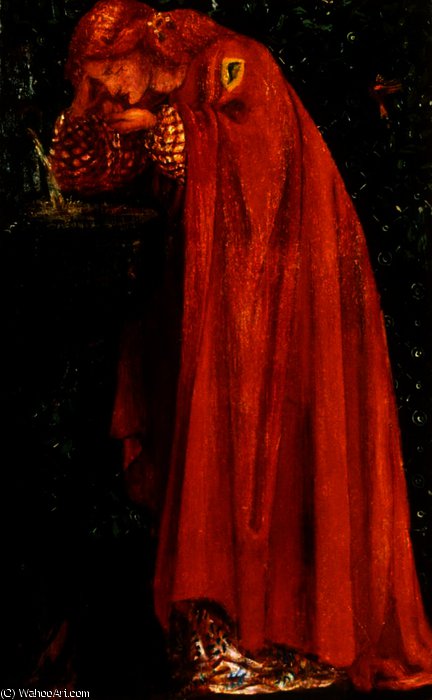
This captivating painting by Dante Gabriel Rossetti presents a solitary female figure enveloped in a striking crimson robe, lost in a moment of profound contemplation. The artwork is a quintessential example of the Pre-Raphaelite aesthetic, renowned for its intense emotionality and meticulous detail. It currently resides at the Walker Art Gallery in Liverpool, offering art enthusiasts a chance to experience this masterpiece firsthand.
Subject & Composition
The composition centers on a woman leaning forward, her head bowed as she drinks from an unseen fountain. Her hands are clasped together, a gesture that speaks volumes about inner turmoil or quiet grief. The dramatic contrast between the vibrant red of her garment and the dark, undefined background immediately draws the viewer’s eye to the figure. Rossetti masterfully employs a vertical orientation, emphasizing the woman's posture and the flowing lines of her robe. The shallow depth of field further concentrates attention on this intimate scene, heightening its emotional impact.
Style & Technique
Rossetti was a leading figure in the Pre-Raphaelite Brotherhood, a group that rebelled against the academic art of their time. They sought to emulate the artistic principles prevalent *before* Raphael – hence the name – prioritizing intense color, abundant detail, and a return to naturalism. ‘Woman Drinking from a Fountain’ exemplifies this approach. The painting is likely executed in oil on canvas, with visible brushstrokes suggesting texture and luminosity, particularly within the folds of the fabric. Rossetti's technique involves layering paint to achieve rich depth and a sense of tactile quality.
Historical Context & Symbolism
Born in London in 1828, Dante Gabriel Rossetti was deeply influenced by medieval Italian art, literature (Shakespeare, Byron), and the Romantic movement’s emphasis on emotion and individualism. The Pre-Raphaelites were fascinated with mythology, Arthurian legends, and religious themes, often imbuing their works with symbolic meaning. While the specific symbolism in ‘Woman Drinking from a Fountain’ remains open to interpretation, the fountain itself can be seen as representing both life and sorrow – a source of refreshment tinged with melancholy. The woman's red robe, a color associated with passion, sacrifice, and even sin, adds another layer of complexity.
It is believed that Rossetti often used real-life models for his paintings, imbuing them with personal significance.
Emotional Impact & Aesthetic Appeal
The painting evokes a powerful sense of melancholy and isolation. The woman’s posture, the somber color scheme, and the indistinct background all contribute to this feeling.
Rossetti's ability to convey such raw emotion through visual means is what makes his work so enduringly captivating. This piece would be a striking addition to any collection, lending an air of sophisticated drama to interior spaces. Its rich colors and evocative imagery make it particularly well-suited for bedrooms, libraries, or studies – spaces designed for contemplation and reflection.
Collecting & Reproduction
- As an iconic work by a major Pre-Raphaelite artist, ‘Woman Drinking from a Fountain’ is highly sought after.
- High-quality reproductions are readily available, allowing art lovers to enjoy Rossetti's vision in their own homes.
- Consider framing the reproduction with ornate detailing to complement the painting’s Victorian aesthetic.