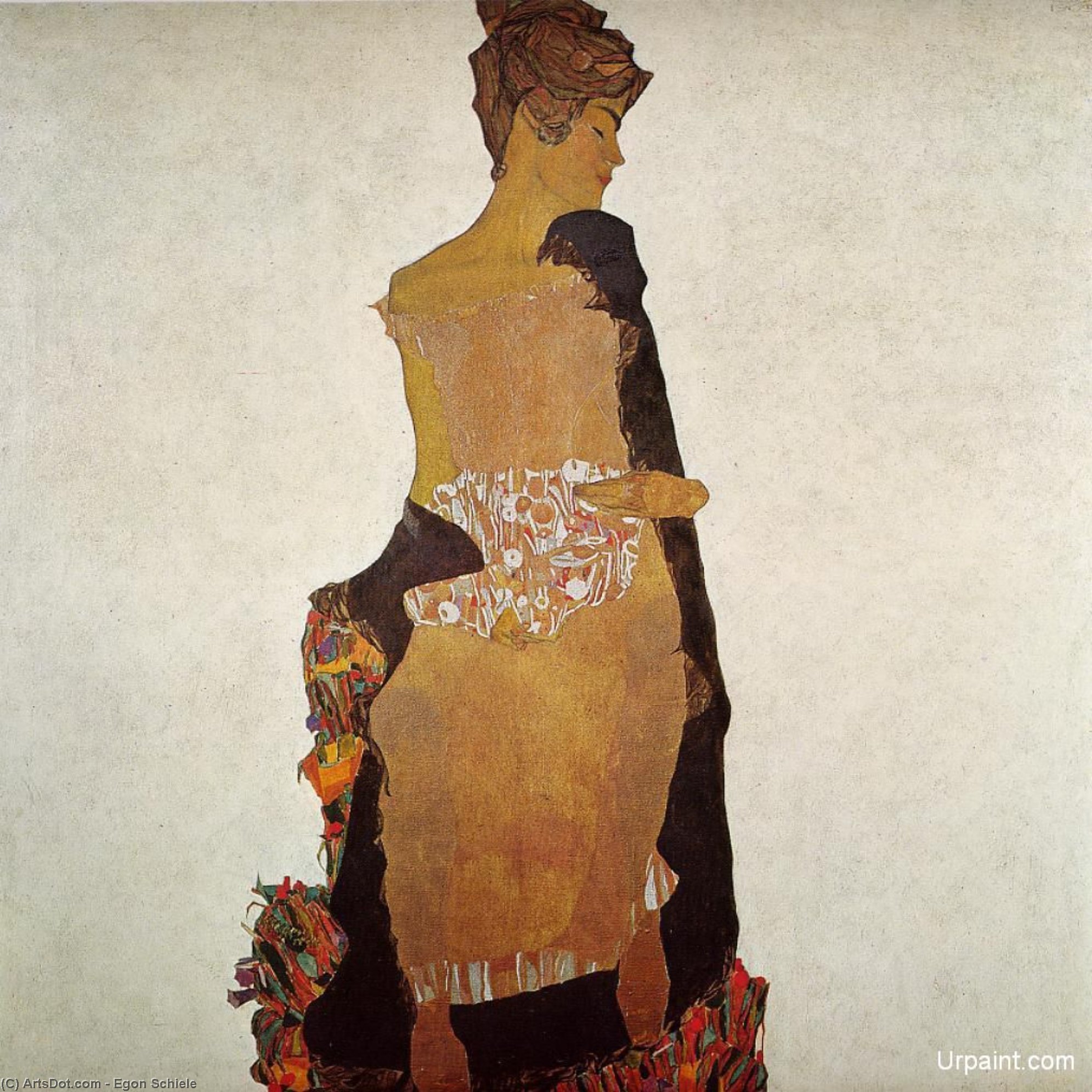
Portrait of Gerti Schiele: A Glimpse into Viennese Modernism
- Artist: Egon Schiele
- Date: 1909
- Medium: Oil on Canvas
- Dimensions: Unknown
‘Portrait of Gerti Schiele,’ painted in 1909 by the Austrian Expressionist master Egon Schiele, offers a captivating study of a young woman rendered with striking stylistic choices. This work isn't merely a likeness; it’s an exploration of form, color, and psychological presence within the burgeoning landscape of early modern art.
Style and Technique: Art Nouveau Influences & Expressionist Undertones
The painting exhibits a clear affinity for Art Nouveau aesthetics, characterized by its flowing lines, decorative elements, and emphasis on elegant posture. However, Schiele’s approach transcends mere imitation; he infuses the composition with an underlying Expressionist sensibility. The subject is depicted from the back, emphasizing her silhouette and elaborate attire rather than focusing on traditional portraiture conventions. The flattened perspective and prioritization of form over realistic representation are hallmarks of this early 20th-century artistic shift.
Schiele’s technique is evident in the visible brushstrokes and layered application of oil paints, creating a sense of depth and richness. The color palette—dominated by warm tones like golds, yellows, oranges, and reds contrasted with darker blacks and browns—adds visual interest and contributes to the painting's overall vibrancy. The lighting appears diffused, softening shadows and enhancing the three-dimensionality of the figure without harsh contrasts.
Gerti Schiele: The Subject & Her Context
‘Gerti’ was a frequent model for Schiele, often appearing in his works during this period. While her full identity remains somewhat elusive, she represented a particular type of Viennese beauty – one that Schiele explored with both fascination and psychological intensity. The elaborate costume worn by Gerti in the portrait suggests wealth, status, or perhaps even a theatrical performance, hinting at the social milieu of early 20th-century Vienna.
Schiele’s life during this time was marked by personal complexities and artistic experimentation. Having recently transferred from the Kunstgewerbeschule to the Akademie der bildenden Künste in Vienna, he was actively developing his unique style, influenced by Gustav Klimt but forging his own path towards a more raw and emotionally charged form of Expressionism.
Symbolism & Emotional Impact: Poise, Contemplation, and Modern Sensibility
The woman’s posture—graceful yet contemplative—conveys a sense of quiet repose. The elaborate costume could be interpreted as symbolic of societal expectations or the performative aspects of identity in a rapidly changing world. Schiele's choice to depict her from behind invites viewers to project their own interpretations onto the subject, fostering a deeper engagement with the artwork.
‘Portrait of Gerti Schiele’ is more than just a depiction of a woman; it’s a window into the artistic and cultural landscape of Vienna at the dawn of the 20th century. It exemplifies Schiele's ability to capture not only physical likeness but also the psychological complexities of his subjects, solidifying his place as a pivotal figure in Expressionist art.