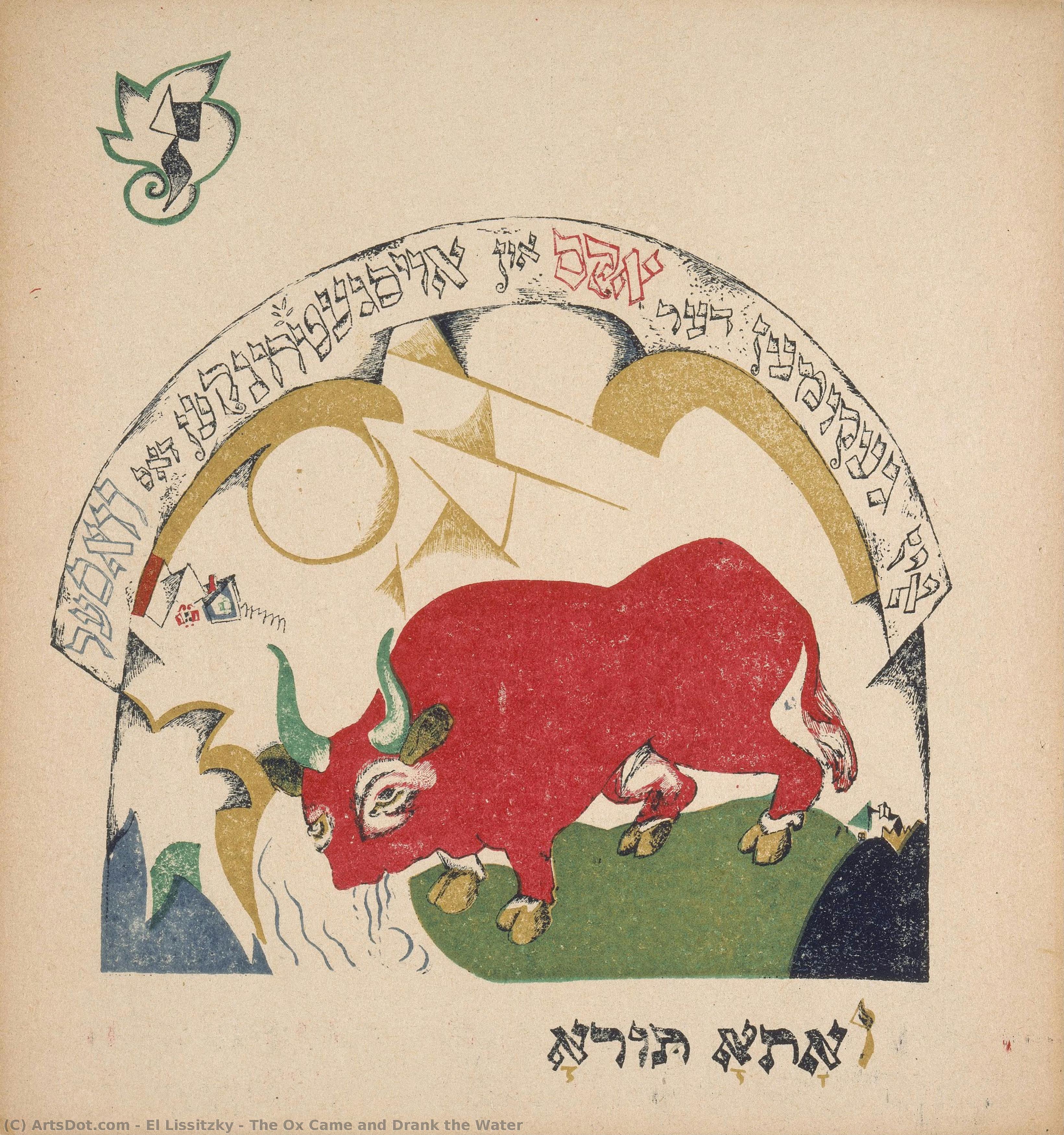
El Lissitzky's 'The Ox Came and Drank the Water' is a dynamic 1919 painting blending traditional themes with Constructivist geometry. Inspired by ‘The Had Gadya,’ it showcases vibrant colors, layered figures, and reflects Lissitzky’s revolutionary artistic vision.
A Surreal Narrative: Unpacking “The Ox Came and Drank the Water”
El Lissitzky’s 1919 painting, "The Ox Came and Drank the Water," is far more than a simple depiction of an animal at a water source. It's a vibrant distillation of the Aramaic folk song “The Had Gadya,” a deceptively complex narrative that has been interpreted across centuries as a parable of loss, transformation, and ultimately, acceptance. Lissitzky doesn’t simply illustrate the story; he translates it into a dynamic visual language, employing the tenets of Constructivism to create an arresting composition brimming with symbolic weight. The painting immediately draws the eye to the imposing red bull, its horns proudly raised as it drinks from the earth – a gesture simultaneously powerful and slightly absurd, hinting at both primal strength and a fundamental need.

Constructivist Geometry and a Fragmented World
Lissitzky’s signature style, deeply rooted in Constructivism, is powerfully evident here. The painting abandons traditional representational techniques in favor of geometric abstraction. Bold lines define the bull, the mountain, and the scattered figures, creating a sense of dynamism and movement. The composition isn't static; it feels like a carefully orchestrated sequence of shapes and forms, mirroring the fragmented nature of the “Had Gadya” itself – each verse building upon the last in an increasingly bizarre chain of events. Lissitzky’s use of color is equally deliberate: the dominant red of the bull commands attention, while the muted tones of the background emphasize its presence. The arrangement of the animals—the two birds soaring above, the three cows positioned strategically—further contributes to the painting's layered symbolism and visual complexity.
The Song’s Enduring Mystery & Jewish Roots
“The Had Gadya” is a song steeped in folklore and open to multiple interpretations. Originally a German ballad about a goat, it was adopted by Jewish communities and transformed into a humorous yet poignant tale of escalating animal encounters. Lissitzky's painting captures this spirit of playful absurdity while simultaneously hinting at deeper themes. The ox drinking from the ground can be seen as a symbol of sustenance, perhaps even a metaphor for life itself – drawing nourishment from the very earth. The presence of people within the scene suggests an audience to this strange spectacle, inviting us to contemplate the story’s meaning alongside them. This connection to Jewish tradition and folklore is crucial to understanding Lissitzky's artistic vision.
A Reproduction for Your Space – Bringing Lissitzky Home
ArtsDot offers meticulously crafted hand-painted reproductions of “The Ox Came and Drank the Water,” allowing you to bring this captivating artwork into your home or office. Our skilled artists replicate Lissitzky’s distinctive style with exceptional accuracy, capturing the painting's vibrant colors, dynamic composition, and underlying symbolism. Available in a range of sizes – from 40 x 35 cm to larger formats – our reproductions are printed on high-quality archival canvas using premium pigments for lasting beauty. Whether you appreciate Lissitzky’s pioneering work or simply admire its striking visual impact, a ArtsDot reproduction is a thoughtful and sophisticated addition to any collection. Explore other works by El Lissitzky at ArtsDot, where you can discover the full breadth of his artistic legacy.