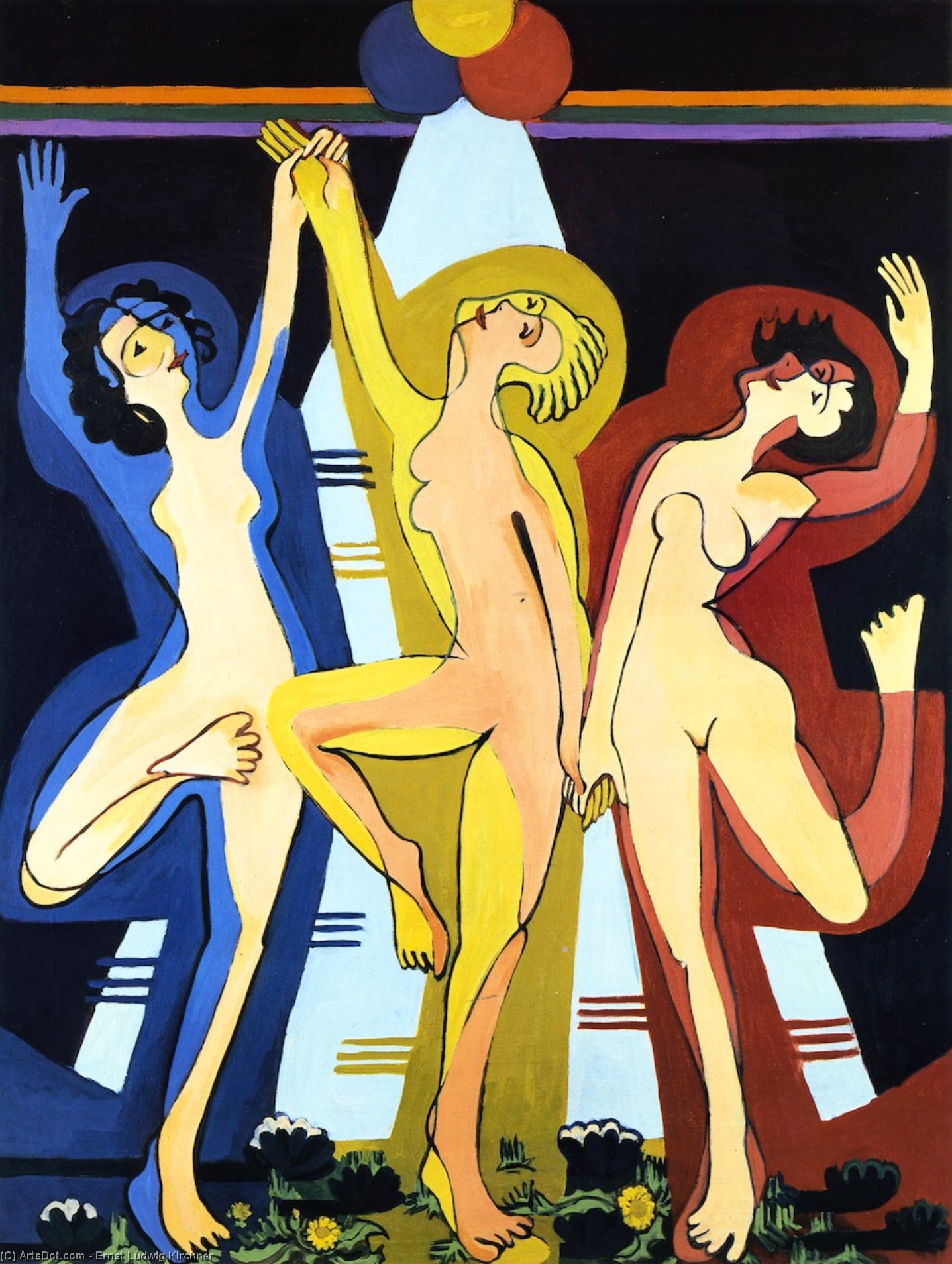
Experience the raw emotion of Ernst Ludwig Kirchner's "Farbentanz II," a vibrant Expressionist masterpiece featuring three nude figures in a dynamic dance of color and form, capturing the artist’s unique style from 1932.
Farbentanz II: A Symphony of Emotion by Ernst Ludwig Kirchner
Ernst Ludwig Kirchner’s “Farbentanz II,” painted in 1932, is more than just a depiction of three nude women; it's a visceral embodiment of the Expressionist movement’s core tenets – a raw and unflinching exploration of human emotion through color and form. Created during a period of intense social and political upheaval in Germany, this painting reflects Kirchner’s profound engagement with the anxieties and uncertainties of his time. The scene unfolds within a stark, almost theatrical space, dominated by a palette of vibrant blues, reds, yellows, and greens that pulsate with an unsettling energy. Two strategically placed oranges serve as jarring focal points, disrupting the overall harmony and further intensifying the painting’s emotional impact.
Decoding the Composition: Form and Symbolism
- The Figures: The three women, posed in a dynamic arrangement that suggests both dance and contemplation, are not idealized representations of beauty. Instead, Kirchner presents them with a deliberate distortion, reflecting his belief that art should capture subjective experience rather than objective reality. Their poses – one raised arms, another clasped hands, the third gazing downwards – evoke a sense of vulnerability and perhaps even unease.
- Color as Emotion: Kirchner’s masterful use of color is central to the painting's power. The intense hues are not merely decorative; they are employed to convey specific emotional states—the blue suggesting melancholy, the red passion or agitation, and the yellows a sense of feverish intensity.
- The Bowl: The inclusion of a simple bowl on the left side adds an element of domesticity, yet it feels strangely out of place, contributing to the overall feeling of disorientation and unease. It’s a subtle detail that deepens the painting's symbolic weight.
Technique and Materials: A Window into Kirchner’s Process
“Farbentanz II” is executed in oil on canvas, a medium that allowed Kirchner to achieve the rich textures and bold brushstrokes characteristic of his style. The application of paint is deliberately loose and expressive, with visible brushwork contributing significantly to the painting's emotional intensity. Kirchner’s technique involved layering colors rapidly, building up thick impasto in certain areas to create a tactile surface that invites close examination. This approach reflects his desire to break free from traditional academic conventions and forge a new path for modern art.
Historical Context and the Expressionist Vision
Painted in 1932, “Farbentanz II” stands as a powerful example of German Expressionism, a movement that sought to express inner emotions through distorted forms and intense colors. Kirchner, along with other Expressionists, rejected the prevailing artistic norms of their time, believing that art should be a vehicle for personal expression rather than a mere imitation of nature. The painting’s themes—anxiety, alienation, and the search for meaning in a rapidly changing world—resonated deeply with audiences grappling with the social and political turmoil of the interwar period. It's a poignant reminder of Kirchner's commitment to portraying the raw realities of human experience.
Owning a Piece of Art History
Handmade oil paintings reproductions of “Farbentanz II” are available on ArtsDot.com, offering art enthusiasts the opportunity to bring this iconic work into their homes or offices. Each reproduction meticulously captures Kirchner’s unique style and emotional intensity, ensuring that you can experience the power of this masterpiece firsthand.