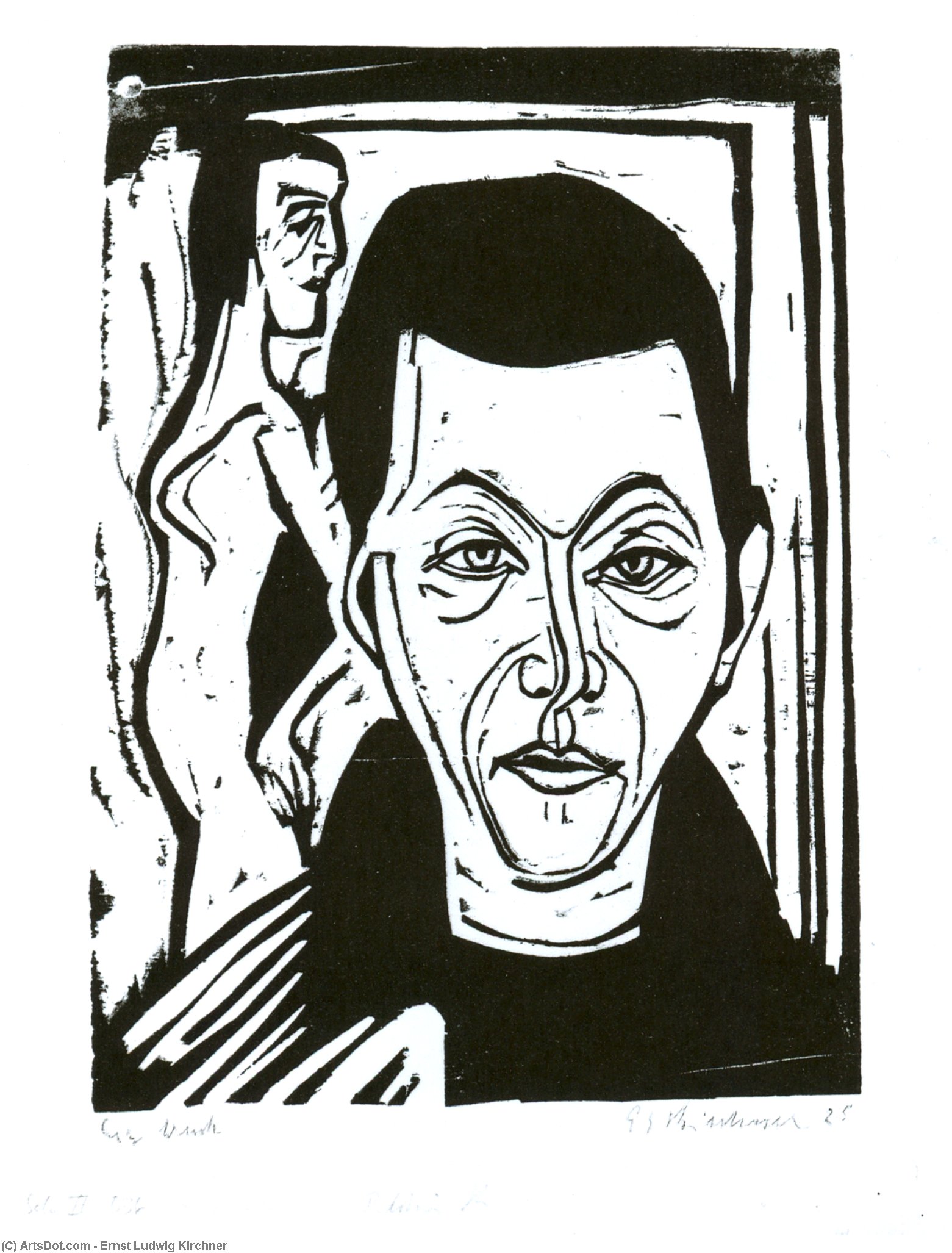
Man's Head. Self-portrait

Ernst Ludwig Kirchner's 'Man’s Head. Self-portrait' is a stark Expressionist woodcut capturing intense anxiety through angular lines and dramatic contrasts. Explore this powerful self-portrait by a pivotal figure in German art – discover or own it.


エルンスト・リュドヴィヒ・キルヒナー (1880 - 1938)

キルヒナー(1880-1938)は、ドイツ表現主義を代表する画家。「Die Brücke」の創設者として都市生活や人物を大胆な色彩と筆致で描き出しました。ベルリンの街並みやヌード像など、初期現代美術における力強い表現が魅力です。

Man's Head. Self-portrait: A Descent into Expressionist Anxiety

  • Ernst Ludwig Kirchner’s “Man’s Head. Self-portrait,” created in 1926, is a profoundly unsettling image that encapsulates the core tenets of German Expressionism. Executed as a woodcut print – a technique demanding both precision and raw emotional force – this piece immediately confronts the viewer with a starkly rendered portrait of the artist himself. It’s not a flattering likeness; rather, it's an unflinching depiction of psychological strain, a visual manifestation of anxieties simmering beneath the surface of early 20th-century Europe.
  • The artwork’s power resides in its deliberate distortion and simplification. Kirchner strips away any semblance of naturalism, employing bold, angular lines to define every contour of the subject's face. The geometric shapes – sharp planes and angles – contribute to a sense of unease, mirroring the fragmented experience of modern life. This rejection of traditional perspective further intensifies the feeling of disorientation, pulling the viewer into the artist’s intensely personal world.

Technique and Materials: The Language of Woodcut

  • Kirchner's "Man's Head. Self-portrait" is a testament to the meticulous process of woodcut printing. The artwork began with Kirchner carving an image into a block of wood, a laborious undertaking that demanded both artistic vision and technical skill. This intricate process involved carefully removing areas of the wood to create the design, which was then meticulously transferred to paper using ink.
  • The resulting print showcases the inherent qualities of this technique – the characteristic roughness and graininess born from the uneven surface of the carved block. These textural elements aren’t accidental; they are integral to the artwork's expressive power, adding a layer of physicality that amplifies the emotional impact.

Symbolism and Emotional Resonance

  • The monochromatic palette – a stark contrast between black and white – is crucial to understanding the work’s symbolism. It intensifies the drama, heightening the sense of isolation and psychological distress that permeates the image. The limited color scheme mirrors the emotional austerity characteristic of Expressionism, reflecting a world perceived as chaotic and threatening.
  • The blurred background figures, positioned on either side of Kirchner's face, add another layer of complexity. They could represent the anxieties and uncertainties of modern relationships, or perhaps they symbolize the artist’s own alienation from society. The intense gaze of the self-portrait itself is a direct challenge to the viewer, inviting contemplation about identity, isolation, and the darker aspects of human experience.

Historical Context and Artistic Significance

  • Created in 1926, “Man’s Head. Self-portrait” reflects the turbulent period following World War I. Kirchner was a key figure in the Expressionist movement, which emerged as a reaction against the perceived superficiality of bourgeois society and the horrors of industrialized warfare. His work anticipated the anxieties and disillusionment that would come to define much of the 20th century.
  • Kirchner’s unflinching portrayal of psychological distress aligns with the broader concerns of Expressionism, a movement characterized by its exploration of subjective experience and its rejection of traditional aesthetic values. This piece stands as a powerful example of Kirchner's artistic vision – a raw, honest, and profoundly moving depiction of the human condition.