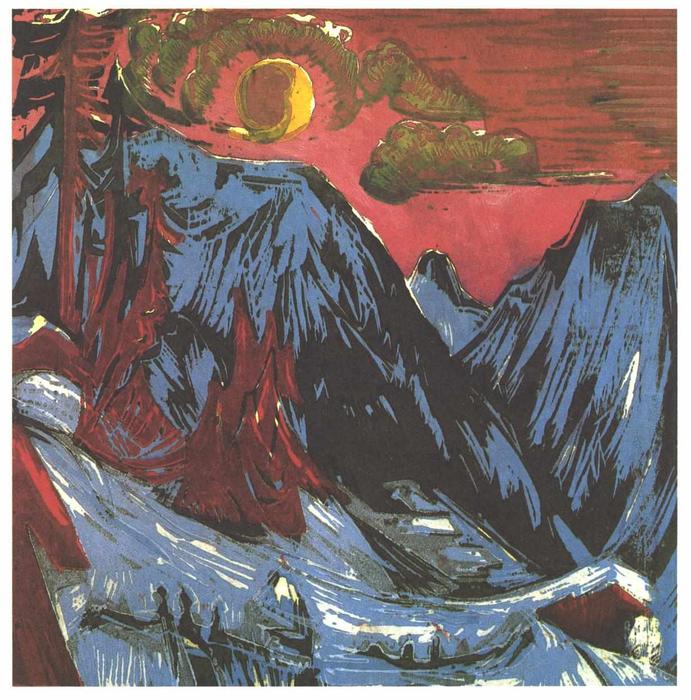
Captured in vivid Expressionist hues, Ernst Ludwig Kirchner’s ‘Mountains in Winter’ portrays a serene yet turbulent landscape bathed in the fiery glow of sunrise—a masterful depiction from 1919 reflecting German Expressionism's emotive spirit. Explore this iconic artwork and bring its beauty into your home.
Mountains in Winter
The painting “Mountains in Winter” by Ernst Ludwig Kirchner stands as a poignant emblem of Expressionist aesthetics—a visual distillation of anxiety and yearning for transcendence amidst the stark beauty of the Alpine landscape. Executed in 1919, this artwork encapsulates not merely a depiction of scenery but rather a profound exploration of psychological states projected onto the natural world.
- Subject Matter: Kirchner’s gaze is firmly fixed on the imposing majesty of winter mountains—a familiar motif within Expressionist art, representing both physical hardship and spiritual contemplation. The artist meticulously captures the contours of snow-capped peaks bathed in the nascent glow of dawn, conveying a sense of isolation and vulnerability against the backdrop of immense geological power.
- Style: Kirchner’s style is unmistakably rooted in Expressionism, characterized by flattened perspectives, angular brushstrokes, and jarring color palettes. Unlike Impressionistic attempts to capture fleeting moments of light, Kirchner prioritizes conveying emotion above all else—a deliberate rejection of academic realism in favor of subjective experience.
- Technique: The painting employs a bold technique utilizing thick impasto—heavy application of paint—to sculpt the mountain surfaces and imbue them with textural richness. Kirchner’s masterful use of color is equally significant; he eschews naturalistic hues, opting instead for vibrant reds, blues, and oranges that heighten the emotional intensity of the scene. These colors aren't merely descriptive but actively contribute to the painting’s expressive force.
The historical context surrounding “Mountains in Winter” illuminates the broader anxieties of the Weimar Republic—a period marked by economic instability, political polarization, and a pervasive sense of disillusionment following World War I. Kirchner’s artistic endeavors coincided with a fervent debate regarding the role of art in confronting societal ills; he sought to articulate the psychological burdens borne by individuals grappling with trauma and uncertainty. The painting reflects this preoccupation with inner turmoil—the solitary figure glimpsed amidst the mountains symbolizes the artist's own struggle for self-expression against the pressures of conformity.
- Symbolism: Beyond its visual representation, “Mountains in Winter” resonates with symbolic significance. The mountains themselves embody resilience and permanence—a counterpoint to the ephemeral nature of human existence. The sunrise symbolizes hope—albeit fragile—amidst darkness—representing the yearning for spiritual renewal.
Ultimately, Kirchner’s masterpiece transcends mere landscape painting; it is a visceral articulation of emotion—a testament to the transformative power of art to confront existential anxieties and capture the sublime beauty of the natural world. Its enduring appeal lies in its ability to evoke feelings of melancholy, contemplation, and awe—inspiring viewers to consider the profound connection between inner experience and external perception. A reproduction of “Mountains in Winter” offers not just a visual delight but also an invitation into Kirchner’s expressive universe—a space where beauty and anguish coexist harmoniously.