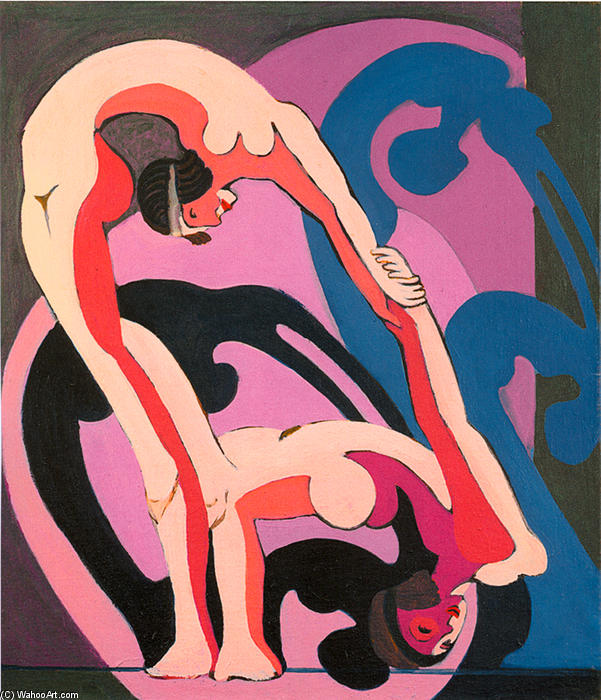
Experience the dynamism of German Expressionism through Kirchner’s ‘Two Acrobats,’ capturing a moment of breathtaking balance and vibrant color against a rich purple backdrop. This masterful painting exemplifies the artist's emotive style, born in 1933.
A Dance Against Darkness: Exploring Ernst Ludwig Kirchner’s “Two Acrobats”
Kirchner's "Two Acrobats," painted in 1933, isn’t merely a depiction of physical prowess; it’s a visceral embodiment of the anxieties simmering beneath the surface of Weimar Germany. Created during a period marked by political instability and social upheaval—the rise of Nazism casting a long shadow over European culture—the painting speaks volumes about the artists' preoccupation with themes of fragility, resilience, and the struggle for equilibrium amidst chaos.
- Subject Matter: The artwork centers on two women engaged in acrobatic maneuvers, their bodies suspended in mid-air against a luminous purple backdrop. This seemingly simple composition is deliberately unsettling, mirroring the precariousness felt by many artists and intellectuals grappling with the impending doom of the era.
- Style & Technique: Kirchner’s signature Expressionist style dominates “Two Acrobats.” Characterized by bold brushstrokes, flattened perspectives, and jarring color palettes—primarily shades of pink, purple, blue, and red—the painting rejects academic realism in favor of conveying emotion directly. The artist employs a technique reminiscent of Cubism, fracturing forms into geometric planes to heighten the sense of disorientation and emphasize the instability inherent in the scene.
The color scheme itself is laden with symbolic significance. Purple, traditionally associated with royalty and spirituality, here represents both aspiration and vulnerability. Juxtaposed against the vibrant pinks and reds—colors often interpreted as representing passion and energy—the purple underscores the characters’ precarious balance and hints at an underlying melancholy. The artist's deliberate use of color isn’t merely decorative; it actively contributes to the painting’s emotional impact, mirroring the psychological turbulence of its time.
Historical Context: Weimar Republic Uncertainty
“Two Acrobats” emerged during the Weimar Republic (1918-1933), a period defined by profound social and political divisions. The trauma of World War I lingered, fueling disillusionment and questioning established values. Kirchner’s artistic output reflects this pervasive sense of unease—a desire to capture not just what is seen but what is felt. He was part of a group of artists who actively resisted the conservative forces attempting to impose order on German society.
Emotional Resonance: A Portrait of Inner Struggle
Ultimately, “Two Acrobats” transcends its visual elements to convey a powerful emotional narrative. The acrobats’ poses—reaching upwards with unwavering determination—suggest defiance against adversity. Yet, their faces remain obscured, emphasizing the difficulty of expressing inner turmoil outwardly. This ambiguity invites contemplation on themes of isolation and vulnerability, resonating deeply with viewers who recognize the universal human experience of striving for stability amidst turbulent circumstances.
- Interior Designers’ Note: Consider incorporating shades of purple and pink into complementary color schemes to evoke a similar mood of contemplative dynamism.