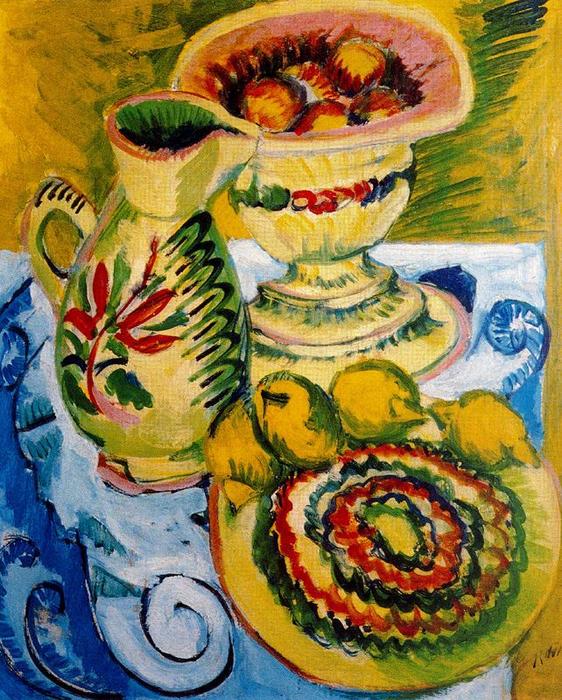
Yellow Still Life: An Expressionist Echo of Anxiety
Ernst Ludwig Kirchner’s “Yellow Still Life,” painted in 1907, isn't merely a depiction of fruit and ceramics; it’s a visceral embodiment of the anxieties simmering beneath the surface of early twentieth-century German art. This striking piece exemplifies Kirchner’s signature Expressionist style—a deliberate rejection of academic realism in favor of conveying emotion through distorted forms and intensely saturated hues.
- Composition & Style: The painting's asymmetrical arrangement immediately grabs the viewer’s attention, mirroring the turbulent spirit of its time. Kirchner abandons traditional perspective, flattening the canvas to heighten the emotional impact. Thick impasto brushstrokes dominate the surface, creating a palpable sense of movement and texture—a technique designed to disrupt visual comfort and stimulate psychological engagement.
- Color Palette & Symbolism: The dominant yellow hue pulsates throughout the composition, reflecting not just illumination but also an underlying feeling of unease. Juxtaposed against greens and reds, these colors aren’t simply descriptive; they carry symbolic weight—yellow representing optimism battling despair, while red hinting at passion intertwined with danger. The inclusion of decorative patterns on the ceramics speaks to a fascination with ornamentation as a form of defense against existential dread.
- Technique & Materials: Kirchner meticulously crafted this artwork using oil paint on canvas, employing a masterful impasto technique that builds up layers of pigment to achieve remarkable textural depth. This deliberate roughness underscores the artist’s desire to communicate raw emotion—a rejection of polished surfaces and idealized representations.
- Historical Context: Created during a period marked by social upheaval and artistic experimentation, “Yellow Still Life” reflects the broader Expressionist movement's preoccupation with psychological states and anxieties about modernity. Kirchner’s work aligns with the Zeitgeist of its era—a reaction against bourgeois complacency and a yearning for authenticity.
- Emotional Impact: Viewing this artwork evokes a feeling of disorientation, mirroring the emotional turmoil experienced by artists grappling with the uncertainties of the time. The chaotic arrangement and distorted forms compel contemplation, prompting viewers to confront uncomfortable truths about human existence – a testament to Kirchner’s profound artistic vision.
“Yellow Still Life” transcends its formal elements; it's a window into Kirchner’s inner world—a poignant reminder that art can serve as both reflection and catalyst for emotional exploration. Its enduring appeal lies in its ability to capture the essence of anxiety and uncertainty, cementing its place as a cornerstone of Expressionist art history.