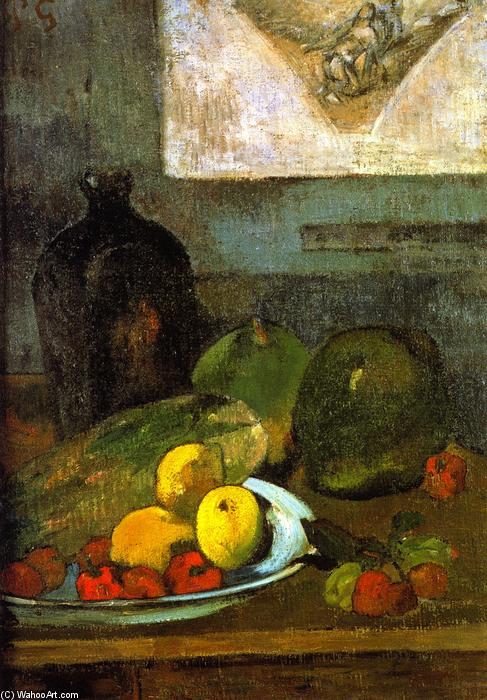
Still Life with Delacroix Drawing
Paul Gauguin, a celebrated French post-impressionist artist, captivated audiences with his visionary works that seamlessly blended realism and profound symbolism. Among his masterpieces is
Still Life with Delacroix Drawing, created in 1887. This painting transcends mere depiction—it’s a testament to Gauguin's artistic prowess and reflects the vibrant intellectual currents of his era.
The Painting: A Detailed Analysis
Measuring 40 x 30 cm and executed in oil on canvas,
Still Life with Delacroix Drawing presents a meticulously arranged tableau of fruits and vegetables—apples dominating the composition alongside a bowl that adds depth to the scene. The strategic placement of these elements establishes a harmonious balance, mirroring Gauguin’s fascination with natural forms and his desire to capture their essence. A bottle situated at the top left corner completes this carefully considered arrangement, furthering enhancing the visual narrative.
Crucially, the inclusion of Eugène Delacroix's drawing—a cornerstone of Romantic art—serves as a deliberate nod to Gauguin’s artistic lineage. This juxtaposition underscores Delacroix’s influence on Gauguin and illuminates the broader context of post-impressionism, demonstrating how earlier movements shaped stylistic developments. The painting exemplifies Gauguin’s experimentation with color palettes and brushstrokes, pushing beyond traditional representational conventions toward a more expressive idiom.
Artistic Influences and Context
Gauguin's artistic vision drew inspiration from Impressionism and Cloisonism, yet he forged his own distinctive path—one characterized by bold hues and flattened surfaces.
Still Life with Delacroix Drawing embodies this stylistic fusion, reflecting Gauguin’s commitment to breaking free from academic constraints and embracing a more intuitive approach. The Musée d'Art Moderne et Contemporain de Strasbourg houses this remarkable artwork—a vital repository of French artistic heritage—providing visitors with invaluable insight into the evolution of modern art. For a comprehensive understanding of the museum’s collection, explore
Musee d'Art Moderne (Strasbourg, France) - A Comprehensive Guide to the Museum and its Artworks.
Relevance in Modern Art
Still Life with Delacroix Drawing stands as a pivotal exemplar of post-impressionist art—a movement that fundamentally reshaped artistic expression and profoundly impacted subsequent stylistic trends. Gauguin’s bold use of color and compositional techniques anticipated the innovations of Fauvism and Cubism, cementing his legacy as one of the most influential artists of the 20th century. To delve deeper into Gauguin's oeuvre, consider exploring
Paul Gauguin: Still Life, The White Bowl and
Paul Gauguin: The Makings of a Bouquet—pieces that showcase his remarkable artistic versatility.
Conclusion
Still Life with Delacroix Drawing by Paul Gauguin remains an enduring symbol of artistic innovation—a captivating fusion of tradition and experimentation that continues to inspire admiration. Its masterful depiction of natural forms and its subtle engagement with Romantic influences solidify its place as a cornerstone of French art history. For those seeking inspiration or contemplating acquiring a stunning reproduction, this painting offers a glimpse into the transformative power of post-impressionism. To broaden your understanding of French artistic heritage, visit
French art on Wikipedia.