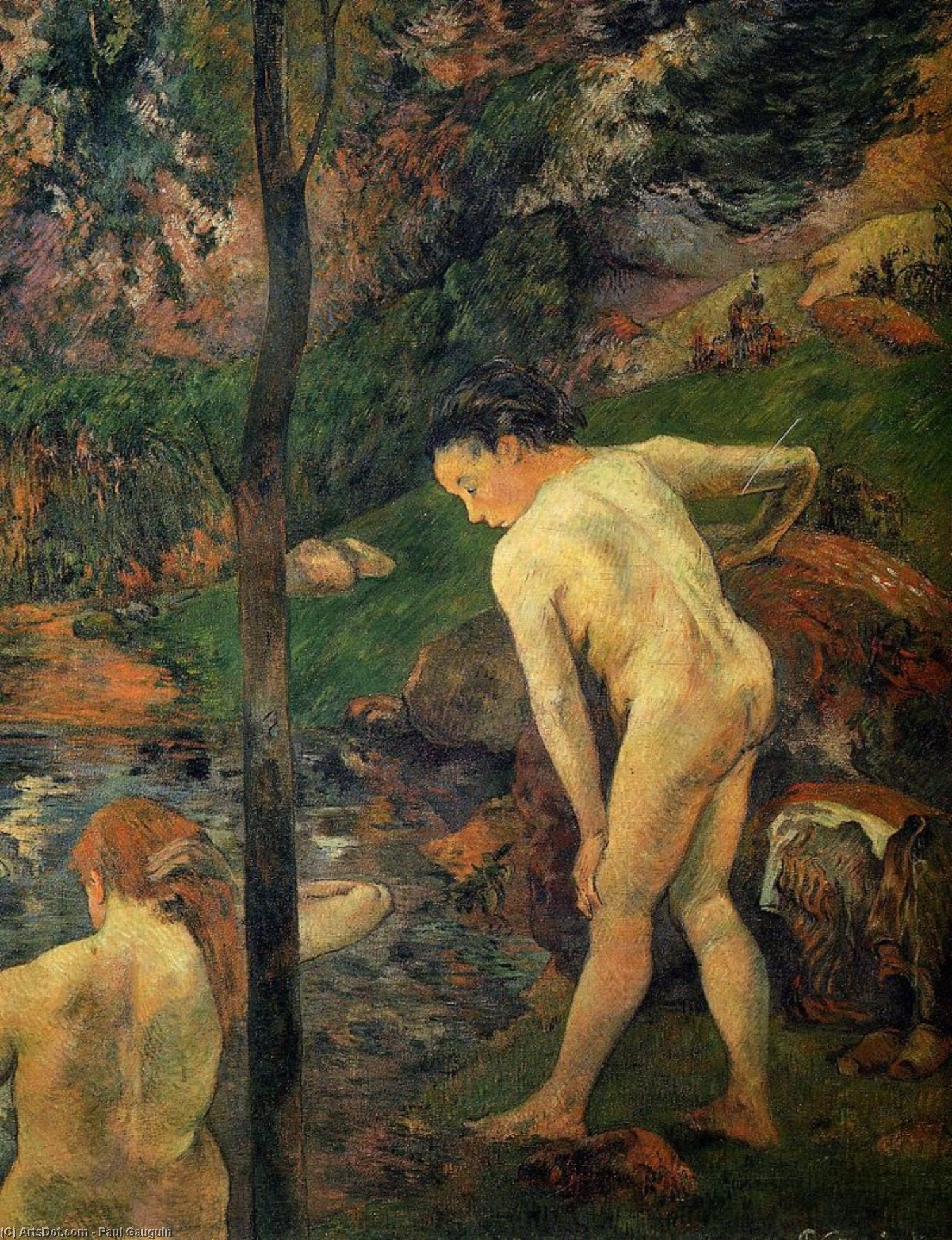
The Genesis of a Masterpiece: Two Girls Bathing (1887)
Paul Gauguin’s “Two Girls Bathing,” painted in 1887, isn't merely a depiction of two women enjoying the tranquility of nature; it’s a carefully constructed tableau brimming with symbolism and reflecting the artist’s evolving artistic philosophy. Born Eugène Henri Paul Gauguin in Paris amidst the turbulent year of 1848, his early life was profoundly shaped by his grandmother, Flora Tristan, an influential figure in the burgeoning socialist movement – a lineage that instilled within him a deep appreciation for social justice and a keen awareness of human experience. This background subtly informs the painting’s quiet observation of female companionship, hinting at a critique of societal norms through its understated portrayal.
The genesis of this work occurred during Gauguin's pivotal period in Tahiti, where he sought refuge from European society and immersed himself in the culture and landscapes of the South Pacific. He deliberately distanced himself from the prevailing Impressionist style, rejecting its emphasis on fleeting moments and optical realism in favor of a bolder, more expressive approach. “Two Girls Bathing” exemplifies this shift – it’s a deliberate move away from photographic accuracy towards conveying mood, emotion, and underlying meaning.
A Symphony of Color and Form: Gauguin's Post-Impressionist Style
Gauguin’s distinctive style is immediately apparent in “Two Girls Bathing.” He employs flattened planes of color, rejecting traditional perspective and creating a sense of immediacy. The figures are rendered with simplified forms, almost mask-like, emphasizing their essential humanity rather than detailed anatomical representation. This simplification wasn't born from a lack of skill; it was a conscious choice to prioritize emotional impact over realistic depiction. The vibrant palette – dominated by rich blues, greens, and ochres – is not merely decorative; each hue contributes to the painting’s overall atmosphere, evoking feelings of serenity, intimacy, and perhaps even a touch of melancholy.
Notably, Gauguin's use of color departs significantly from Impressionism. While Impressionists sought to capture the effects of light, Gauguin uses color symbolically – blues suggest coolness and depth, while warmer tones evoke warmth and sensuality. The deliberate juxtaposition of these colors creates a dynamic tension within the composition.
Light as Narrative: Exploring the Painting's Composition
The strategic placement of light is paramount to understanding “Two Girls Bathing.” Gauguin masterfully utilizes dappled sunlight filtering through the trees, casting dramatic shadows and highlighting the figures’ forms. This interplay of light and shadow isn’t simply a technical exercise; it’s integral to the painting's narrative. The diffused light creates an atmosphere of intimacy and seclusion, suggesting a private moment shared between the two women.
The surrounding landscape – the trees, the boats, and the distant horizon – serves as a backdrop that amplifies the figures’ emotional state. The boats, positioned strategically in the foreground and background, create a sense of depth and draw the viewer's eye into the scene. The birds, subtly integrated into the composition, add to the feeling of peacefulness and connection with nature.
Symbolism and Emotional Resonance: A Deeper Interpretation
Beyond its surface beauty, “Two Girls Bathing” is rich in symbolic meaning. Some art historians interpret the painting as a meditation on female solidarity and the challenges faced by women in a patriarchal society. The figures’ anonymity allows viewers to project their own experiences and emotions onto them, fostering a sense of empathy and connection. The act of bathing itself can be seen as a ritual of purification and renewal – a symbolic cleansing of the soul.
Ultimately, “Two Girls Bathing” is a testament to Gauguin’s ability to capture not just a scene but also an emotional state. It's a painting that invites contemplation, prompting viewers to consider themes of beauty, intimacy, and the enduring power of human connection. A reproduction captures this essence beautifully, allowing you to bring this evocative masterpiece into your own space.