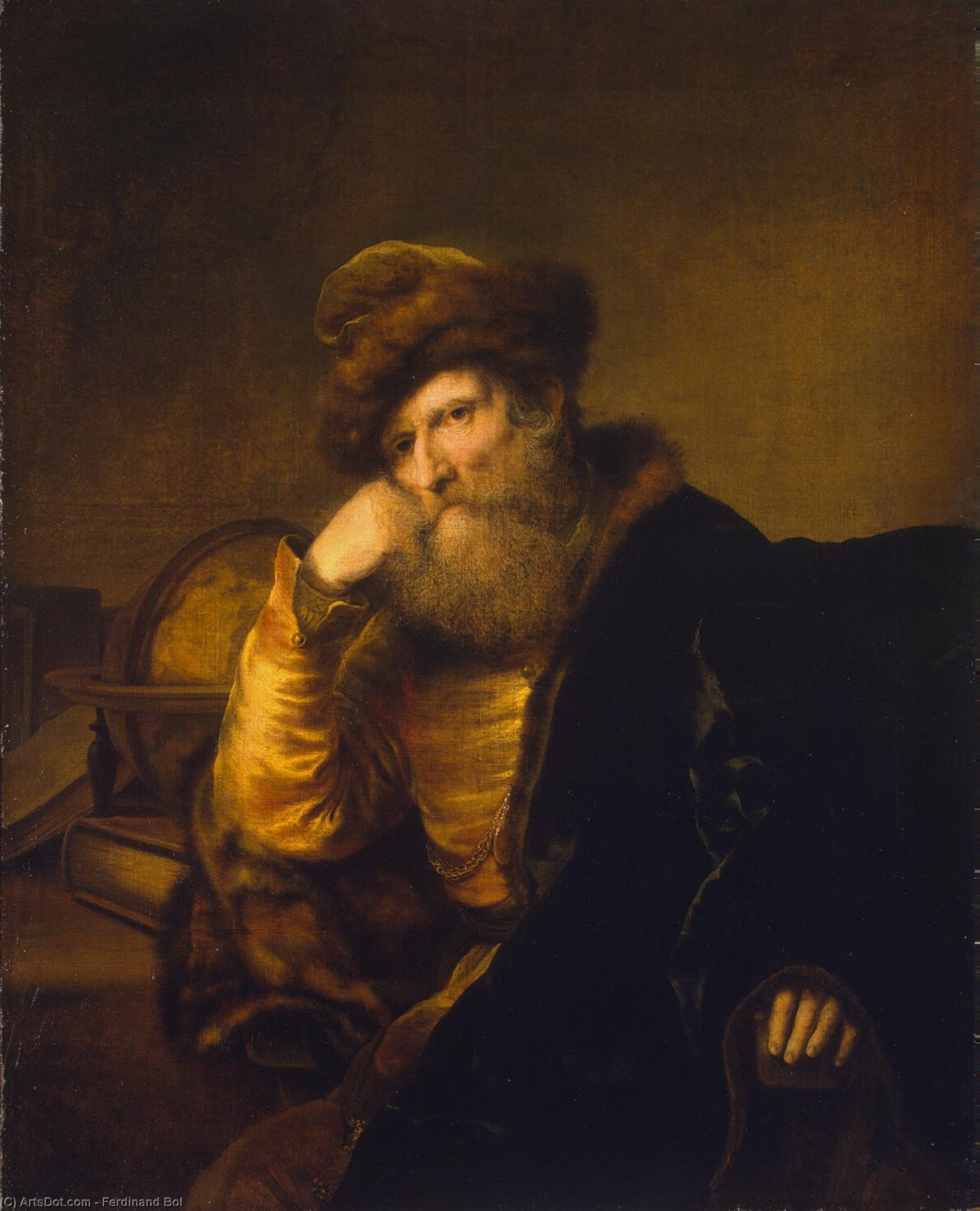
A Portrait of Scholarly Reflection: Ferdinand Bol’s Masterpiece
Ferdinand Bol's "Portrait of a Scholar," painted in 1650, is more than just a likeness; it’s a carefully constructed tableau of intellectual pursuit and quiet contemplation. This remarkable work, housed within the confines of the Indianapolis Museum of Art, offers a rare glimpse into the Dutch Golden Age – a period defined by burgeoning commerce, artistic innovation, and a profound engagement with humanist ideals. Bol, often overshadowed by his more celebrated contemporary Rembrandt van Rijn, reveals himself here as a master of nuanced observation and atmospheric depth, crafting an image that resonates with both historical significance and enduring aesthetic appeal.
The painting immediately draws the eye to its central figure: a man of considerable age, distinguished by a neatly trimmed beard and mustache. His attire – a dark, enveloping coat – speaks to his status and perhaps a certain formality, while his posture exudes an air of serene concentration. The key element, however, lies in his hand resting thoughtfully on his chin; this gesture is not merely idle but powerfully communicates deep thought, intellectual wrestling, or perhaps the absorption in a complex idea. Bol skillfully employs chiaroscuro – the dramatic interplay of light and shadow – to sculpt the figure’s form and emphasize the intensity of his gaze, which seems directed inward, lost within the labyrinth of his own mind.
The Baroque Setting: Books as Symbols
Bol doesn't present a solitary scholar in isolation. Instead, he places him within a richly detailed interior setting – a room brimming with books. This isn’t simply a backdrop; it’s integral to the painting’s meaning. The bookshelf, overflowing with volumes of varying sizes and colors, immediately establishes the subject’s profession and intellectual life. Books, in the 17th century, represented knowledge, wisdom, and access to the accumulated learning of generations. Their presence here elevates the scholar's status, suggesting a man deeply immersed in the world of ideas.
Notice also the carefully positioned elements within the room: a simple chair, a clock hanging on the wall – each contributes to the overall sense of order and stability. The clock, particularly, subtly anchors the scene in time, reminding us that this is not merely a snapshot but a moment captured within a larger narrative of intellectual development. Bol’s use of perspective creates a believable space, inviting the viewer into the scholar's world and fostering a feeling of intimacy.
Technique and Style: A Rembrandt-Inspired Vision
Bol’s artistic style is undeniably influenced by his apprenticeship under Rembrandt van Rijn, a connection that has often been debated among art historians. Early in his career, Bol produced works strikingly similar to Rembrandt's, characterized by their dramatic lighting, rich textures, and psychological depth. However, as he matured, Bol developed a more refined and individualized style, moving away from the overt theatricality of his early work towards a greater emphasis on subtlety and restraint.
“Portrait of a Scholar” exemplifies this evolution. While retaining elements of Rembrandt’s chiaroscuro technique – particularly in the modeling of the figure's face and hands – Bol employs it with a more controlled and nuanced approach. The colors are muted, dominated by browns, grays, and blacks, creating a sense of gravitas and seriousness. Bol’s brushwork is remarkably detailed, capturing the texture of the books, the folds in the coat, and the subtle nuances of the scholar's expression. This meticulous attention to detail speaks to his mastery of technique and his commitment to portraying his subject with remarkable accuracy and psychological insight.
Symbolism and Emotional Resonance
Beyond its technical merits, “Portrait of a Scholar” is imbued with symbolic meaning. The figure’s contemplative posture suggests a man engaged in the pursuit of truth, wisdom, and understanding – values highly prized during the Dutch Golden Age. The painting speaks to the importance of intellectual inquiry, the value of knowledge, and the quiet dignity of scholarly pursuits. It's a portrait not just of a man, but of an ideal: the embodiment of learning and reflection.
Furthermore, the image evokes a sense of melancholy and introspection. The scholar’s gaze is inward-focused, suggesting a mind grappling with complex ideas or perhaps burdened by the weight of knowledge. This emotional resonance elevates the painting beyond a simple likeness, transforming it into a powerful meditation on the human condition.