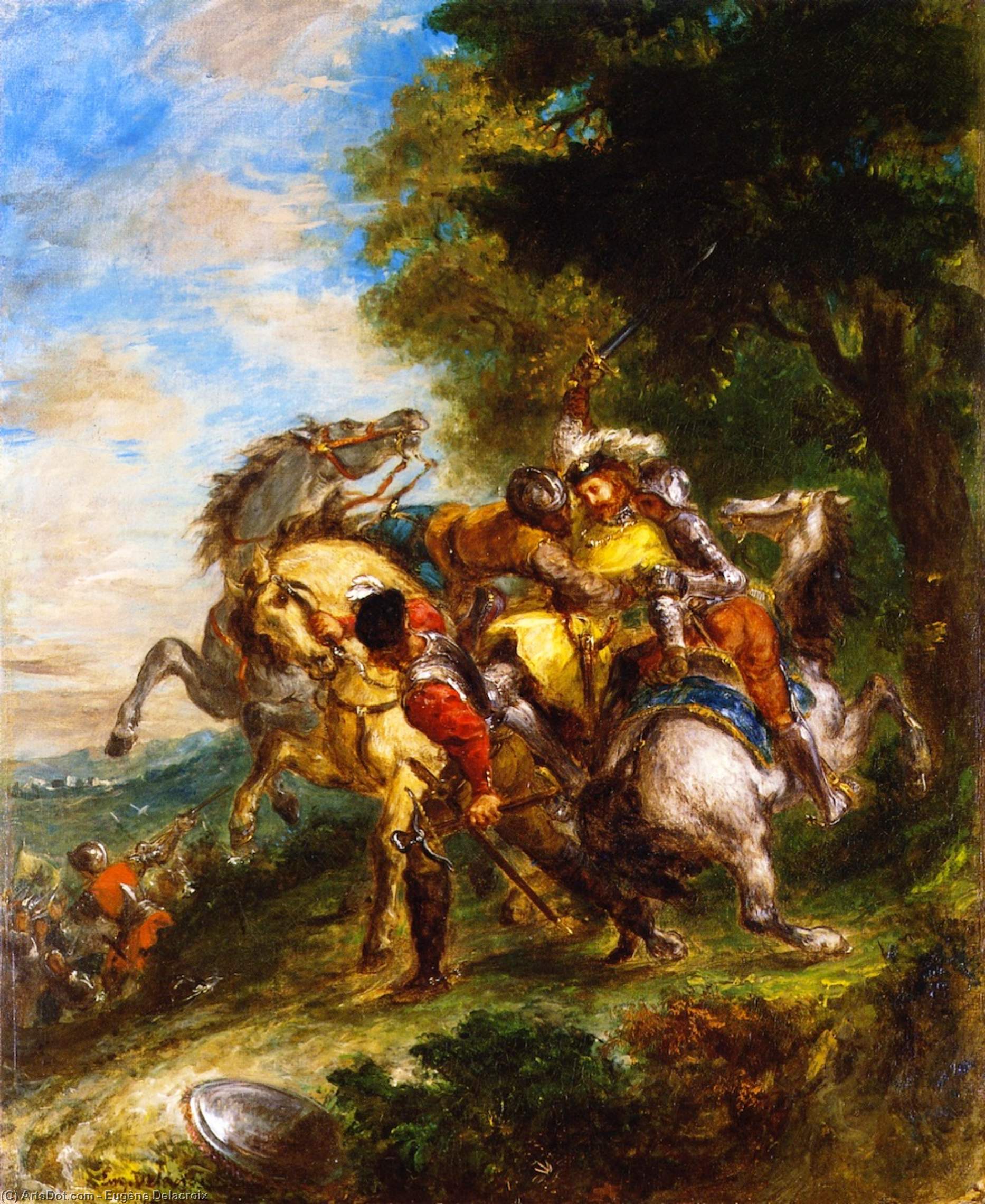
A Symphony of Chaos: Delacroix’s Vision of Conflict
In the grand tapestry of French Romanticism, few moments capture the raw, unbridled energy of human struggle as effectively as Eugène Delacroix’s Weislingen Captures by Goetz's Men. Painted in 1853, this oil on canvas masterpiece serves as a window into a turbulent era, transporting the viewer directly into the heart of a historical upheaval. The scene is not merely a depiction of a battle; it is an immersive experience of motion and tension. As we gaze upon the canvas, we find ourselves amidst the dust and clamor of Weislingen’s capture, where the air seems thick with the scent of iron and the heavy breathing of spirited steeds. Delaclyox, a master of the dramatic, utilizes a composition that refuses to let the eye rest, guiding us through a whirlwind of riders and horses that appear to surge forward from the very depths of the frame.
The technical brilliance of this work lies in Delacroix’s rejection of the static, polished perfection favored by his Neoclassical contemporaries. Instead, he embraces a more fluid, painterly approach where brushstrokes contribute to the sense of urgency. The interplay of light and shadow—a hallmark of the Romantic movement—creates a chiaroscuro effect that lends weight to the figures and depth to the battlefield. One can almost feel the rhythmic thud of hooves against the earth as at least six horses dominate the midground, their muscular forms rendered with an anatomical vitality that speaks to the artist's profound understanding of life in motion. The scattered figures and the solitary shield resting on the ground serve as poignant anchors, grounding the chaotic movement within a tangible, tragic reality.
The Emotional Resonance of Romanticism
Beyond the mere documentation of a historical event, Weislingen Captures by Goetz's Men is an exploration of the sublime—that overwhelming feeling of awe mixed with terror. Delacroix was a pioneer in using color not just for representation, but as a vehicle for emotion. The palette here is deeply evocative; the rich, earthy tones and sudden flashes of light work in tandem to heighten the psychological stakes of the encounter. There is a palpable sense of destiny and desperation woven into the fabric of the painting. Each rider, caught in a moment of decisive action or breathless anticipation, embodies the unpredictable nature of fate that so fascinated the Romantic soul.
For the discerning collector or the interior designer seeking to infuse a space with character, this piece offers more than just aesthetic beauty; it offers a narrative soul. A high-quality reproduction of this work brings a sense of historical gravity and intellectual depth to any environment. Whether placed in a study filled with leather-bound books or as a commanding focal point in a contemporary gallery-style living room, the painting commands attention. It invites conversation, prompting viewers to contemplate the fleeting nature of peace and the enduring power of human courage. To possess such a work is to hold a fragment of the nineteenth century's most passionate artistic revolution, making it an incomparable addition to any curated collection of fine art.