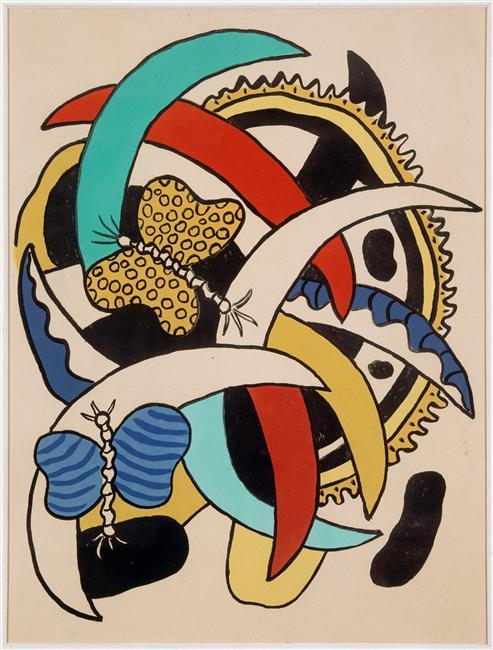
Date: 1948 ; Style: Purism ; Genre: flower painting ; Location: Musee National Fernand Leger, Biot, France ; Dimensions: 65 x 50 cm ...
レジェは、キュビスムと「チューブズム」の先駆者。機械美や都市生活を大胆な色彩と形態で表現し、ポップアートへの道を開いたフランス画家。現代社会のエネルギーと躍動感を捉えた作品群は、今なお多くの人々に影響を与え続けています。
Fernand Léger’s “Butterflies” – A Triumph of Tubism and Modern Vision
Fernand Léger's "Butterflies" (Still Life with Butterflies), painted in 1948, represents a cornerstone of Purist art and embodies Léger’s singular approach to depicting the world around him. More than just a botanical study—though undeniably beautiful—the painting is a deliberate manifesto of Tubism, Léger's groundbreaking artistic innovation that sought to liberate painting from representational constraints while retaining its expressive power. This artwork isn’t merely decorative; it’s a carefully constructed dialogue between observation and abstraction, reflecting Léger’s fascination with the dynamism of industrial progress and his belief in the transformative potential of geometric forms.
The Tubist Aesthetic: Simplifying Complexity
Léger's Tubism—derived from “tube”—was born out of a reaction against Cubism’s fragmentation and analytical dissection of objects. Instead, Léger championed simplification, reducing complex shapes into basic cylinders, spheres, and cones. In "Butterflies," this principle is brilliantly applied to the depiction of the butterflies themselves – each butterfly rendered as a stylized cylinder, conveying movement and energy without resorting to detailed anatomical representation. This technique isn’t about illusion; it's about capturing *essence*, distilling the visual information into its most fundamental components. The artist meticulously arranges these cylinders against a muted background, creating a harmonious balance between abstraction and naturalism.
A Botanical Still Life Infused with Geometric Precision
Despite its abstract core, “Butterflies” retains a palpable connection to the natural world. Léger’s masterful handling of color—primarily earthy tones accented by splashes of vibrant yellow—enhances the visual impact of the flowers and butterflies. The careful placement of the bananas adds textural contrast and reinforces the painting's compositional unity. However, it is the geometric underpinning that elevates this still life beyond mere depiction; it speaks to Léger’s conviction that abstraction could illuminate the underlying structure of reality. The artist’s meticulous attention to detail—evident in the rendering of each butterfly wing—demonstrates a profound respect for observation while simultaneously pushing artistic boundaries.
Historical Context and Léger's Artistic Legacy
Painted during the post-war period, “Butterflies” reflects Léger’s optimism about the future – a belief that humanity could overcome adversity through technological advancement and rational thought. Tubism emerged as a response to the anxieties of the time, offering a counterpoint to Surrealist explorations of subconsciousness. Léger's work anticipated developments in later art movements like Pop Art, demonstrating his prescience regarding the shifting cultural landscape. His unwavering commitment to geometric abstraction solidified his position as one of the most influential artists of the 20th century, inspiring generations of painters and designers.
Emotional Resonance: Quiet Dynamism
Ultimately, “Butterflies” transcends its formal qualities to convey a subtle emotional resonance. The painting’s muted palette evokes a sense of serenity, juxtaposed with the energetic dynamism suggested by the stylized butterflies. Léger's deliberate simplification invites contemplation—encouraging viewers to consider not just what is seen but also how it feels. It’s a testament to Léger’s ability to capture the spirit of his time while simultaneously expressing universal themes of beauty and transformation. This artwork remains an enduring symbol of Léger’s artistic vision: a celebration of form, color, and the harmonious coexistence of abstraction and observation.