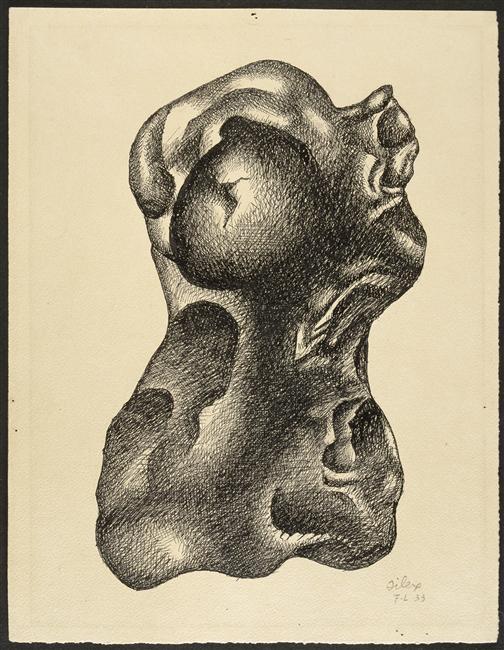
The photograph captures the details of the painting, including the various lines and shapes that make up the composition. The image is displayed in a book or album, which further emphasizes its importance as a piece of art.
The Pulse of Purism: Decoding Fernand Léger’s Flint
To encounter Fernand Léger’s "Flint" is to step directly into the rhythmic, metallic heartbeat of the early twentieth century. Created in 1933, this masterpiece serves as a profound declaration of Purist Abstraction, a movement that dared to strip away the decorative illusions of the past to reveal the raw, geometric truth beneath. Léger, a visionary who found beauty in the industrial landscape, did not merely seek to represent the world; he sought to distill it. In "Flint," we see the artist’s famous dictum—“I want to paint only what I see”—manifested through a composition that rejects subjective sentimentality in favor of a stark, powerful visual perception. The painting acts as a window into an era where the boundaries between human existence and mechanical progress were beginning to blur, offering a gaze that is both clinical and deeply captivating.
The technical mastery of "Flint" lies in its deliberate, architectural precision. Léger employs a vocabulary of bold, angular lines and simplified geometric shapes—circles, squares, and triangles—that are arranged with a meticulous sense of balance. There is no traditional depth or vanishing point to guide the eye; instead, the artist utilizes a deliberate flatness of the picture plane to reinforce the abstraction. His technique, heavily influenced by the principles of industrial design, features broad, purposeful brushstrokes that lend a textured solidity to the canvas. This creates a fascinating tension between the static nature of the shapes and a dynamic sense of movement, as if the very components of the composition are caught in a state of perpetual, mechanical motion.
A Symphony of the Machine Age
Beyond its formal qualities, "Flint" is a profound historical document. Emerging from the anxieties and rapid transformations of the 1930s, the work reflects the pervasive influence of the Machine Age on European culture. As factories rose and urban sprawl reshaped the landscape, Léger captured the energy of this new reality. The painting’s subject matter—an abstract representation that hints at a human torso through fragmented forms—symbolizes the integration of the organic with the industrial. It is an exploration of how technology does not merely surround us but becomes part of our very structure. For the modern collector or interior designer, this piece offers more than just aesthetic appeal; it provides a sophisticated dialogue about the relentless progression of time and the enduring strength of human innovation.
For those looking to bring a sense of structured elegance and intellectual depth into a contemporary space, a high-quality reproduction of "Flint" serves as an extraordinary focal point. Its bold outlines and rhythmic composition possess a unique ability to anchor a room, providing a sense of ordered energy that complements both minimalist and avant-garde interiors. To display Léger’s work is to invite the spirit of modernism into one's home—a celebration of clarity, strength, and the beautiful, unyielding geometry of our modern world.