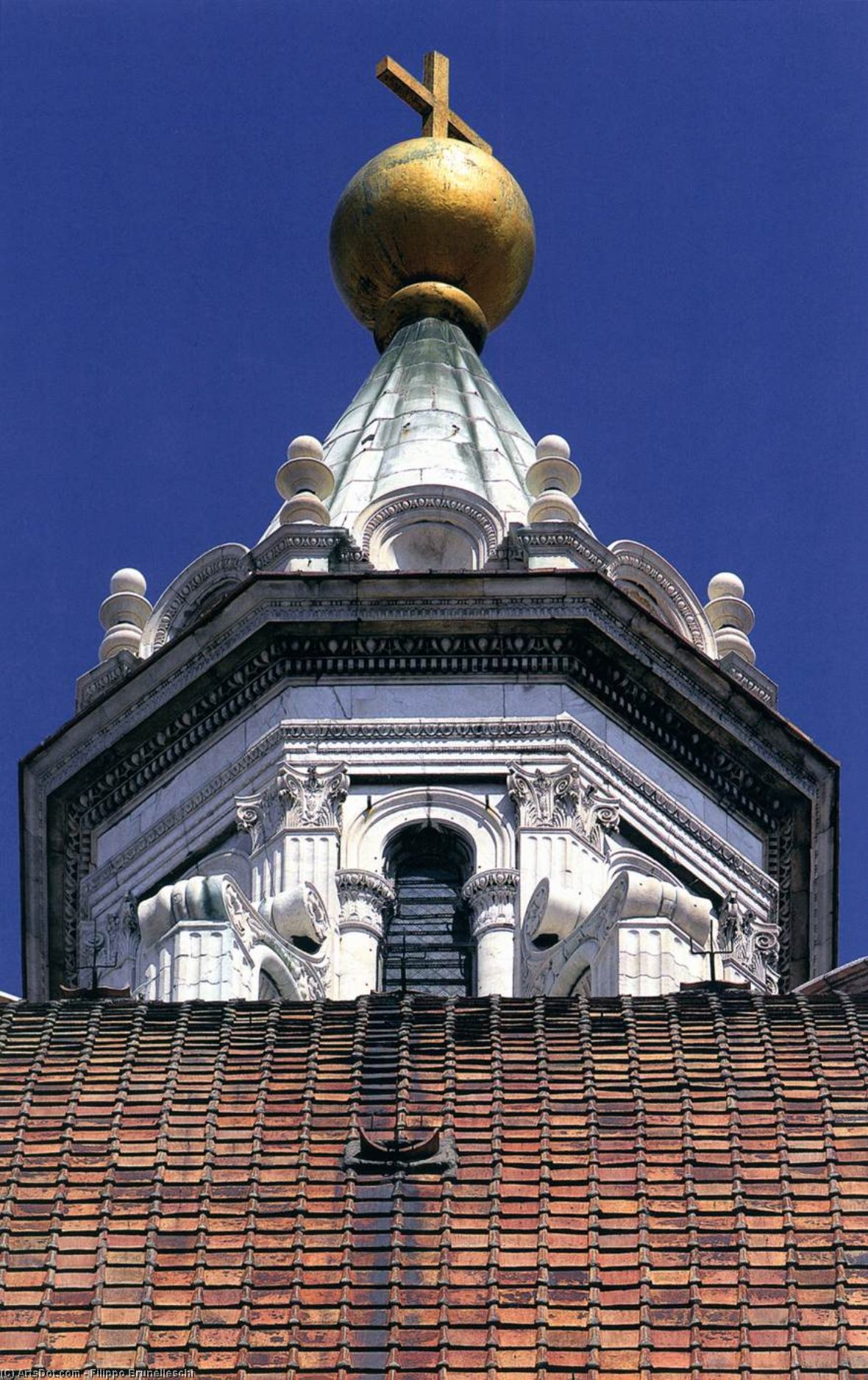
The Majesty of Brunelleschi’s Lantern
Perched atop Florence's iconic Duomo, or Cathedral of Santa Maria del Fiore, stands a beacon of Renaissance ingenuity – Filippo Brunelleschi’s lantern. More than just a decorative element, it represents the culmination of a daring engineering feat and embodies the spirit of innovation that defined the era. This meticulously crafted structure isn’t merely a light source; it's a testament to Brunelleschi’s genius, a harmonious blend of mathematics, artistry, and structural brilliance.

The lantern itself is a complex, octagonal marvel. At its apex, a gleaming golden cross pierces the azure sky, signifying divine guidance and anchoring the structure to the heavens. Below, a massive golden sphere – a deliberate echo of the dome beneath – radiates an aura of grandeur and stability. The base, a robust square framework adorned with intricate carvings of mythical creatures and gargoyles, speaks to the enduring power of classical Roman motifs, subtly integrated into the burgeoning Renaissance style. These figures, often interpreted as allegorical representations of virtue and strength, add layers of symbolic depth to the overall composition.
A Revolutionary Design: Engineering and Innovation
Brunelleschi’s design wasn't simply aesthetically pleasing; it was fundamentally revolutionary for its time. He faced a daunting challenge: how to support the immense weight of the lantern atop the soaring dome without compromising its structural integrity. His solution involved a sophisticated system of counterweights, meticulously calculated and precisely engineered – a testament to his mastery of mathematics and mechanics. This innovative approach wasn’t just about building; it was about understanding the very principles of gravity and balance.
The lantern's construction itself was a remarkable undertaking, completed in 1470 after years of painstaking work. It stands as a symbol of Florence’s ambition and its willingness to embrace groundbreaking ideas. Brunelleschi’s success not only transformed the appearance of the Duomo but also established him as a pioneer in architectural engineering – a legacy that continues to inspire architects and engineers today.
Historical Context: The Renaissance at its Peak
To fully appreciate the lantern, one must understand the context of the Florentine Renaissance. The 15th century was a period of unprecedented artistic and intellectual flourishing, fueled by a renewed interest in classical antiquity and a spirit of humanism. Brunelleschi’s work embodies this spirit perfectly – a celebration of human ingenuity and a rejection of the rigid conventions of the Middle Ages.
Commissioned during the reign of Lorenzo de' Medici, the “Magnificent,” the lantern became a powerful symbol of Florence’s wealth, power, and cultural prestige. The Duomo itself, with its magnificent dome designed by Brunelleschi, was intended to be a visible declaration of Florence’s status as a leading European city.
Symbolism and Emotional Impact
Beyond its technical brilliance, the lantern is rich in symbolism. The golden cross represents faith and divine authority, while the sphere symbolizes unity and completeness. The intricate carvings evoke classical ideals of beauty, harmony, and order. Standing beneath this illuminated structure, one can’t help but feel a sense of awe and wonder – a connection to centuries of artistic achievement and human aspiration.
The lantern on the Duomo is more than just an architectural element; it's a powerful emblem of Florence’s enduring legacy. It represents the city’s commitment to innovation, its embrace of beauty, and its unwavering belief in the potential of human creativity. It remains a source of inspiration for artists, architects, and anyone who appreciates the majesty of human endeavor.