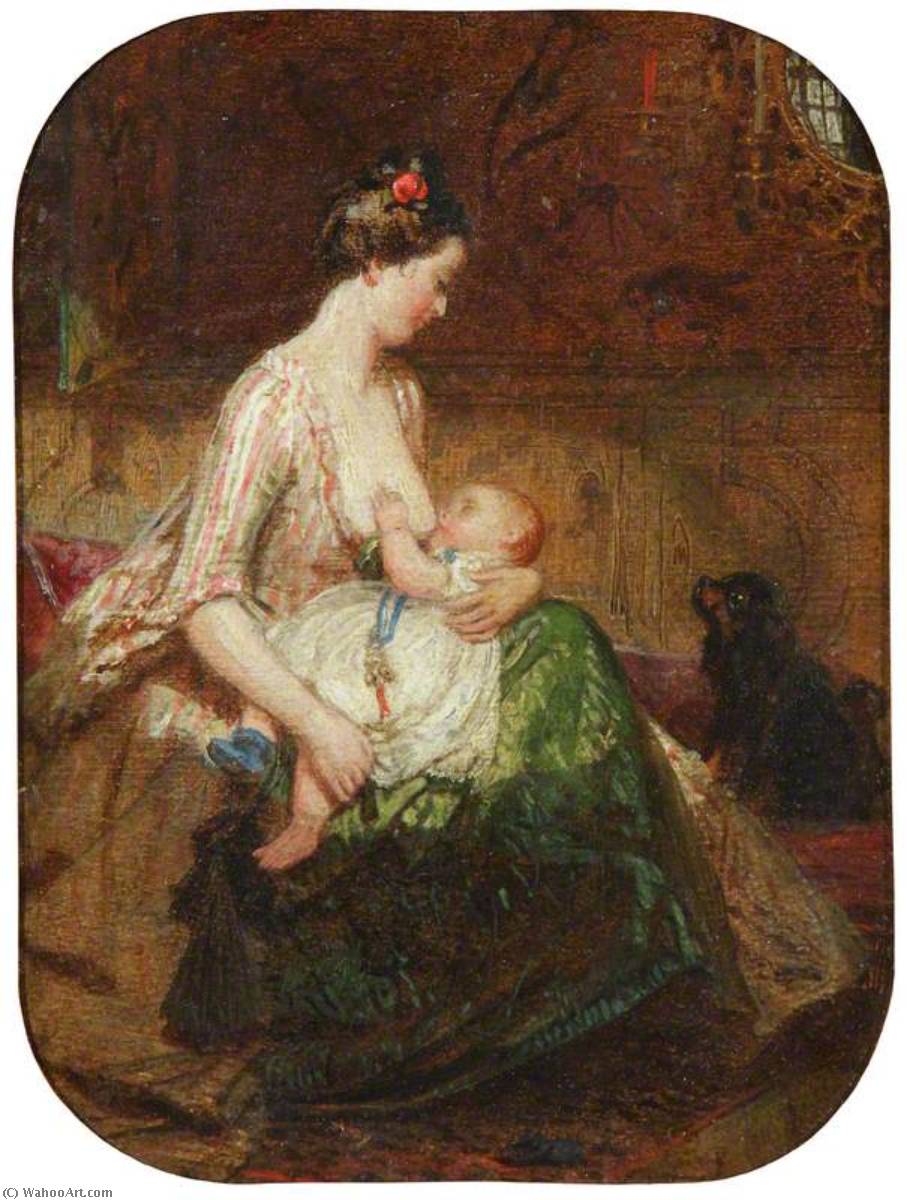
A Tender Glimpse into Victorian Intimacy
In the quiet corners of art history, few works capture the profound sanctity of domestic life as poignantly as Ford Madox Brown’s “The Young Mother.” Completed between 1848 and 1849, this intimate oil on canvas serves as a breathtaking cornerstone of the Pre-Raphaelite movement. At first glance, the viewer is drawn into a private, sacred moment: a woman nursing her infant child within the sheltered embrace of a richly furnished interior. There is an immediate, palpable warmth that radiates from the canvas, inviting the observer to pause and reflect on the universal themes of nurture, protection, and the delicate vulnerability of new life. The composition is masterfully centered, focusing our gaze entirely on the biological and emotional bond between mother and child, while a dark dog rests subtly in the background, adding a layer of domestic tranquility and watchful companionship.
The painting transcends mere sentimentalism through its remarkable technical execution and stylistic depth. While Brown’s work is firmly rooted in the Romantic tradition—emphasizing emotion and imagination—he masterfully weaves in the meticulous observation characteristic of Victorian realism. His technique is a testament to the Pre-Relphaelite commitment to detail; every fold of heavy fabric, every subtle shift in skin tone, and every texture within the opulent room is rendered with extraordinary precision. Through a sophisticated use of chiaroscuro, Brown allows light to spill from an unseen source, casting dramatic shadows that define the figures' forms and imbue the scene with a sense of psychological depth. This interplay of light and shadow does more than create dimension; it crafts a mood of quiet melancholy and profound intimacy that lingers in the mind long after the first viewing.
Symbolism and the Soul of the Pre-Raphaelite Vision
Beyond its aesthetic beauty, “The Young Mother” is a rich tapestry of symbolic meaning, reflecting the social anxieties and enduring values of the mid-19th century. Created during the height of the Industrial Revolution—a period of seismic shifts in Britain’s economic and social landscape—the painting acts as a deliberate sanctuary for traditional values. In an era marked by rapid urbanization and upheaval, Brown presents a vision of domestic stability and the timelessness of maternal love. The organic, curvilinear lines that define the flowing drapery and the soft contours of the figures evoke a sense of natural grace, contrasting sharply with the rigid, mechanical progress of the outside world. The painting serves as a philosophical meditation on the role of women and the sanctity of the home, elevating a simple domestic act into a monumental statement on human connection.
For the discerning collector or interior designer, this artwork offers much more than visual appeal; it provides an emotional anchor for any space. Whether placed in a sunlit study or a sophisticated living area, a high-quality reproduction of this masterpiece brings with it a sense of historical gravity and soulful warmth. The palette, dominated by rich earth tones punctuated by subtle blues and greens, harmonizes beautifully with both classical and contemporary decor. To possess such a work is to invite a piece of the Victorian soul into one's home—a constant reminder of the enduring strength found in tenderness and the quiet beauty of life’s most fundamental bonds.