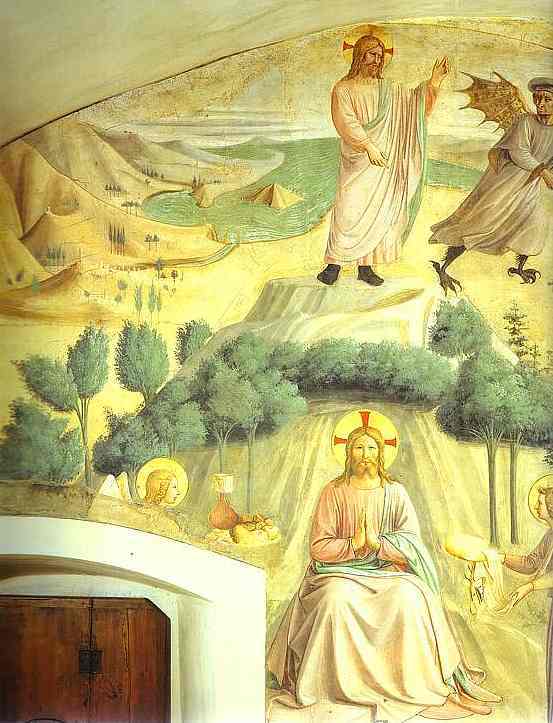
Introduction to the Painting and its Artist
Fra Angelico, born as Guido di Pietro, was an early Italian Renaissance painter who is best known for his frescoes in the Convent of San Marco in Florence. His work is characterized by a deep spirituality and a sense of serenity that pervades even the most dramatic scenes. The
Temptation of Christ is one of his most famous works, painted around 1437-1446.
Historical Context: The Italian Renaissance
The Italian Renaissance was a period of great cultural change and achievement that began in Italy around the end of the 13th century until the 16th century. It marked the transition between Medieval and early modern Europe, with Florence and Tuscany being at the forefront of this movement. For more information on the Italian Renaissance, visit
Art Movements 2/2 or
Italian Renaissance on Wikipedia.
Analysis of the Painting
The
Temptation of Christ is a tempera on panel painting that measures 190 x 165 cm. It depicts the scene from the New Testament where Satan tempts Jesus in the wilderness (Matthew 4:1-11). The use of light in this painting is particularly noteworthy, with
chiaroscuro and
sfumato creating a sense of depth and volume.
Symbolism and Meaning
The
Temptation of Christ carries deep symbolic meaning. The use of light, color, and composition all contribute to the overall message of the painting. For example, the brightly lit figures represent the divine nature of Christ, while the dark background symbolizes the temptations of the world. You can find more information on
Fra Angelico and his works at
Fra Angelico on ArtsDot.
Conclusion
The
Temptation of Christ by
Fra Angelico is a true masterpiece of Italian Renaissance art. Its innovative use of light, color, and composition, as well as its deep spiritual symbolism, make it a captivating and thought-provoking work of art. At
ArtsDot.com, you can find high-quality hand-made oil painting reproductions of this masterpiece, allowing you to appreciate its beauty in your own home or office. Visit the
Berenson Collection at Villa I Tatti, Florence to learn more about Italian Renaissance art and its history.
You can also explore other works by
Fra Angelico, such as the
Fiesole Triptych or the Lamentation, on
ArtsDot.