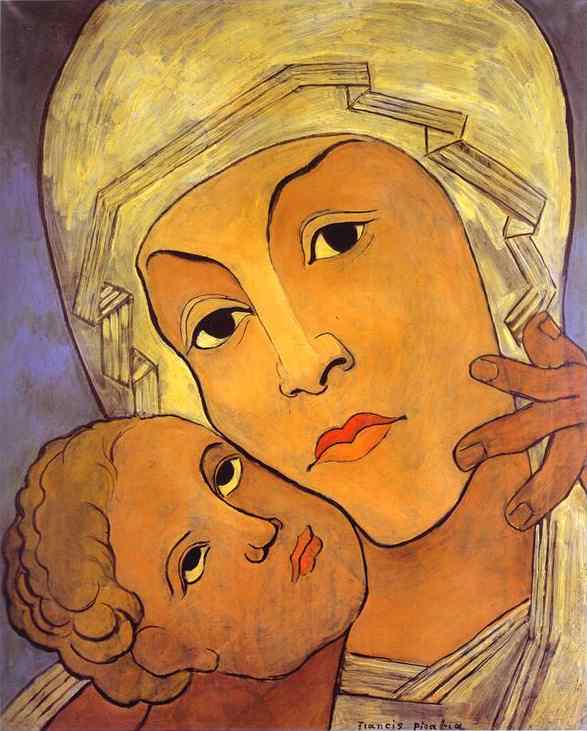
Virgin with Infant: A Glimpse into Picabia's Dadaist Vision
Francis Picabia’s "Virgin with Infant" (1935) is a remarkable piece of art that showcases the artist's unique style and contribution to the Dadaism movement. Created in 1935, this oil on canvas artwork measures 160 x 130 cm and presents a striking representation of the Virgin Mary holding her child.
Artistic Style and Technique
The painting exemplifies Picabia's distinctive blend of Cubism and Dadaist aesthetics. The composition centers around the two figures, tightly framed within the canvas. Shapes are predominantly angular and geometric, contributing to the Cubist aesthetic. Lines are used expressively to define contours and create a sense of dynamism. There’s a deliberate distortion of perspective, creating a flattened effect that challenges traditional artistic conventions. Texture appears somewhat rough and layered, suggesting an impasto technique. The use of bold colors—yellow, red, blue, and green—creates depth and contrast within the image, drawing the viewer's attention to the central figures. The faces of Mary and the child are rendered with exaggerated features and bold outlines, conveying a sense of emotional intensity.
Historical Context and Dadaism
To understand "Virgin with Infant," it’s crucial to consider Picabia’s involvement in the Dada movement. Emerging after World War I, Dada was an anti-art movement that rejected logic, reason, and aesthetic conventions in favor of absurdity, irrationality, and chance. Picabia embraced this spirit, often employing irony and satire to critique societal norms and artistic traditions. This painting can be seen as a playful yet subversive commentary on religious iconography, typical of Dada’s rejection of established values. Picabia's work frequently challenged the art establishment, making him a prominent figure in early 20th-century avant-garde circles.
Symbolism and Emotional Impact
While rooted in traditional Christian imagery—the Virgin Mary and Child—Picabia’s rendition transcends simple religious representation. The stylized forms and flattened perspective strip away sentimentality, presenting a more complex emotional landscape. The exaggerated features and bold outlines convey a sense of both tenderness and detachment. The painting evokes a feeling of quiet contemplation rather than reverence. It invites viewers to question the conventional portrayal of sacred figures and consider the human emotions underlying religious narratives. The halos above their heads are present but simplified, further emphasizing the artist's departure from traditional depictions.
The Artist: Francis Picabia
Francis Picabia (1879-1953) was a French artist known for his eclectic and innovative style, which blended elements of Cubism, Fauvism, and Dadaism. His work often featured bold colors and abstract forms, making him a prominent figure in the early 20th-century art scene. To learn more about Francis Picabia’s life and works, visit ArtsDot.