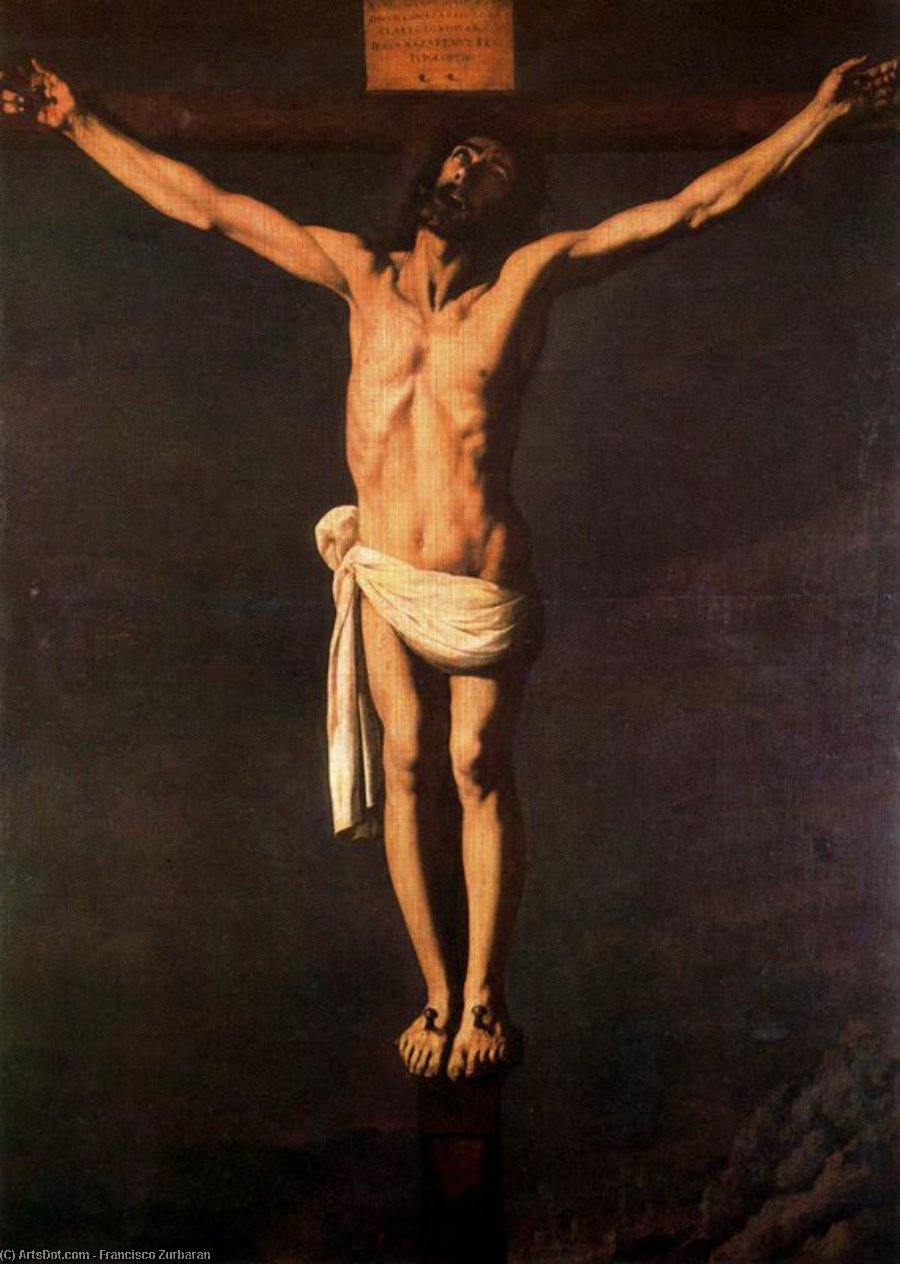
Explore Francisco Zurbarán’s ‘Cristo Crucificado,’ a dramatic Baroque masterpiece. Witness intense emotion & chiaroscuro in this poignant depiction of Christ's suffering – a timeless work of art.
16世紀末~17世紀スペインのバロック絵画を代表するフランシスコ・デ・スールバララン。劇的な光と影のコントラスト(テネブリズム)で、聖人や修道士を描き出しました。深遠な精神性と写実性を兼ね備えた作品は、後の世代に多大な影響を与えました。
A Vision of Suffering: Francisco Zurbarán’s *Cristo crucificado*
This powerfully moving depiction of Christ on the cross is a quintessential example of the Spanish Baroque master, Francisco de Zurbarán's, deeply spiritual and dramatically realistic style. Painted sometime during his prolific career (1598-1664), *Cristo crucificado* isn’t merely a representation of a biblical scene; it’s an invitation to contemplate sacrifice, faith, and the very essence of human suffering.
Style & Technique: The Language of Light and Shadow
Zurbarán was profoundly influenced by the tenebrist style – a hallmark of Baroque painting popularized by Caravaggio. This is immediately evident in *Cristo crucificado*. Dramatic chiaroscuro, the stark contrast between light and dark, dominates the composition. A focused light source illuminates Christ’s body, emphasizing his musculature and the physical torment endured during the crucifixion. Deep shadows engulf the background and much of the cross itself, creating a sense of claustrophobia and intensifying the emotional weight of the scene. The technique, almost certainly oil on canvas, allows for rich layering of pigments and visible brushstrokes that contribute to both the smoothness of skin tones and the rough texture of the wooden cross.
Historical Context: Spain’s Golden Age & Religious Zeal
Francisco de Zurbarán lived during Spain's *Siglo de Oro* (Golden Age), a period marked by immense wealth, imperial power, and fervent religious devotion. His art reflects this context profoundly. Commissioned largely by monastic orders and the Church, his paintings served as devotional objects intended to inspire piety and contemplation. Zurbarán’s work often focused on saints, monks, and scenes from the life of Christ – subjects that resonated deeply with a society steeped in Catholic faith. He became known as the “Spanish Caravaggio” for his mastery of light and shadow and his realistic depictions of religious figures.
Symbolism & Iconography: A Weighty Representation
Every element within *Cristo crucificado* carries symbolic weight. Christ’s outstretched arms are not simply a physical posture, but represent the ultimate sacrifice – an offering to humanity. The verticality of the composition emphasizes Christ's suffering and his connection between heaven and earth. The flattened perspective draws the viewer into the scene, forcing a direct confrontation with the pain and sorrow depicted. While seemingly simple in its presentation, the image is rich with theological meaning, intended to evoke empathy and reverence.
Emotional Impact & Aesthetic Appeal
*Cristo crucificado* evokes powerful emotions – sorrow, pity, and profound contemplation. The realism of Christ’s body, rendered with anatomical precision, makes his suffering palpable. The somber color palette—dominated by dark tones—further reinforces the atmosphere of grief and solemnity. This artwork isn't intended to be merely *looked at*; it is meant to be *experienced*.
For collectors and interior designers, a high-quality reproduction of this work offers a striking focal point. Its dramatic composition and rich textures lend themselves well to both traditional and contemporary settings, adding depth, spirituality, and artistic gravitas to any space. It’s a piece that invites conversation, reflection, and a deeper appreciation for the power of Baroque art.