The Silent Strength of Santa Eulalia
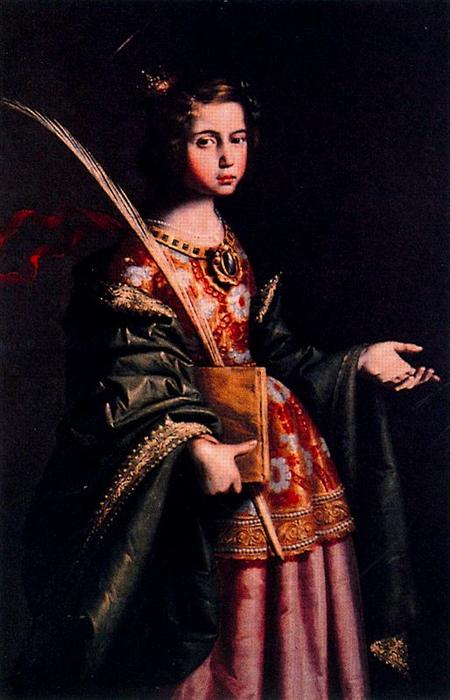
Francisco de Zurbarán’s “Santa Eulalia” is not merely a portrait; it's a profound meditation on faith, sacrifice, and the enduring spirit within adversity. Painted circa 1630-1635 during his most intensely productive period, this work exemplifies the artist’s signature style – a stark realism imbued with an almost palpable sense of solemnity and spiritual depth. The painting depicts a young woman, identified as Eulalia of Barcelona, a Roman virgin martyred in the 4th century for her unwavering Christian beliefs. Zurbarán masterfully captures her stoic composure, a quiet defiance radiating from her eyes and the set of her jaw. It’s a portrait not of suffering, but of an inner fortitude that transcends physical pain.
The composition is deliberately restrained, emphasizing the figure within a dark, almost monastic space. The background, rendered in deep, velvety blacks, serves to heighten the luminosity of Eulalia's form and the subtle details of her attire. This use of tenebrism – dramatic contrasts between light and shadow – was a hallmark of Zurbarán’s technique, borrowed from Caravaggio but adapted with his own distinctive sensitivity. The single shaft of light illuminating her face and hands draws the viewer’s eye directly to her, creating an immediate connection and inviting contemplation.
A Symbol of Martyrdom and Resilience
Eulalia's attire—a simple, flowing gown adorned with a delicate crown—suggests both her noble birth and her impending sacrifice. The bow and arrow she holds are not symbols of aggression, but rather represent the tools of her martyrdom, a poignant reminder of her unwavering faith in the face of brutal persecution. The placement of these objects is deliberate; they speak to her readiness for death, a willingness to embrace suffering as an act of devotion. This isn’t a depiction of fear or anguish, but of acceptance and spiritual strength.
Crucially, this painting draws heavily on the hagiography surrounding Eulalia's life, particularly the “Sequence of Saint Eulalia,” a French text from 880 AD. This account details her extraordinary endurance during torture – flaying, branding, and ultimately crucifixion – before meeting her end with grace and unwavering faith. Zurbarán doesn’t explicitly depict these horrors; instead, he focuses on the *aftermath*—the quiet dignity of a soul prepared for its final journey. The crown, often interpreted as symbolizing her virginity and connection to divinity, adds another layer of symbolic richness.
The Master's Technique & Context
Zurbarán’s skill in rendering texture is remarkable. Observe the meticulous detail with which he portrays the folds of her gown, the sheen on her skin, and the smooth surface of the bow and arrow. He achieved this realism through a combination of direct observation and careful study of drapery—a technique honed during his apprenticeship with Juan Martínez Montañés, another influential Spanish painter. His work was deeply rooted in the religious fervor of 17th-century Spain, a period marked by intense piety and a fervent desire to depict scenes from the lives of saints and martyrs.
Furthermore, “Santa Eulalia” reflects Zurbarán’s broader artistic trajectory – his move away from the more flamboyant styles of earlier Baroque painters towards a greater emphasis on simplicity, austerity, and spiritual intensity. He was considered by some contemporaries as "Spanish Caravaggio" for his dramatic use of light and shadow. This painting stands as a testament to his ability to convey profound emotion through restrained means, solidifying his reputation as one of the most significant artists of the Spanish Golden Age.
Bringing “Santa Eulalia” Home
ArtsDot offers meticulously crafted hand-painted reproductions of Francisco de Zurbarán’s "Santa Eulalia," allowing you to experience the power and beauty of this iconic masterpiece in your own space. Our artists replicate Zurbarán's masterful technique, capturing the nuances of light, shadow, and texture with exceptional fidelity. Whether displayed as a statement piece in a contemporary setting or incorporated into a traditional interior, this reproduction will serve as a constant reminder of faith, resilience, and the enduring strength of the human spirit.
Explore related works by Zurbarán on our website and discover how to bring the profound beauty of Spanish Baroque art into your home. View the Reproduction