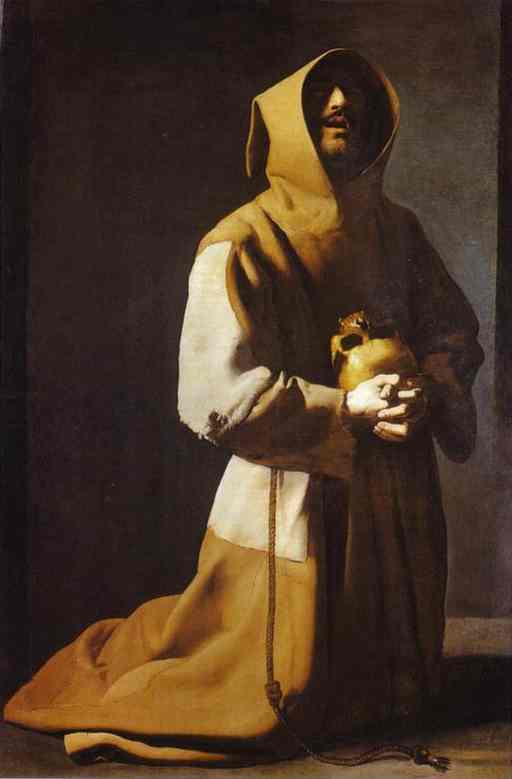
A Moment of Profound Devotion: Francisco Zurbarán’s *St. Francis Kneeling*
This captivating painting by Francisco de Zurbarán offers a deeply moving portrayal of Saint Francis of Assisi, captured in a moment of intense prayer and humble contemplation. The image presents the saint kneeling, his gaze lowered in reverence, clutching a small bell – a symbol often associated with Franciscan orders, used to call the faithful to prayer. He is enveloped in the simple, yet dignified, brown habit characteristic of the Franciscan order, further emphasized by a hooded cloak that draws attention to his bowed head and spiritual focus.
Masterful Technique & The Power of Tenebrism
Zurbarán, celebrated as the “Spanish Caravaggio,” was a master of
tenebrism, a dramatic use of light and shadow. In *St. Francis Kneeling*, this technique is powerfully employed. A strong, focused light source illuminates the saint’s figure, highlighting the texture of his robe and the delicate details of his hands clasped in prayer. This stark contrast against the dark, undefined background intensifies the sense of intimacy and spiritual isolation, drawing the viewer into the scene's quietude. The meticulous rendering of fabric – a hallmark of Zurbarán’s style – demonstrates his exceptional skill as an oil painter.
Historical Context & Religious Zeal
Painted during Spain’s Baroque period (likely mid-17th century, though the exact date remains unknown), this work reflects the fervent religious climate of the Counter-Reformation. Zurbarán received numerous commissions from monastic orders, and his paintings often served as devotional aids within churches and monasteries. The presence of a clock on the wall in the background is an intriguing detail; it could symbolize the passage of time dedicated to prayer or perhaps allude to the regulated life within a religious community. Zurbarán’s work was deeply rooted in Spanish mysticism, aiming to evoke a sense of piety and spiritual experience.
Symbolism & Spiritual Significance
Saint Francis of Assisi (1181/82–1226) remains one of the most beloved saints in Christian tradition, renowned for his poverty, humility, and love of nature. His life embodied a radical commitment to following Christ. In Zurbarán’s depiction, the saint's kneeling posture signifies submission and reverence before God. The simplicity of his attire underscores his renunciation of worldly possessions.
The bell, beyond its practical function, can be interpreted as a call to repentance and spiritual awakening.
Emotional Impact & Interior Design Considerations
*St. Francis Kneeling* evokes feelings of serenity, contemplation, and reverence. The painting’s subdued palette and dramatic lighting create an atmosphere of quiet intensity. This artwork would serve as a powerful focal point in a variety of interior settings – from traditional libraries or studies to more contemporary spaces seeking a touch of spiritual depth. Its vertical composition lends itself well to hallways or areas with high ceilings. A reproduction of this painting could bring a sense of calm and reflection to any room, offering a visual reminder of faith, humility, and the power of inner peace.
Zurbarán’s Legacy
- Born in 1598 in Fuente de Cantos, Spain, Zurbarán established himself as a leading figure of the Spanish Baroque.
- He was deeply influenced by both Caravaggio's tenebrism and the sculptural realism prevalent in Seville during his formative years.
- His paintings often depict monastic life, saints, and still lifes with remarkable precision and emotional depth.
- Though his popularity waned towards the end of his life, Zurbarán’s work has experienced a resurgence in appreciation, solidifying his place as one of Spain's greatest masters.