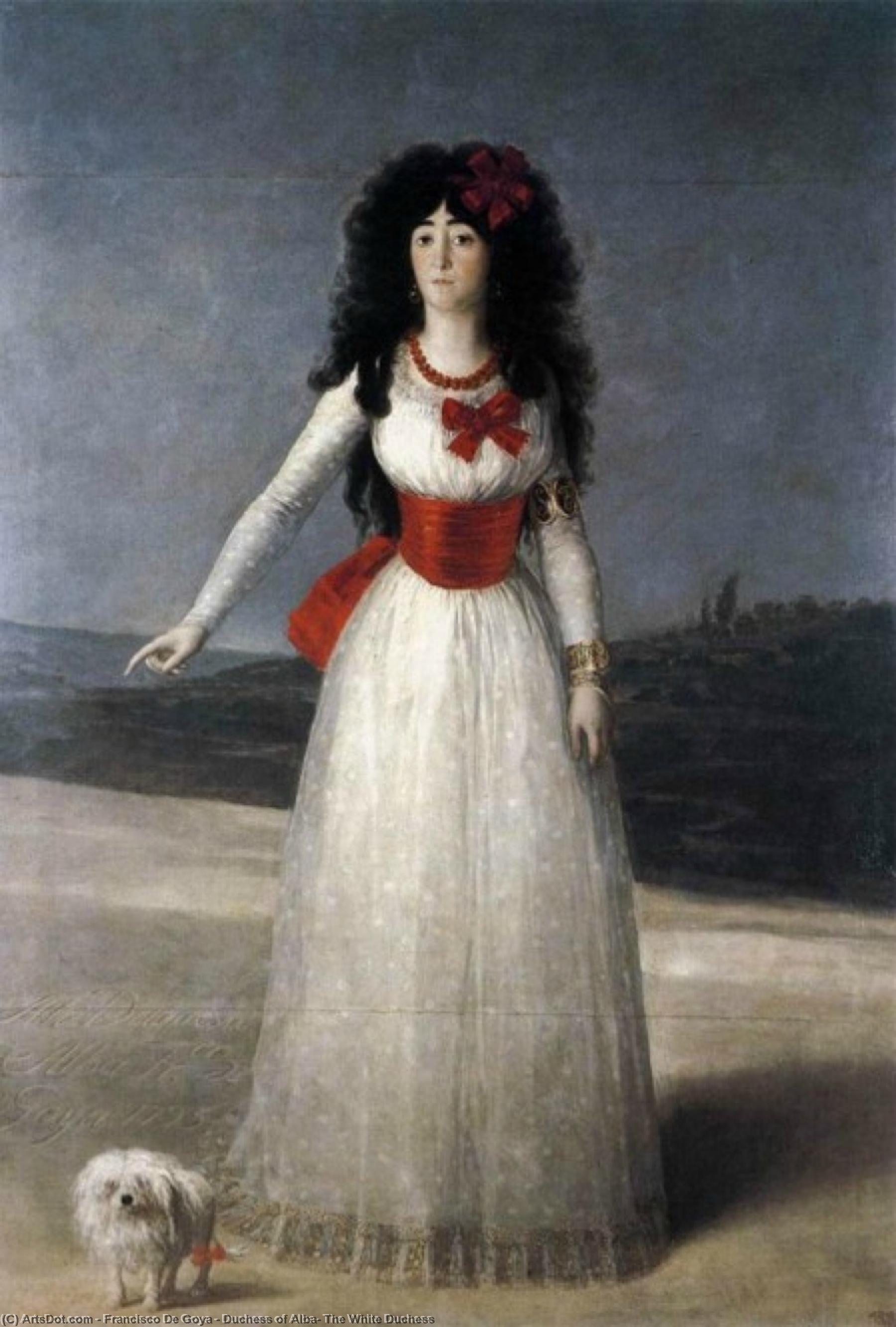
The Duchess of Alba, The White Duchess
Francisco de Goya’s “Duchess of Alba” stands as an emblem of Romanticism—a movement that prioritized emotion and imagination over strict academic conventions. Completed in 1795 during a pivotal moment in Goya’s career, coinciding with his appointment as Director of the Royal Academy and a shift towards darker thematic explorations, this portrait transcends mere likeness; it embodies a profound psychological insight into its subject.
Maria del Pilar Teresa Cayetana de Silva Alvarez de Toledo y Silva, XIII Duchess of Alba, was a woman of considerable influence and beauty. Goya captured her essence with remarkable sensitivity, portraying her in a gown of pristine white accented by bold crimson—a deliberate contrast that speaks to the duality inherent in Romantic art.
The painting’s meticulous technique reveals Goya's mastery of oil paint on canvas. Notice the subtle gradations of color, achieved through layering and blending, creating an ethereal luminescence that illuminates the Duchess’s face and hair. The artist skillfully utilizes chiaroscuro—the dramatic interplay between light and shadow—to sculpt her form and imbue the scene with a palpable sense of drama.
Historically, “The White Duchess” reflects the anxieties and aspirations of Spain during the Napoleonic era. Goya’s depiction aligns with the broader Romantic preoccupation with individualism and psychological complexity, mirroring the turbulent political landscape of the time. The inclusion of a small dog—a symbol of loyalty and companionship—adds another layer of narrative richness.
Beyond its aesthetic qualities, “The White Duchess” resonates emotionally due to Goya’s masterful portrayal of human vulnerability. The gaze of the Duchess—direct yet contemplative—suggests an inner life brimming with emotion and intellect. It's a portrait that invites viewers to contemplate beauty alongside melancholy, cementing Goya’s legacy as one of art history’s most profound interpreters of the human condition.
For those seeking to experience the grandeur of Goya’s vision firsthand, explore a high-quality reproduction on ArtsDot.com.
Experience the beauty of Goya's art with ArtsDot.com, offering handmade oil painting reproductions of his masterpieces.