The Allure of Rococo Sensuality: Hercules and Omphale
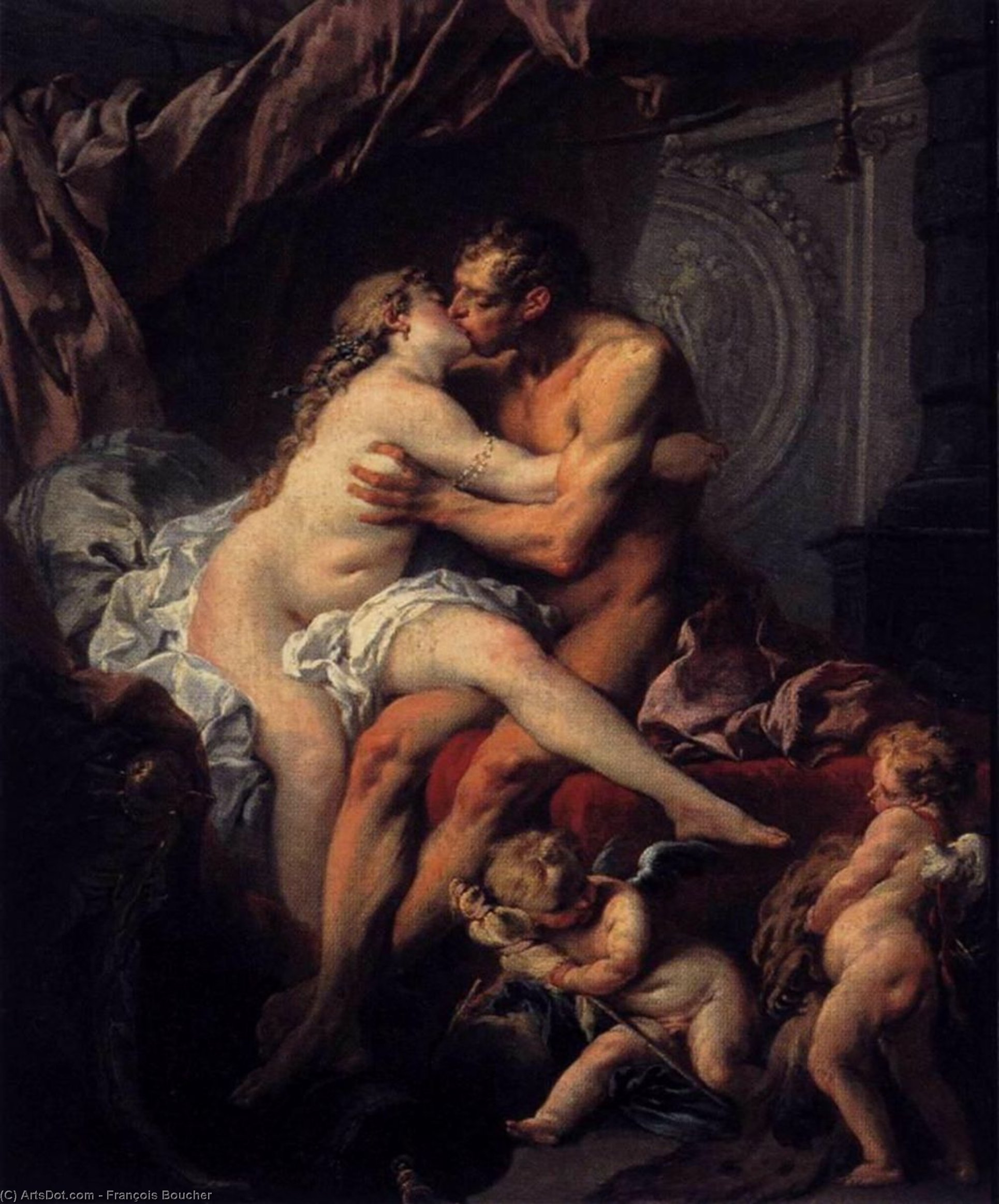
To gaze upon this depiction of Hercules and Omphale is to step directly into the gilded, languid atmosphere of the mid-eighteenth century. François Boucher, a master architect of pleasure in paint, captures not merely a mythological encounter, but an exquisite moment suspended between divine passion and earthly intimacy. The composition immediately draws the eye to the central embrace—a tableau vivant of profound connection. Here, the raw power suggested by Hercules meets the yielding grace embodied by Omphale. Boucher renders their union with an almost breathless immediacy; the deep kiss and the man’s possessive yet tender grasp around her waist speak volumes of desire, filtered through the highly polished lens of Rococo elegance.
Mastery in Flesh and Form: Technique and Style
Boucher's technique, characteristic of his period, is nothing short of breathtaking. His handling of the nude form is legendary; the skin appears impossibly soft, almost luminous against the surrounding tones. The palette itself—a symphony of delicate pastels, creamy whites, and warm flesh tones—is quintessential Rococo. This style favored lightness over drama, prioritizing decorative beauty and sensual suggestion. While the central coupling commands attention with its overt passion, it is the peripheral figures that elevate the narrative complexity. The inclusion of two small children and an accompanying adult figure adds a layer of intriguing domesticity or perhaps watchful curiosity to what might otherwise be read as pure mythological abandon. These secondary elements ground the intense foreground action, suggesting that even moments of divine ecstasy are observed by the quiet rhythms of life.
Historical Echoes and Mythological Resonance
Painted in 1735, this work sits at the zenith of Boucher’s career, a period where mythological subjects were frequently employed to explore themes of romance, leisure, and aristocratic pleasure. The myth itself—the union between Hercules and Omphale—is rich with symbolism concerning fertility, divine favor, and the passage from struggle to repose. For the collector or decorator, this piece offers more than just decoration; it is a conversation starter steeped in classical allusion. It speaks to an era that celebrated art as an enhancement of life’s pleasures, where mythology served as the ultimate backdrop for human emotion.
Bringing Rococo Romance Home
For those seeking to infuse a space with the airy sophistication and warm glow of 18th-century French salon culture, this reproduction offers unparalleled depth. The scale, measuring 90 x 74 cm, allows it to function as a magnificent focal point in a drawing-room or boudoir. When considering a hand-painted reproduction, one is acquiring not just pigment on canvas, but the very spirit of Boucher’s brushwork—that delicate balance between overt passion and refined artistry. It promises an atmosphere of cultivated romance, making it a timeless acquisition for those who appreciate art that whispers rather than shouts its beauty.