A Symphony of Devotion: The Ethereal Grace of Navez
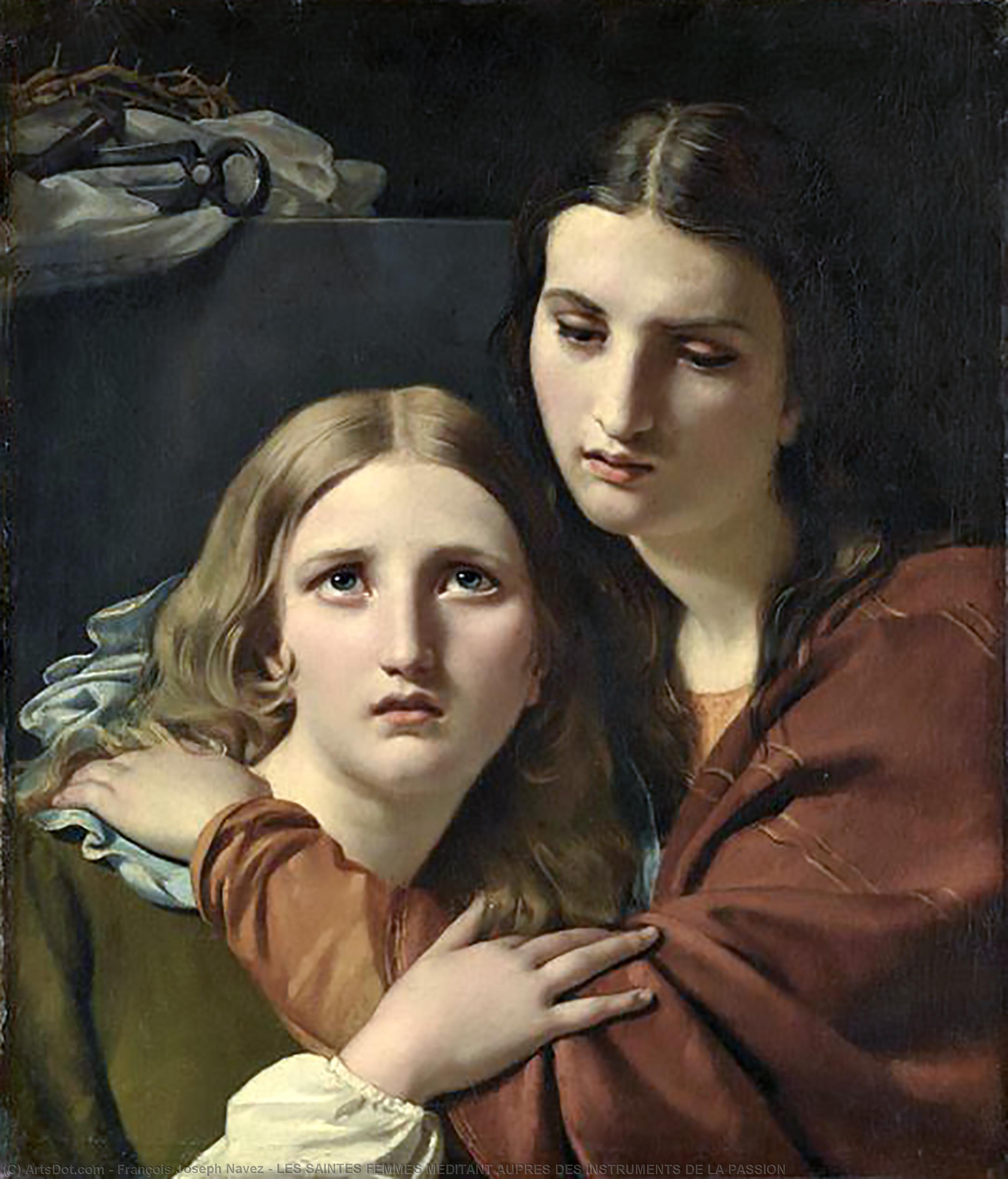
In the quietude of François Joseph Navez’s 1822 masterpiece, “Les Saintes Femmes Méditant Aupres des Instruments de la Passion,” one finds a profound intersection of earthly beauty and divine contemplation. This captivating work serves as more than a mere portrait; it is an evocative window into the Neoclassical soul, capturing a moment of shared spiritual intimacy. The composition centers on two women, likely idealized figures drawn from biblical narratives, whose presence commands the viewer's attention through a delicate balance of posture and gaze. As one woman leans toward her companion in a gesture of quiet solidarity, the other directs her eyes upward, lost in a serene, celestial trance. This subtle interplay of movement creates a rhythmic harmony that guides the eye across the canvas, inviting the observer to join their silent meditation.
The inclusion of musical instruments—a violin and a guitar resting within the scene—transcends simple ornamentation. In the language of 19th-century art, these objects act as powerful symbols of spiritual resonance and cosmic order. Just as music seeks to harmonize disparate notes into a singular, beautiful melody, the presence of these instruments suggests that the women’s devotion is a form of divine music, an internal song of faith. For the discerning collector or interior designer, this symbolic depth adds a layer of intellectual richness to any space, offering a focal point that encourages reflection and peace.
Mastery of Light and Neoclassical Precision
Navez’s technical execution is a testament to his rigorous training under the legendary Jacques-Louis David. The painting embodies the very essence of Neoclassicism, prioritizing clarity, anatomical precision, and an almost sculptural sense of form. There is no room for the chaotic distortion found in later movements; instead, Nerva employs smooth, nearly invisible brushstrokes and subtle tonal gradations to achieve a breathtaking, ethereal luminescence. This light does not merely illuminate the subjects; it seems to emanate from within their very skin, casting a soft glow that highlights the delicate textures of their garments and the gentle contours of their faces.
The artist’s commitment to meticulous detail ensures that every element, from the polished wood of the violin to the flowing drapery of the women's dresses, is rendered with profound reverence. This level of craftsmanship provides a sense of permanence and dignity, making a high-quality reproduction of this piece an exquisite addition to a curated collection. The painting’s ability to marry the disciplined rigor of the French academic tradition with a soft, Romantic sensibility makes it a versatile treasure, capable of anchoring a room with its sophisticated elegance and timeless grace.
A Timeless Legacy for the Modern Collector
To possess or display a work inspired by Navez is to invite a sense of historical continuity into the modern home. Created during a period when the boundaries between classical restraint and romantic emotion were being beautifully explored, this painting offers an emotional impact that remains potent today. It evokes a sense of nostalgia for a time of profound stillness, providing a much-needed sanctuary of calm in our fast-paced contemporary world. Whether placed in a sunlit library or a formal sitting room, the artwork acts as a silent interlocutor, sparking conversations about faith, art history, and the enduring pursuit of beauty.
For those seeking to elevate an interior with pieces that possess both narrative weight and aesthetic splendor, Navez’s work stands as a pinnacle of achievement. It is a piece that does not merely decorate a wall but enriches the atmosphere of a home, offering a window into the sublime through the lens of masterful Belgian Neoclassicism.