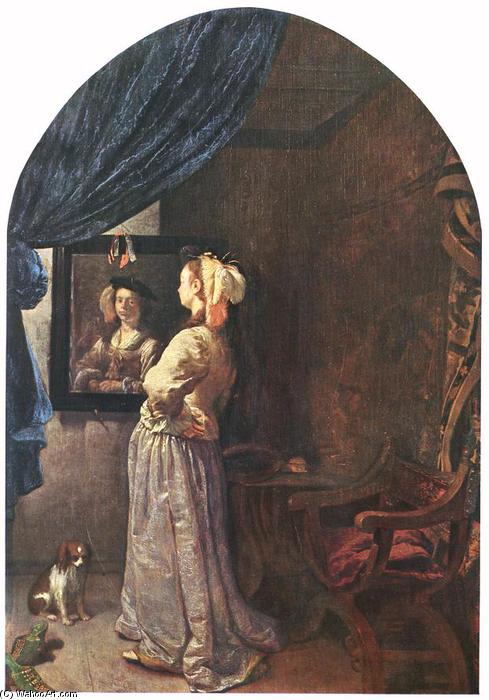
A Portrait of Introspection: Frans van Mieris’ “Woman Before the Mirror”
Frans van Mieris’ “Woman Before the Mirror,” painted around 1670, is more than just a depiction of a young woman contemplating her reflection; it's a profound meditation on identity, vanity, and the complexities of self-awareness. This exquisite work, housed in the Alte Pinakothek in Munich, exemplifies the height of Dutch Golden Age painting – a period characterized by meticulous detail, subtle emotion, and an intimate engagement with human experience. Van Mieris, a master of the *fijnschilder* style, meticulously crafted this scene to capture not just a likeness, but a mood, a moment of quiet contemplation that resonates powerfully across centuries.
The Master’s Technique: A Symphony of Light and Shadow
Van Mieris' skill lies in his ability to render the illusion of reality with breathtaking precision. The painting is executed in oil on wood, a medium he expertly manipulated to achieve remarkable luminosity and texture. Notice the delicate brushstrokes that define the folds of the draped curtain behind the woman, creating a sense of depth and volume. The subtle gradations of light and shadow – particularly evident in the play across her face and the mirror’s surface – are hallmarks of his technique, drawing the viewer's eye into the scene. He employed a flattened perspective, typical of the period, yet skillfully used shading to create an illusion of three-dimensionality, anchoring the figure within a believable interior space. The meticulous rendering of fabrics—the satin skirt, the velvet cushions—demonstrates Van Mieris’ dedication to capturing the textures and details of 17th-century life.
Symbolism and Narrative: Reflections on Identity
The painting's symbolism is layered and intriguing. The woman herself, positioned centrally within a modestly furnished room, appears lost in thought as she gazes into the mirror. This act of self-reflection immediately invites questions about her inner world – what does she see when she looks at her own image? The inclusion of the dog, a common motif in Dutch Golden Age art, adds an element of companionship and domesticity, suggesting a life of comfort and security. However, the mirror itself is a potent symbol: it represents not just physical appearance but also vanity, self-admiration, and perhaps even a hint of deception. The slightly distorted reflection hints at the subjective nature of perception – that our image in the mirror is merely one facet of a complex and multifaceted identity.
Historical Context: A Window into Dutch Society
“Woman Before the Mirror” offers a valuable glimpse into the social and cultural landscape of 17th-century Holland. Van Mieris’ work reflects the growing emphasis on portraiture during this period, as wealthy merchants and members of the upper class sought to document their status and achievements. His meticulous attention to detail—the luxurious fabrics, the refined furnishings—underscores the importance of material possessions in defining social standing. Furthermore, the painting aligns with the broader artistic trends of the *fijnschilder* movement, which prioritized realism, psychological insight, and a nuanced portrayal of human emotion. Frans van Mieris’ life was deeply intertwined with that of his father, Jan Bastiaans van Mieris, who was a goldsmith and carver of rubies and diamond setter. This family legacy instilled in him an appreciation for detail and craftsmanship.
Emotional Resonance: A Timeless Portrait of the Human Condition
Despite its historical context, “Woman Before the Mirror” transcends time with its universal themes of self-reflection and introspection. The woman’s enigmatic expression invites viewers to contemplate their own identities and the ways in which they perceive themselves. The painting's muted color palette—dominated by browns, beiges, and grays—creates a sense of quiet melancholy, while the subtle lighting evokes a feeling of intimacy and contemplation. It is a work that speaks to our shared human experience – the desire for self-understanding, the awareness of our own imperfections, and the enduring fascination with our reflections.