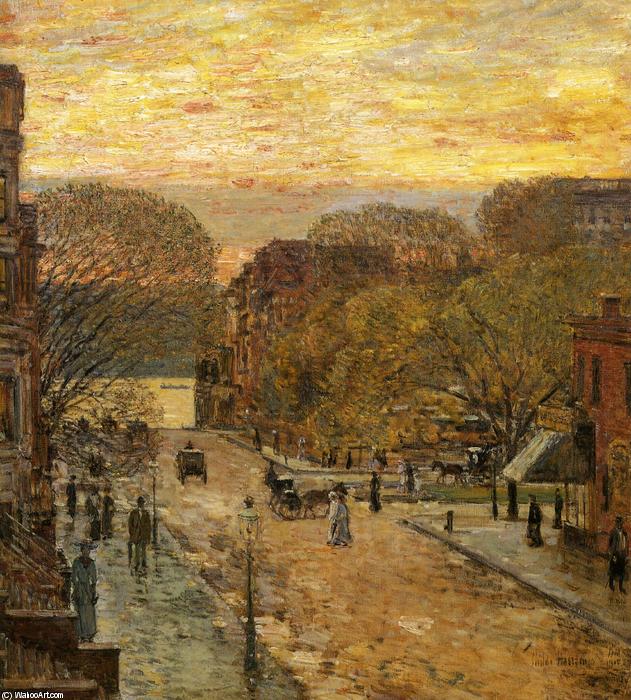
A Twilight Symphony on West 78th Street
In the heart of New York City, amidst the rhythmic pulse of urban life, Frederick Childe Hassam captured a moment of profound serenity in his 1905 masterpiece, Spring on West 78th Street. This exquisite oil on canvas serves as a window into a bygone era, inviting the viewer to wander through a bustling Manhattan street at the precise moment when the day begins to surrender to the evening. As the sun dips below the horizon, it bathes the cityscape in a warm, amber glow, transforming a common metropolitan thoroughfare into a stage for a quiet, impressionistic drama. The painting is not merely a depiction of a location, but an emotional resonance of that fleeting, golden hour when the frantic energy of the city softens into a contemplative twilight.
Hassam, a pioneer of American Impressionism, utilizes his signature technique to breathe life into the urban landscape. Rather than focusing on sharp, clinical details, he employs bold, rhythmic brushstrokes that allow light and movement to merge. The composition is masterfully layered; in the foreground, the presence of a small dog and scattered pedestrians provides an intimate connection to the scene, while the middle ground reveals the historical charm of a horse-drawn carriage navigating the street. The inclusion of bicycles—one near the center and another toward the right—acts as a subtle nod to the evolving technology and changing pace of life at the turn of the century. Through his use of vibrant, warm tones, Hassam captures the way light interacts with the atmosphere, creating a sense of depth and luminosity that feels almost palpable.
The Essence of Urban Impressionism
Beyond its visual beauty, Spring on West 78th Street embodies the historical transition of the American metropolis. The painting functions as a nostalgic tapestry, weaving together elements of tradition and modernity. The horse-drawn carriage represents the lingering echoes of the past, while the bicycles and the growing density of the crowd hint at the accelerating momentum of the twentieth century. This juxtaposition creates a rich narrative texture, making the artwork a profound study of time and progress. For the collector or interior designer, this piece offers more than just decoration; it provides a sophisticated focal point that brings a sense of historical weight and cultured elegance to any space.
The emotional impact of the work lies in its ability to find peace within chaos. Despite the "busy surroundings" mentioned in its historical accounts, there is an undeniable stillness found in the way the sunset settles over the figures. It is a celebration of the everyday—the simple act of walking through a city, the shared experience of a beautiful evening, and the transient beauty of light. For those seeking to adorn their homes or galleries with art that inspires tranquility and wonder, this reproduction of Hassam’s vision offers an enduring connection to the soul of New York City, making it a timeless addition to any curated collection.