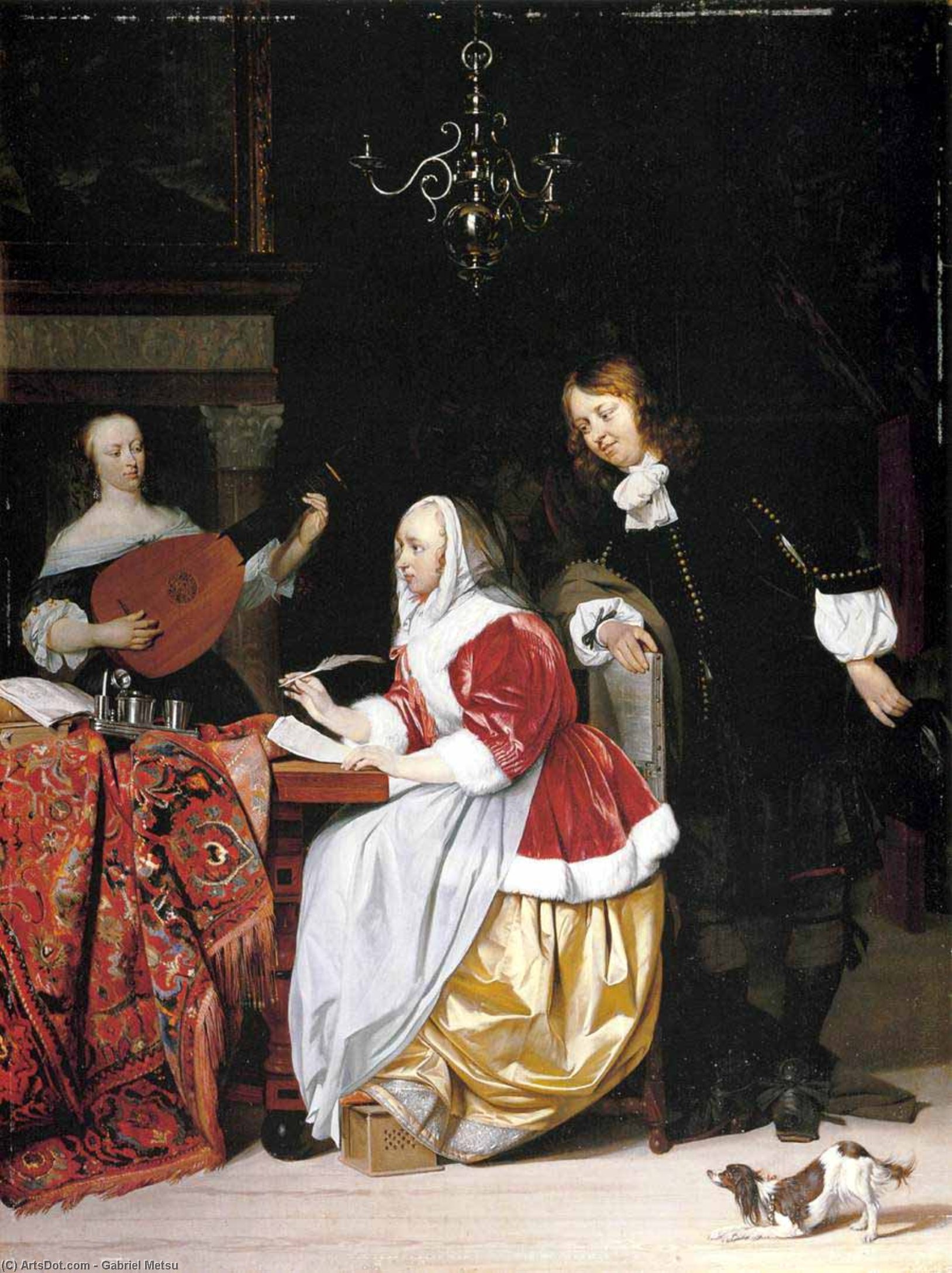
A Moment Frozen in Time: Gabriel Metsu’s “A Young Woman Composing Music”
Gabriel Metsu's "A Young Woman Composing Music," painted around 1662-1663, isn’t merely a depiction of a scene; it’s a carefully constructed tableau brimming with quiet observation and subtle symbolism. This intimate interior painting, now housed in the Mauritshuis museum in The Hague, offers a rare glimpse into the domestic life of 17th-century Holland – a world of refined leisure and intellectual pursuits. Metsu, an artist known for his eclectic style and masterful use of light and shadow, eschewed grand historical narratives or dramatic portraits, instead focusing on capturing fleeting moments of everyday existence with remarkable precision.
The central figure, a young woman seated at a table, is immediately captivating. She’s not actively performing, but rather lost in the act of composing music – her hand poised above a lute, a look of intense concentration etched upon her face. Metsu's skill lies in his ability to convey emotion through subtle gestures and expressions; here, it’s the quiet intensity of creative engagement that dominates. Beside her stands a man, seemingly observing her work with a thoughtful expression – perhaps a patron, a fellow musician, or simply a companion. The inclusion of this secondary figure adds a layer of narrative complexity, hinting at a shared experience and a connection between the two individuals.
The Baroque Interior: Light, Shadow, and Atmosphere
Metsu’s mastery of Baroque techniques is evident in every detail of the painting. He employs a masterful use of chiaroscuro – the dramatic contrast between light and shadow – to create a sense of depth and atmosphere. The room itself is bathed in soft, diffused light that seems to emanate from an unseen window, casting long shadows across the table and highlighting the textures of the furniture and fabrics. This careful manipulation of light not only adds visual interest but also contributes to the painting’s overall mood of intimacy and contemplation.
Notice, too, the meticulous rendering of the objects within the room: a partially consumed meal on the table, a book resting open, a musical instrument awaiting its player. These seemingly insignificant details are rendered with astonishing realism – a testament to Metsu's keen eye for observation and his ability to capture the essence of everyday life. The inclusion of a dog near the woman adds a touch of domesticity and warmth to the scene.
Symbolism and Interpretation
Beyond its realistic depiction, “A Young Woman Composing Music” is rich in symbolic meaning. The lute itself represents musical creativity and intellectual pursuit. The book suggests learning and knowledge, while the meal hints at sustenance and comfort. The presence of the dog – often associated with fidelity and loyalty – could symbolize the enduring nature of artistic inspiration or perhaps a connection between the woman and her companion.
Interestingly, Metsu frequently incorporated emblems into his paintings, drawing upon the rich tradition of visual symbolism found in emblem books. This practice added layers of meaning to his works, inviting viewers to interpret them on multiple levels. The painting’s composition itself can be seen as an emblem – a carefully arranged arrangement of objects and figures that conveys a specific message or idea.
A Legacy of Quiet Observation
Gabriel Metsu's “A Young Woman Composing Music” is more than just a pretty picture; it’s a profound meditation on the nature of creativity, companionship, and the beauty of everyday life. His ability to capture fleeting moments with such sensitivity and detail has secured his place as one of the most important artists of the Dutch Golden Age. Reproductions of this captivating work offer a chance to bring this intimate scene into your own home, inviting you to pause, reflect, and appreciate the quiet elegance of Metsu’s vision.