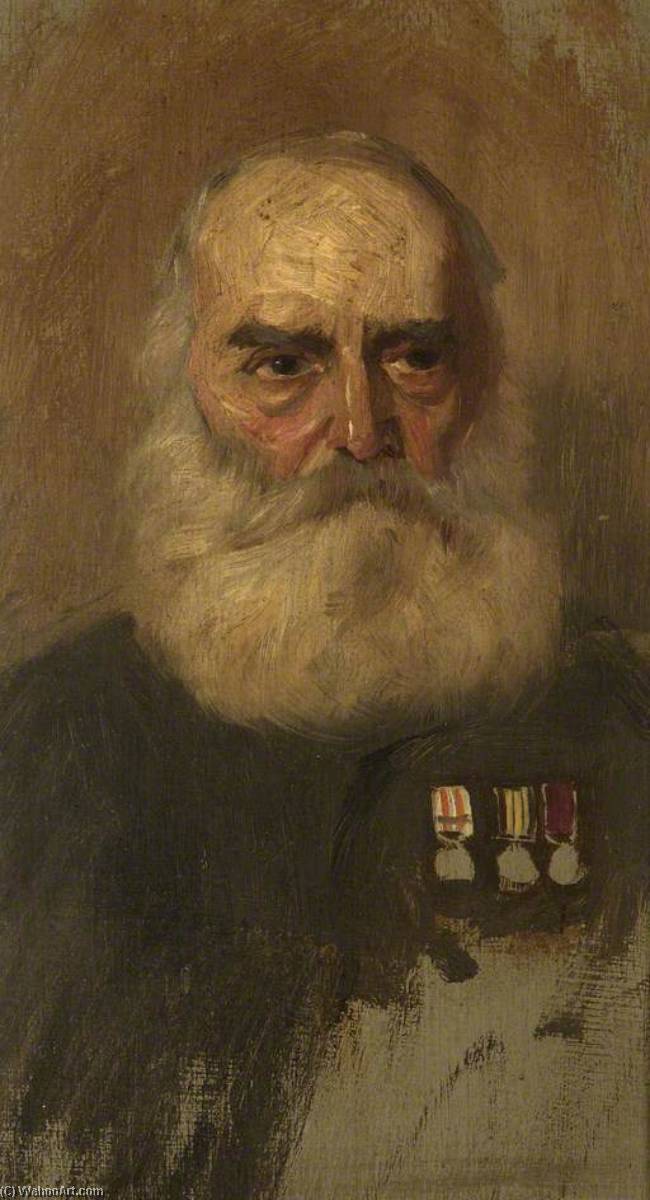
A Portrait of Dignified Resilience: George Edmund Butler’s Rifle Brigade Veteran
George Edmund Butler's 1920 oil painting, “W. Puttick, Rifle Brigade,” is more than just a likeness; it’s a poignant meditation on duty, honor, and the enduring spirit forged in the crucible of war. The work depicts Lieutenant General Sir Edward Puttick, a distinguished officer who served with distinction during both World War I and II, as an elderly veteran, his face etched with the quiet wisdom accumulated through years of service. Butler’s masterful execution captures not merely the physical appearance of a man but also the palpable weight of experience – a dignified resilience that speaks volumes beyond mere portraiture.
The painting immediately draws the eye to Puttick's face, rendered in a remarkably realistic style characterized by meticulous attention to detail. Butler skillfully employs visible brushstrokes, lending texture and depth to the skin, capturing the subtle nuances of wrinkles and the reflective quality of his eyes. The lighting is directional, casting shadows that accentuate the contours of his features and highlighting the strong lines of his jawline. This careful manipulation of light and shadow imbues the portrait with a sense of gravitas, suggesting both strength and vulnerability.
The Language of Military Symbolism
Beyond its technical brilliance, “W. Puttick, Rifle Brigade” is rich in symbolic elements that speak to the officer’s military career and the era in which it unfolded. Prominently displayed on his uniform are medals – a testament to his bravery and leadership during wartime. These aren't merely decorative; they represent years of service, battles fought, and sacrifices made. The presence of these awards subtly elevates the portrait beyond a simple likeness, transforming it into a visual chronicle of a life dedicated to duty.
The Rifle Brigade’s cap badge, visible in the painting, further reinforces this connection to military history. The Rifle Brigade, originally formed as sharpshooters and scouts, was renowned for its distinctive green uniforms and its role in numerous conflicts throughout the 19th and early 20th centuries. Butler's choice of depicting Puttick within this context underscores his allegiance to a storied regiment with a proud legacy.
A Window into Wartime New Zealand
The painting’s creation occurred during a pivotal moment in New Zealand’s history – the First World War. George Edmund Butler, an expatriate from England who had settled in New Zealand, found himself thrust into the role of official war artist for the New Zealand Expeditionary Force (NZEF). This commission provided him with a unique opportunity to document the experiences of his adopted homeland and its soldiers. “W. Puttick, Rifle Brigade” is therefore not simply a portrait; it’s a window into the realities of wartime service in New Zealand.
Butler's decision to focus on a veteran like Puttick highlights the importance of honoring those who had served their country. The painting serves as a reminder of the sacrifices made by ordinary men during times of conflict, and offers a poignant reflection on the enduring impact of war on individuals and communities. It’s a testament to Butler’s ability to capture not just outward appearances but also the inner lives of his subjects.
A Legacy of Skill and Sentiment
“W. Puttick, Rifle Brigade” is a remarkable example of early 20th-century portraiture – a synthesis of technical skill, symbolic resonance, and emotional depth. Butler’s meticulous attention to detail, combined with his ability to convey the subject's character and experience, results in a work that is both visually compelling and profoundly moving. The painting stands as a testament to the artist’s talent and offers a valuable glimpse into a significant period of New Zealand history.