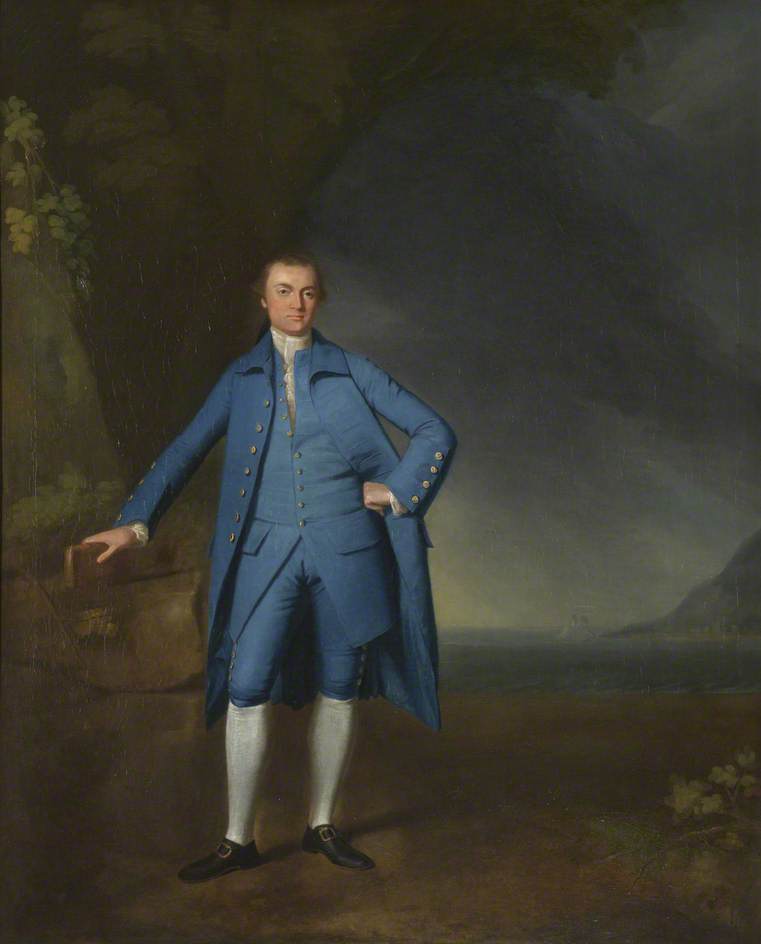
A Portrait of Power and Grace: George Romney’s Captain Robert Banks
George Romney's "Captain Robert Banks (b.1734)," painted in 1760, is more than just a likeness; it’s a carefully constructed tableau of status, ambition, and the burgeoning confidence of Georgian England. This captivating portrait offers a glimpse into the life of a prominent naval officer, rendered with Romney's signature blend of meticulous detail and subtle psychological insight. The painting immediately draws the eye to Banks himself – a man of commanding presence despite his relatively youthful appearance. His posture is upright, almost regal, suggesting authority and responsibility, while his hands rest confidently on his hips, projecting an air of self-assuredness.
Romney’s masterful technique reveals a deep understanding of light and shadow, creating a remarkably three-dimensional effect. The rich blue of Banks' coat is expertly rendered, reflecting the ambient light and highlighting the texture of the fabric. Notice how Romney uses subtle gradations to model the form of his face – the delicate curve of his cheekbone, the slight furrow in his brow, all contributing to a sense of realism that transcends mere representation. The background landscape, though somewhat generalized, provides context—a distant view of rolling hills and trees hinting at Banks’s connection to the land and perhaps even suggesting naval voyages undertaken on the coast.
The Man Behind the Portrait: Context and Character
Captain Robert Banks was a significant figure in British maritime history. Born into a wealthy family, he rose through the ranks of the Royal Navy, serving with distinction during the Seven Years’ War. Romney's portrait captures him at a pivotal moment – likely shortly after his promotion to captain, signifying both professional achievement and social standing. The inclusion of details like the elaborate lace collar and the finely crafted buttons on his coat underscore his wealth and status within Georgian society.
Furthermore, Banks’s appearance—his neatly trimmed wig, the carefully chosen attire—reflects the prevailing fashion trends of the time. Romney skillfully integrates these elements into the portrait, creating a believable representation of a man deeply embedded in his social milieu. Researching Banks reveals he was known for his sharp wit and political acumen, suggesting that Romney may have aimed to capture not just Banks’s physical appearance but also his personality – a shrewd and capable leader.
Rococo Refinement: Style and Technique
“Captain Robert Banks” is firmly rooted in the Rococo style, which flourished during the mid-18th century. Characterized by its elegance, grace, and emphasis on decorative detail, Rococo painting sought to evoke a sense of pleasure and refinement. Romney’s work exemplifies these qualities perfectly – observe the delicate brushstrokes, the subtle use of color, and the overall sense of lightness and airiness. The composition itself is carefully balanced, with Banks occupying a central position within a shallow space, drawing the viewer's eye directly to his face.
Romney’s training under Christopher Steele in Paris undoubtedly influenced his style. He adopted many of Steele’s techniques—particularly his ability to capture fleeting expressions and convey subtle emotions—while developing his own distinctive approach characterized by a greater emphasis on realism and psychological depth. Romney's portraits were immensely popular during his lifetime, commissioned by wealthy patrons eager to immortalize themselves and their families.
A Window into Georgian Society: Symbolism and Emotion
Beyond its technical brilliance, “Captain Robert Banks” offers a valuable window into the social and cultural values of Georgian England. The portrait speaks volumes about the importance of status, wealth, and military achievement in this era. However, Romney’s skill lies not just in depicting these external markers but also in conveying the subject's inner character. There is an undeniable sense of dignity and self-possession radiating from Banks’s image – a quiet confidence that suggests both strength and vulnerability.
The painting invites us to contemplate the life of this remarkable man, imagining his experiences at sea, his political dealings, and his personal relationships. It's a testament to Romney’s ability to transform a simple portrait into a compelling narrative—a lasting tribute to Captain Robert Banks and a captivating example of Georgian artistry.