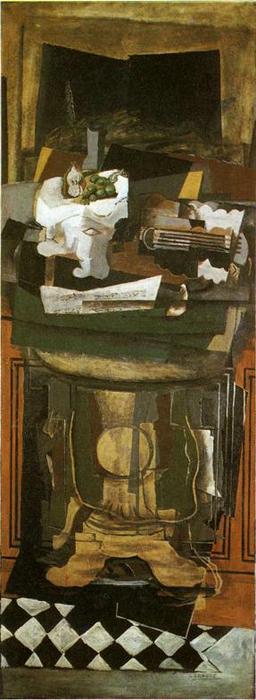
Georges Braque’s Analytical Cubism masterpiece captures quiet elegance with fragmented forms—a guitar, fruit bowls, and books—reflecting the intellectual debates of 1920s Paris. Explore this iconic artwork and bring modern art history into your home.
A Fragment of Modern Elegance: Georges Braque’s ‘Guitar and Still Life on a Guéridon’
Georges Braque's “Guitar and Still Life on a Guéridon” (1922) stands as a testament to the transformative power of Cubism, simultaneously embracing its radical geometric exploration while subtly grounding itself in the traditions of Neoclassical composition. Painted during Braque’s pivotal period alongside Pablo Picasso—a collaboration that irrevocably shaped the course of 20th-century art—this artwork transcends mere representation; it invites contemplation on perception and materiality. The muted palette, dominated by earthy browns and ochres, contributes to an atmosphere of quiet solemnity, mirroring the contemplative mood evoked by Braque’s masterful handling of texture.
- Subject Matter: The centerpiece is a guéridon—a diminutive French side table—upon which rests a guitar alongside several books and bowls filled with fruit. These objects are not depicted in realistic detail but rather fragmented into interlocking planes, characteristic of Braque’s Cubist approach.
- Style & Technique: Braque employed the innovative technique of Analytical Cubism, meticulously dissecting forms into geometric shapes—cubes, cylinders, and cones—that overlap and intersect to create a composite image. The artist utilized oil paint mixed with sand – a groundbreaking method that introduced a tactile element into painting, enhancing the visual depth and simulating the appearance of polished surfaces.
The historical context surrounding “Guitar and Still Life on a Guéridon” is inextricably linked to the burgeoning artistic debates of the early 1920s. Following Picasso’s initial foray into Cubism—specifically ‘Les Demoiselles d'Avignon’—Braque refined and disseminated the movement’s principles, establishing it as a dominant force in European art. This painting reflects the broader intellectual currents of the time, grappling with ideas about simultaneity and multiple viewpoints – concepts central to Einstein’s theories of relativity.
Symbolism & Emotional Impact:
Beyond its formal innovations, “Guitar and Still Life on a Guéridon” possesses an understated emotional resonance. The guitar symbolizes musical expression and contemplation, while the books represent knowledge and intellectual curiosity. The carefully arranged objects convey a sense of order amidst apparent chaos—a visual metaphor for the artist’s exploration of perception and reality. Braque's deliberate use of color and texture invites viewers to engage in a dialogue with the artwork, prompting reflection on its aesthetic qualities and conceptual significance.
- Material & Reproduction: A high-quality reproduction captures the subtle nuances of Braque’s original canvas—the grainy surface created by sand incorporation—allowing collectors and interior designers alike to appreciate the artist's meticulous craftsmanship.