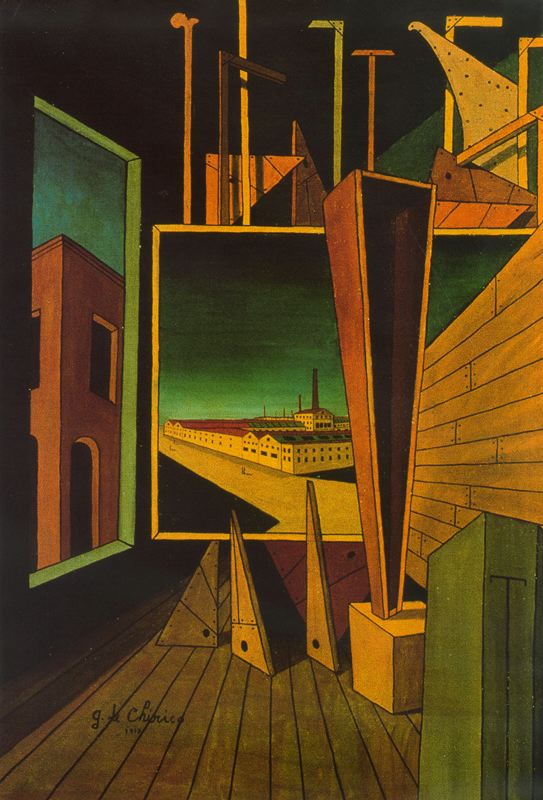
This enigmatic painting by Giorgio de Chirico embodies the essence of Metaphysical art, featuring a stark factory landscape juxtaposed against angular geometric forms. Influenced by Nietzsche and Schopenhauer’s philosophies, it captures a dreamlike atmosphere and explores themes of isolation and absence.
A Dreamscape of Industry: Exploring Giorgio de Chirico’s Geometric Vision
Giorgio de Chirico's “Geometric Composition with Industrial Landscape,” painted in 1917, stands as a cornerstone of Metaphysical Art—a movement that irrevocably altered the course of twentieth-century painting and profoundly influenced Surrealism. More than just a depiction of an industrial setting, this artwork delves into the subconscious mind, presenting a meticulously crafted illusion designed to unsettle and provoke contemplation.
- Subject Matter: The canvas captures a starkly rendered factory interior bathed in muted browns and greens. Dominating the scene is a towering clock tower—a recurring motif in de Chirico’s oeuvre—symbolizing time's relentless march and hinting at an inescapable past. Alongside it stretches a bridge overlooking a tranquil body of water, creating a paradoxical juxtaposition between urban decay and serene stillness.
- Style & Technique: De Chirico employed a distinctive geometric style characterized by flattened planes and angular lines. The artist meticulously constructed the composition using precise mathematical ratios—a deliberate rejection of Impressionistic spontaneity—to achieve an unsettling sense of spatial ambiguity. Thick brushstrokes contribute to textural depth, emphasizing the materiality of the industrial landscape while simultaneously conveying a feeling of isolation.
- Historical Context: Created during the turbulent years leading up to World War I, “Geometric Composition with Industrial Landscape” reflects the anxieties and disillusionment prevalent in European intellectual circles at the time. De Chirico’s fascination with Nietzschean philosophy—particularly concepts of eternal recurrence and the will to power—permeates his artistic vision. The painting embodies a desire to escape rational thought and confront primal instincts.
- Symbolism: The clock tower, as mentioned earlier, serves as a potent symbol of time's passage and mortality. However, its presence alongside the tranquil water suggests an underlying tension between order and chaos—a preoccupation with de Chirico’s exploration of psychological states. Furthermore, the solitary figure positioned near the center embodies existential loneliness and questions about identity.
- Emotional Impact: Viewing “Geometric Composition with Industrial Landscape” evokes a palpable sense of unease and disorientation. The artist skillfully manipulates perspective and color to create an atmosphere that feels both familiar and profoundly unsettling—a hallmark of Metaphysical Art’s aim to bypass conscious awareness and tap into the realm of dreams and subconscious desires.
This artwork's enduring appeal lies in its ability to transcend mere representation, inviting viewers to engage in a dialogue with their own inner landscapes. Its meticulous geometric construction and evocative symbolism continue to inspire artists and collectors alike—a testament to Giorgio de Chirico’s genius as a pioneer of Surrealist thought.