Unveiling the Enigma: Giorgio de Chirico’s “Untitled (6713)”
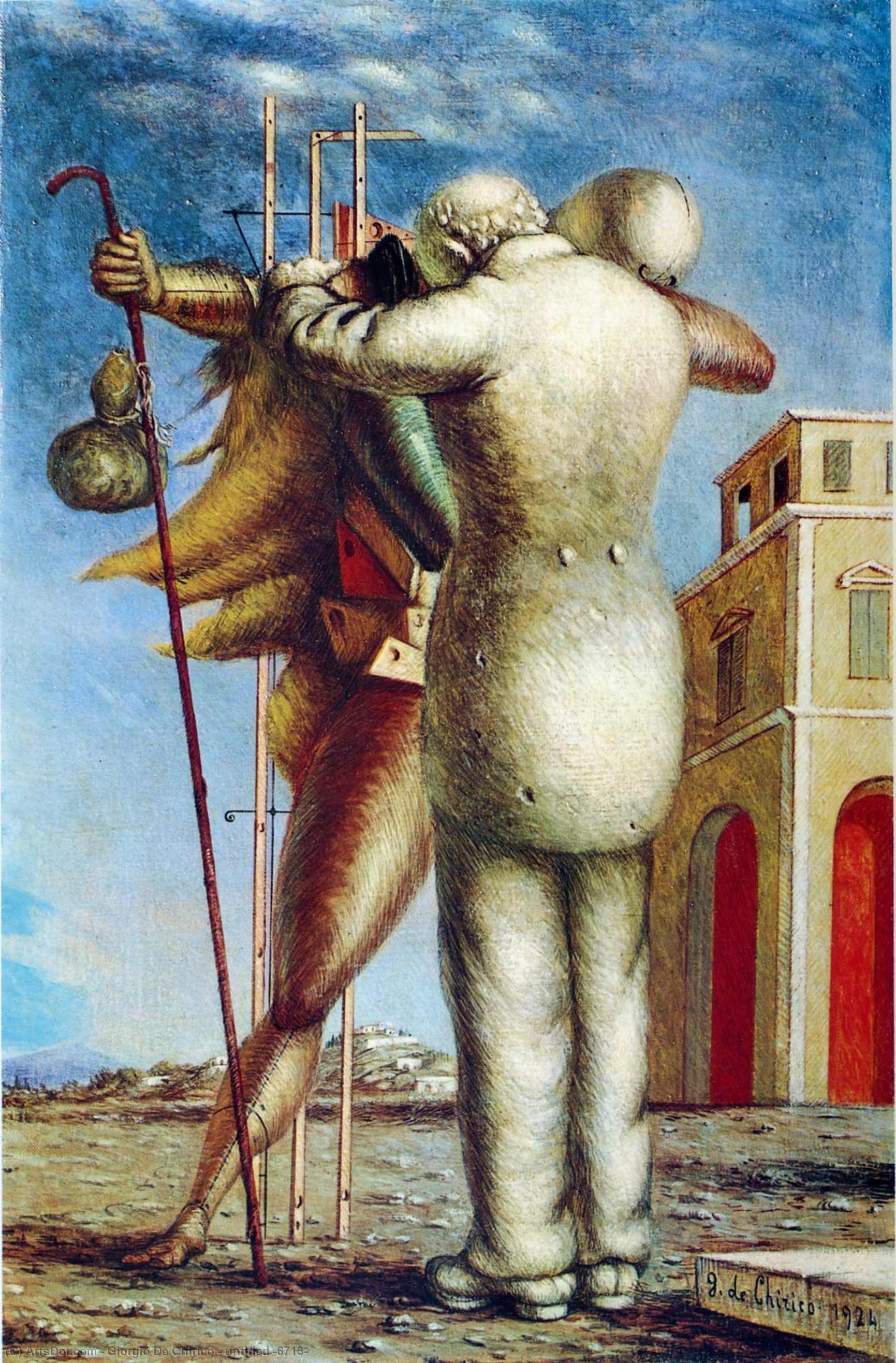
Giorgio de Chirico's "Untitled (6713)" is not merely a depiction of two men; it’s an immersion into the unsettling realm of the subconscious, a quintessential example of the artist’s groundbreaking metafisica movement. Painted in stark black and white, the artwork immediately arrests the viewer with its disquieting stillness and ambiguous narrative. The scene unfolds on what appears to be a European street – likely Rome, given de Chirico's frequent depictions of the city – yet it feels utterly detached from time and place, existing as a dreamscape constructed within the artist’s mind.
- Subject Matter: Two figures engaged in an intimate, almost ritualistic embrace. The posture of one man holding the other's head above his shoulders evokes vulnerability and perhaps even a sense of dominance, while their joined bodies suggest a profound connection – or a disturbing tableau of shared isolation.
- Composition: De Chirico masterfully employs geometric forms and unsettling spatial relationships to create a feeling of disorientation. The receding lines of the building, coupled with the strategically placed objects—the umbrellas, handbag, and chair—further contribute to this sense of unease and amplify the painting’s dreamlike quality.
The Metafisica Movement and Existential Angst
Created around 1920, “Untitled (6713)” embodies the core tenets of de Chirico's metafisica – a movement he founded alongside Carlo Carrà and Giorgio Morandi. Rejecting the Impressionistic focus on fleeting moments and optical realism, metafisica sought to capture a deeper, more profound reality—one rooted in memory, emotion, and the unsettling distortions of perception. De Chirico was profoundly influenced by philosophical currents of the time, particularly the writings of Nietzsche and Schopenhauer, which explored themes of alienation, irrationality, and the subjective nature of experience. This is evident in the painting’s starkness and its deliberate rejection of naturalistic representation.
The black and white palette intensifies this effect, stripping away any illusion of color and emphasizing the formal elements – lines, shapes, and textures – to create a heightened sense of drama and psychological tension. The lack of vibrant hues mirrors the emotional void at the heart of the scene, reflecting the anxieties and uncertainties of the modern age.
Symbolism and Emotional Resonance
The symbolism within “Untitled (6713)” remains deliberately ambiguous, inviting multiple interpretations. The umbrellas, for instance, could represent protection from an unseen threat or perhaps a futile attempt to shield oneself from the harsh realities of existence. The handbag suggests a preoccupation with material possessions – a common theme in de Chirico’s work – hinting at the superficiality and emptiness that lie beneath the surface of modern life.
Ultimately, the painting's power lies in its ability to evoke a profound sense of melancholy and disorientation. It taps into our deepest fears about isolation, mortality, and the fragility of human connection. The figures’ closed-off postures and the unsettling atmosphere contribute to a feeling of profound loneliness – a hallmark of de Chirico’s artistic vision.
Technique and Legacy
De Chirico's technique is characterized by precise draftsmanship and meticulous attention to detail, combined with an expressive use of line and shadow. He employed oil paints on canvas, layering thin glazes to achieve a luminous effect and creating dramatic contrasts between light and dark. The painting’s starkness is achieved through careful control of tonal values, further emphasizing the unsettling atmosphere.
“Untitled (6713)” stands as a pivotal work in the history of 20th-century art, profoundly influencing Surrealist artists like Salvador Dalí. De Chirico's exploration of dreamlike imagery and psychological themes continues to resonate with viewers today, solidifying his place as one of the most important and enigmatic figures in modern art.