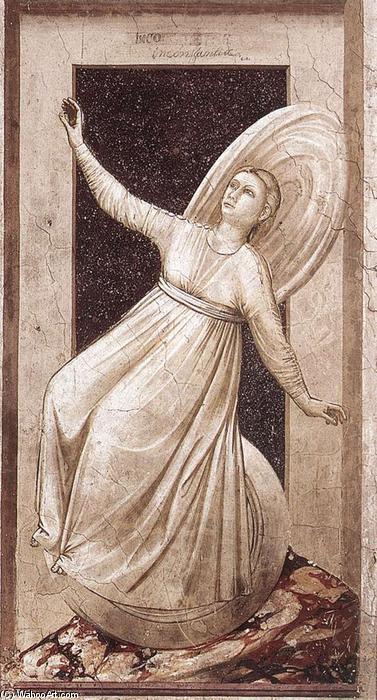
A Window into Medieval Morality: Exploring Giotto’s “Inconstancy”
Giotto di Bondone's "No. 52 The Seven Vices: Inconstancy," painted in 1306, stands as a monumental achievement of early Renaissance art and a poignant reflection of its time. Located within the Cappella Scrovegni (Arena Chapel) in Padua, Italy—a chapel commissioned by Enrico Scrovegni to commemorate his deceased family—this fresco transcends mere visual representation; it embodies a profound moral lesson rooted in Christian theology.
The artwork depicts a woman poised mid-flight, arms outstretched against a turbulent backdrop. Her posture conveys both vulnerability and dynamism, capturing the essence of “inconstancy,” one of the seven vices depicted alongside virtues within the chapel’s expansive cycle. Giotto's masterful use of perspective—revolutionary for its era—creates an illusionistic space that draws viewers into the scene, immersing them in a dramatic narrative.
Technical Innovation and Artistic Vision
Giotto’s genius lay not only in his spatial realism but also in his ability to imbue figures with palpable emotion. Unlike the stylized depictions prevalent in Byzantine art, Giotto achieved unprecedented psychological depth through expressive facial features and gestures. He skillfully employed tempera paint on plaster—a technique that allowed for luminous colors and subtle gradations—resulting in a breathtaking visual experience.
The Cappella Scrovegni itself represents an extraordinary feat of architectural ambition. Constructed between 1303 and 1305, it’s adorned with frescoes by Giotto and Taddeo Gaddi that illustrate biblical stories and moral precepts. The chapel's walls are covered in vibrant pigments—a testament to the artistic prowess of the period.
Symbolism and Spiritual Significance
"Inconstancy," as represented here, symbolizes a fundamental flaw within human nature – the tendency to abandon commitments and succumb to fleeting desires. Alongside this vice is depicted fortitude, representing steadfastness and resilience—a counterpoint that underscores the chapel’s overarching message of redemption and moral reform.
Giotto's influence extended far beyond Padua. His frescoes in the Scrovegni Chapel profoundly impacted subsequent artists, establishing a new standard for naturalism and emotional expression. Viewing “No. 52 The Seven Vices: Inconstancy” today offers an unparalleled glimpse into the artistic sensibilities of the early Renaissance—a period marked by a burgeoning interest in human experience and a desire to convey spiritual truths with unwavering conviction.
To explore this remarkable artwork further, visit No. 52 The Seven Vices: Inconstancy by GIOTTO di Bondone and discover more about the Cappella Scrovegni museum at www.cappelladegliscrovegni.it.