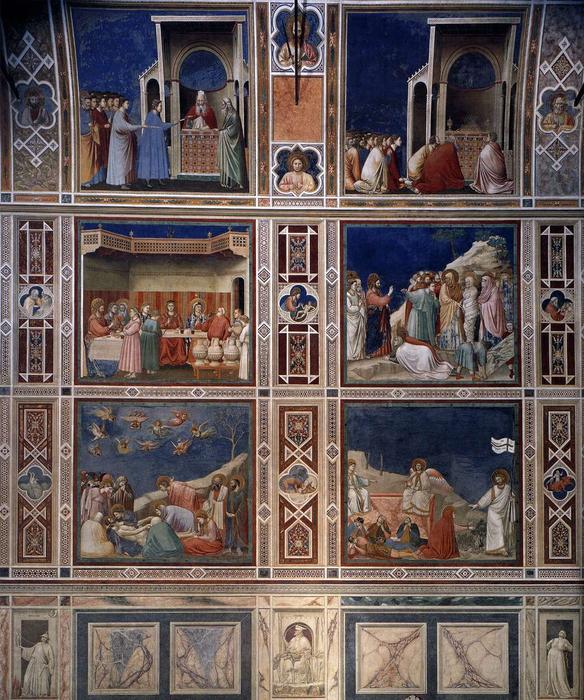
A Renaissance Dawn: Unveiling Giotto’s “Scenes with Decorative Bands”
“Scenes with Decorative Bands,” created in 1304 by the Italian master
Giotto di Bondone, is far more than a decorative fresco; it's a pivotal moment in Western art history. Part of the breathtaking cycle adorning the walls of the Cappella Scrovegni (Arena Chapel) in Padua, Italy, this work embodies Giotto’s revolutionary approach to painting and storytelling. Commissioned by Enrico Scrovegni as an act of piety and atonement, the chapel itself is a testament to faith and artistic patronage.
Decoding the Composition
The painting presents a dynamic arrangement of figures – individuals engaged in everyday actions: sitting, standing, walking, conversing. These aren’t static representations; Giotto masterfully creates depth through varied positioning, some figures closer to the viewer, others receding into the background. This deliberate layering and spatial awareness were groundbreaking for their time. The “decorative bands” themselves are not merely ornamental but serve as visual dividers, organizing the narrative flow while adding a layer of aesthetic richness. While seemingly simple in subject matter – scenes from daily life interwoven with religious narratives – the composition’s complexity lies in its ability to convey human interaction and emotion within a defined space.
Giotto's Revolutionary Technique
Giotto departed dramatically from the prevailing Byzantine style, characterized by flat, stylized figures and gold backgrounds. He embraced
naturalism, striving for realistic depictions of anatomy, drapery, and emotion. His use of
chiaroscuro – the interplay of light and shadow – gives his figures volume and weight, making them appear remarkably lifelike. Executed in fresco—pigments applied to wet plaster—the technique demanded speed and precision, a testament to Giotto’s skill and planning. The fresco medium itself contributes to the work's enduring quality and subtle textural nuances.
Historical & Religious Significance
The Cappella Scrovegni wasn’t simply a place of worship; it was a visual sermon. Giotto’s frescoes narrate the lives of Mary and Christ, from the Annunciation to the Resurrection, offering a comprehensive theological program for medieval viewers. Enrico Scrovegni's motivations were complex – seeking divine forgiveness while simultaneously showcasing his wealth and status. The chapel stands as a powerful symbol of this intersection between faith, art, and social ambition. Giotto’s work within this context elevated fresco painting to an unprecedented level of artistic expression.
Symbolism & Emotional Resonance
Beyond the literal depiction of biblical events, “Scenes with Decorative Bands” is rich in symbolism. Gestures, clothing, and architectural details all carry specific religious meanings understood by contemporary audiences. More importantly, Giotto infused his figures with genuine
emotion. Joy, sorrow, fear, and piety are palpable in their expressions and body language – a radical departure from the detached formality of earlier art. This emotional depth is what truly connects viewers to the narrative, making it relatable even centuries later.
A Lasting Legacy & Interior Inspiration
Giotto’s innovations laid the foundation for the Renaissance. His emphasis on naturalism, perspective, and human emotion profoundly influenced generations of artists, including Masaccio, Michelangelo, and Leonardo da Vinci. Today, “Scenes with Decorative Bands” continues to inspire awe and admiration. For interior designers, a high-quality reproduction offers a timeless focal point, bringing a touch of Renaissance elegance and spiritual depth to any space. The fresco’s muted color palette—blues, greens, and ochres—lends itself well to both traditional and contemporary settings, creating an atmosphere of serene contemplation and artistic refinement. It's a piece that invites conversation, reflection, and a deeper appreciation for the power of art.
- Style: Proto-Renaissance, Gothic
- Technique: Fresco
- Period: 1304
- Location: Cappella Scrovegni, Padua, Italy