A Moment Frozen in Harlem’s Soul
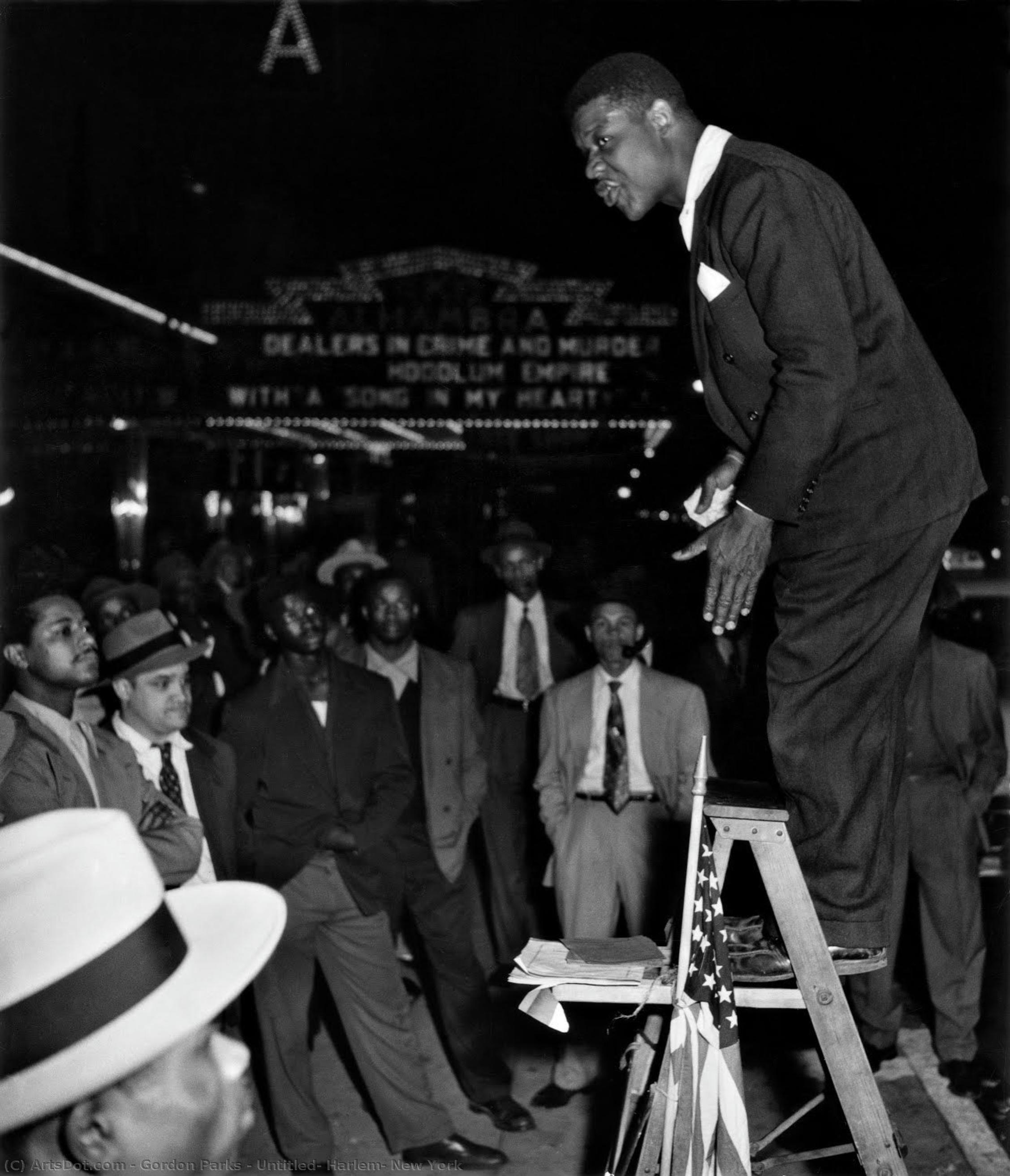
Gordon Parks' "Untitled, Harlem, New York" (1952) isn’t merely a photograph; it’s a distilled essence of an era and a community – a poignant snapshot of resilience captured within the stark contrasts of black and white. Taken during his time documenting poverty and social injustice for Life magazine, this image transcends its documentary origins to become a powerful meditation on visibility, authority, and the quiet dignity of everyday life in Harlem during the 1950s. The photograph immediately commands attention with its dynamic composition: a man, elevated upon a ladder, addresses a crowd below, his gesture both commanding and slightly hesitant. This central figure isn’t simply delivering a speech; he embodies a point of connection, a conduit between an unseen power and the assembled faces before him.
Parks' masterful use of light and shadow is crucial to the image’s impact. The strong overhead lighting casts deep shadows across the crowd, partially obscuring their features and creating a sense of distance – they are observers rather than participants in this particular moment. This deliberate obscurity invites us to focus on the speaker, highlighting his posture and expression, while simultaneously suggesting a broader narrative of anonymity and marginalization within the community. The photograph’s monochrome palette further emphasizes form and texture; the rough grain of the ladder, the folds of clothing, and the subtle variations in skin tone all contribute to a richly detailed surface that draws the viewer into the scene.
Documentary Style with an Unsettling Edge
Technically, “Untitled, Harlem, New York” firmly resides within the realm of documentary photography. Parks employed a shallow depth of field, prioritizing sharpness in the foreground – specifically the speaker and the ladder – while gently blurring those further back. This technique directs our attention to the central action, creating a sense of immediacy and drawing us into the scene as if we are witnessing this event firsthand. The composition itself is carefully constructed, utilizing diagonal lines created by the ladder and the speaker’s stance to inject dynamism and movement into what could otherwise be a static portrait. However, beneath the surface of straightforward documentation lies an element of surrealism; the man's upward gaze, coupled with the obscured faces in the crowd, evokes a subtle sense of unease – a feeling that something unspoken is simmering beneath the surface of this seemingly ordinary gathering.
Symbolism and Context: A Voice in the Shadows
The photograph’s historical context is inextricably linked to its symbolic weight. Harlem in 1952 was a vibrant, complex neighborhood grappling with issues of racial segregation, economic hardship, and social injustice. Parks' work during this period aimed to shed light on these realities, giving voice to those often overlooked by mainstream media. The speaker atop the ladder can be interpreted as representing authority – perhaps a community leader, a preacher, or simply someone attempting to address the concerns of his neighbors. Yet, his elevated position also suggests a certain distance, a barrier between him and the crowd below. The sign visible behind him likely provided further context for the event, reinforcing the message being conveyed.
A Legacy of Observation and Empathy
“Untitled, Harlem, New York” is more than just a historical document; it’s a testament to Gordon Parks' extraordinary ability to capture human emotion and social realities with profound empathy. The photograph invites us to contemplate the complexities of community engagement, the challenges faced by marginalized communities, and the enduring power of visual storytelling. It remains a potent reminder that even in seemingly fleeting moments, there is often a story waiting to be told – a story of resilience, struggle, and the quiet dignity of the human spirit. Reproductions of this iconic image offer a powerful connection to a pivotal moment in American history and a lasting tribute to Parks’ artistic vision.