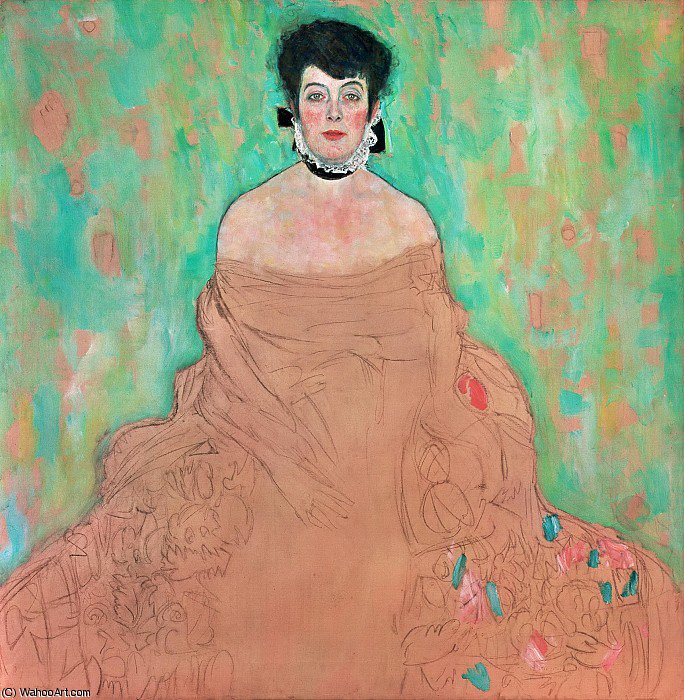
A Portrait of Viennese Society: Unveiling Amalie Zuckerkandl
Gustave Klimt’s *Amalie Zuckerkandl* (1918) is more than just a portrait; it's a captivating glimpse into the opulent world of Vienna’s high society during the twilight years of the Austro-Hungarian Empire. This painting exemplifies Klimt’s mastery of Art Nouveau, showcasing his unique ability to blend decorative beauty with psychological depth. The subject, Amalie Zuckerkandl, was a prominent figure in Viennese cultural circles and the wife of Jewish industrialist Bernhard Zuckerkandl, a patron of Klimt.
Art Nouveau & The Vienna Secession
Klimt was a leading member of the Vienna Secession, an artistic movement that rebelled against the conservative academic traditions of the time. *Amalie Zuckerkandl* embodies the core tenets of Art Nouveau – characterized by flowing lines, organic forms, and a rejection of realistic representation in favor of stylized aesthetics. The painting’s decorative elements aren't merely ornamental; they are integral to conveying Amalie’s personality and social standing. Klimt’s work during this period often explored themes of femininity, sensuality, and the complexities of modern life, all while pushing boundaries within artistic expression.
Technique & Composition: A Symphony of Texture
The painting is remarkable for its rich texture and innovative technique. Klimt employed a heavily impasto style, applying paint in thick layers that create a sculptural quality. This tactile approach draws the viewer into the work, emphasizing the materiality of the medium itself. The vibrant green background provides a striking contrast to Amalie’s attire, while her dress is adorned with intricate patterns and floral motifs – hallmarks of Klimt's decorative style. Notice how the artist uses color not just descriptively but expressively, creating an atmosphere of both elegance and subtle melancholy.
Symbolism & Hidden Meanings
While seemingly a straightforward portrait, *Amalie Zuckerkandl* is imbued with symbolic meaning. The clock visible in the background isn’t merely a timekeeping device; it can be interpreted as a memento mori – a reminder of mortality and the passage of time. This adds a layer of poignancy to the painting, hinting at the fragility of life and beauty. The vase, another carefully placed element, symbolizes refinement and cultural sophistication. The overall composition suggests a woman comfortable in her status but perhaps aware of the changing world around her.
Emotional Resonance & Lasting Impact
*Amalie Zuckerkandl* evokes a sense of quiet dignity and introspective contemplation. The subject’s gaze is direct yet enigmatic, inviting viewers to ponder her thoughts and emotions. Klimt's ability to capture the inner life of his subjects is what sets him apart as a master portraitist. The painting’s emotional impact is amplified by its historical context; created in 1918, it reflects a society on the brink of profound change following World War I. The work stands as a testament to Klimt's artistic genius and continues to captivate audiences with its beauty, complexity, and enduring relevance.
- Style: Art Nouveau, Vienna Secession
- Technique: Oil on canvas, Impasto, Decorative Patterning
- Key Elements: Flowing lines, Organic forms, Symbolic objects (clock, vase)
- Emotional Impact: Dignity, Introspection, Melancholy
This painting is an ideal addition to collections seeking iconic examples of Art Nouveau and Symbolism. Its sophisticated palette and elegant composition make it a stunning focal point for any interior space.