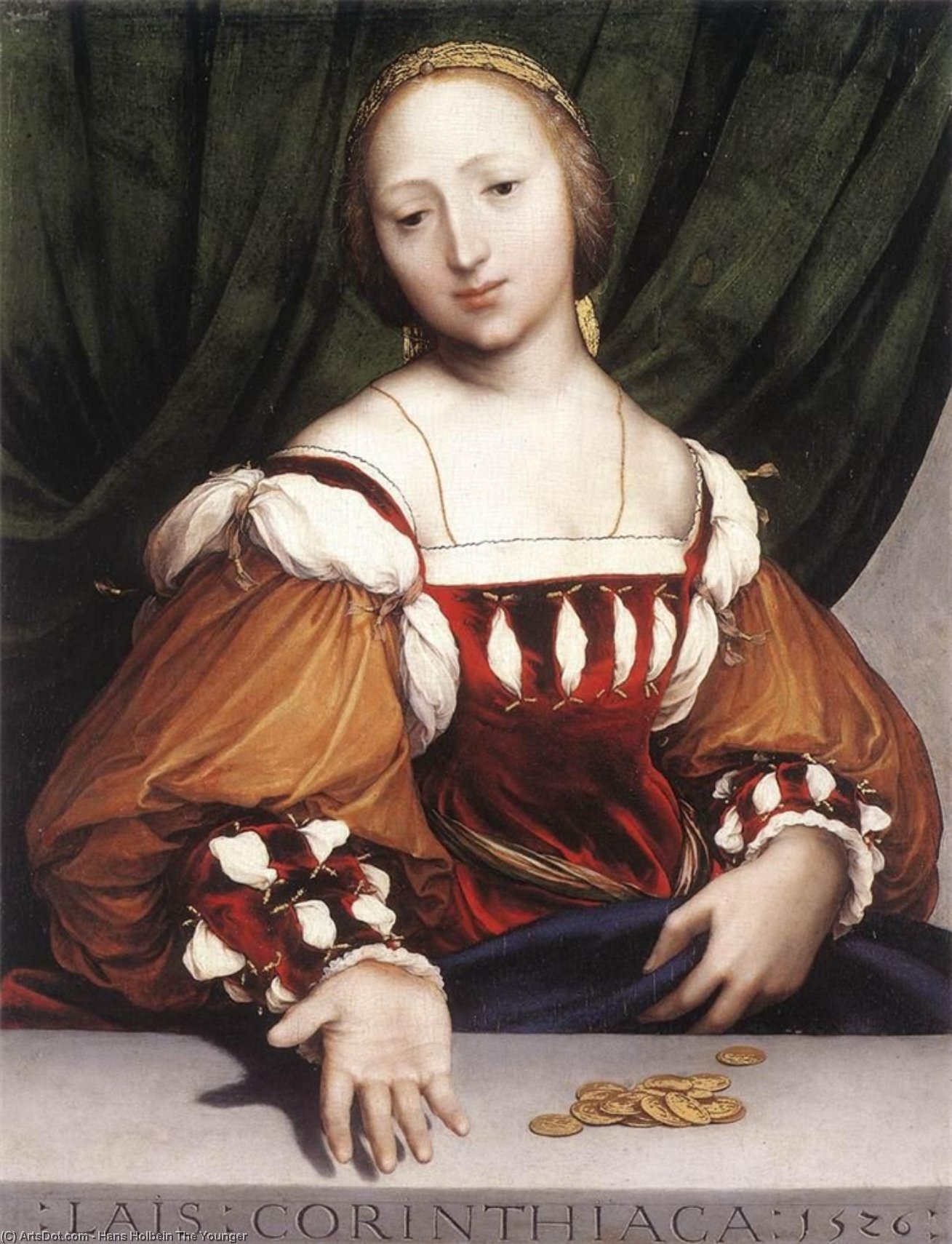
The painting showcases Holbein’s exceptional skill in capturing the essence of his subject—Magdalena Offenburg—through masterful modeling and nuanced expression. Its use of oil on panel allows for rich textures and luminous colors, furthering its impact as a testament to Renaissance artistic innovation.
A Portrait Steeped in Renaissance Sensuality
Hans Holbein the Younger’s “Lais of Corinth,” completed in 1526, stands as a testament to the Northern Renaissance fascination with capturing human emotion and idealized beauty. Currently residing at the Kunstmuseum in St. Gallen, Switzerland, this oil on panel painting transcends mere representation; it embodies a sophisticated dialogue between classical allusion and humanist observation.
Subject Matter: Myth Meets Reality
The artwork depicts Lais of Corinth, a legendary courtesan from ancient Greece famed for her exorbitant fees. More than just a depiction of a celebrated woman, Holbein subtly references Apelles, the renowned painter of antiquity who was said to have been captivated by Lais’s allure—a connection underscored by Holbein's own sobriquet as “Apelles” within humanist circles.
Technical Brilliance: Venetian Influence
Holbein’s masterful technique exemplifies the stylistic innovations emerging from Venice during this period. The artist skillfully employs oil on panel, allowing for unparalleled tonal depth and luminous color—a departure from the more subdued palettes favored by his contemporaries. Notice the meticulous modeling of Magdalena Offenburg's face and hands, mirroring the Venetian tradition of portraying figures with palpable flesh tones and subtle shading effects.
Symbolism: Coins and Contemplation
Beyond its aesthetic qualities, “Lais of Corinth” is laden with symbolic significance. The woman’s outstretched hand holding coins speaks volumes about the transactional nature of beauty and desire—a theme explored extensively in Venetian art alongside references to classical mythology. Holbein's careful composition directs the viewer's gaze towards this gesture, emphasizing its importance within the broader narrative.
Historical Context: Renaissance Ideal
“Lais of Corinth” firmly establishes Holbein’s place within the Northern Renaissance movement—a period characterized by a renewed interest in classical art and humanist thought. Like many portraits commissioned during Henry VIII's reign, it reflects the prevailing cultural values of the time, prioritizing elegance, refinement, and intellectual engagement. Its enduring appeal lies in its ability to convey not only physical likeness but also psychological complexity.