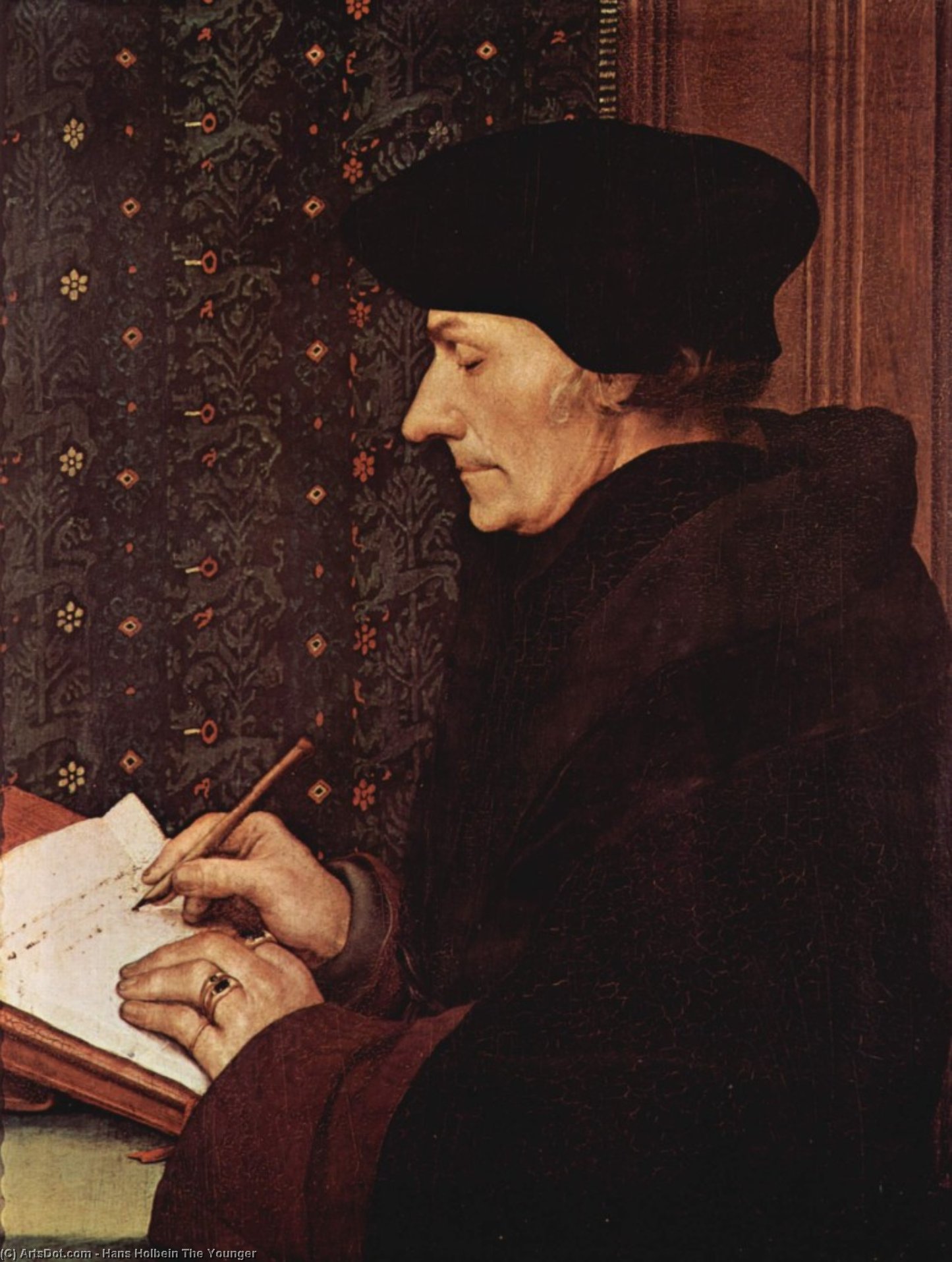
Portrait of Desiderius Erasmus
The
Portrait of Desiderius Erasmus, painted by
Hans Holbein the Younger in 1523, stands as a cornerstone of Renaissance humanism and Northern European artistic achievement. This oil on panel masterpiece measures 32 x 42 cm and embodies the meticulous observation and expressive power characteristic of Holbein’s oeuvre. Its enduring appeal lies not merely in its visual beauty but also in its profound reflection of intellectual ideals prevalent during Erasmus's lifetime.
The Subject: Desiderius Erasmus
Desiderius Erasmus (1466–1536) was a Dutch humanist, Catholic priest, and theologian who profoundly shaped the intellectual landscape of his era. Revered for his critiques of papal authority and unwavering advocacy for ecclesiastical reform, Erasmus commanded respect within scholarly circles across Europe. Holbein’s portrait captures him in a contemplative posture—seated at a desk—surrounded by symbols that illuminate his dedication to scholarship and philosophical inquiry. The artist skillfully conveys Erasmus's inner life through subtle gestures and facial expressions, establishing him as an emblem of humanist thought.
Artistic Elements
The painting is set against a backdrop featuring a delicately patterned wallpaper – a common decorative motif in Renaissance interiors—which lends depth and visual richness to the scene. Two books are prominently displayed: one positioned near the bottom left corner and another resting on the right side. These texts represent Erasmus’s intellectual pursuits, signifying his commitment to classical learning and theological debate. Holbein’s masterful use of chiaroscuro – dramatic contrasts between light and shadow—creates a palpable sense of volume and dimensionality, drawing the viewer into the intimate space of Erasmus's study. The artist’s meticulous attention to detail extends to the rendering of Erasmus’s clothing, capturing the texture and drape of his robe with remarkable accuracy.
Symbolism and Allusions
Holbein infused the portrait with layers of symbolism that resonate beyond its immediate visual representation. The books serve as reminders of Erasmus's contributions to literature and philosophy—his translations of Homer and Virgil were particularly influential—and underscore his role as a champion of humanist ideals. Furthermore, Holbein subtly incorporated a Latin couplet inscribed on the edge of the leaning book: “I am Johannes Holbein, whom it is easier to denigrate than to emulate.” This inscription encapsulates Erasmus’s conviction that originality and authenticity are paramount in artistic endeavor—a sentiment that aligns perfectly with Holbein's own stylistic approach. The inclusion of an empty wine flask symbolizes contemplation and intellectual reflection.
Artistic Style
Holbein’s style is characterized by unparalleled precision and realism, reflecting the humanist spirit of his time. His portraits were renowned for their uncanny likenesses—a testament to his meticulous observation skills and technical mastery—and this painting exemplifies Holbein's ability to convey psychological depth through visual form. The artist’s technique—primarily oil paint on panel—allowed him to achieve luminous colors and subtle tonal gradations, creating an image that is both aesthetically pleasing and intellectually stimulating. Like many of Holbein’s works, it embodies the Renaissance ideal of clarity and elegance, securing its place as one of the most celebrated portraits in European art history.
Legacy
The
Portrait of Desiderius Erasmus resides in the Mauritshuis in The Hague, Netherlands—a testament to its enduring artistic significance. Holbein’s art continues to inspire admiration for its masterful execution and profound psychological insight, demonstrating his unparalleled ability to capture the essence of human character within a framework of refined aesthetic principles. For those seeking inspiration or contemplating acquiring a high-quality reproduction, exploring more of Holbein's masterpieces—such as
Hans Holbein The Younger: Portrait of Desiderius Erasmus and
Hans Holbein The Younger: Portrait of Erasmus of Rotterdam—offers a captivating glimpse into the artistic genius of one of the Renaissance’s most influential figures. To delve deeper into Holbein's life and work, visit
Hans Holbein the Younger on Wikipedia.