A Glimpse into Australian Entomology: Helena Scott’s Bent-Wing Swift Moth
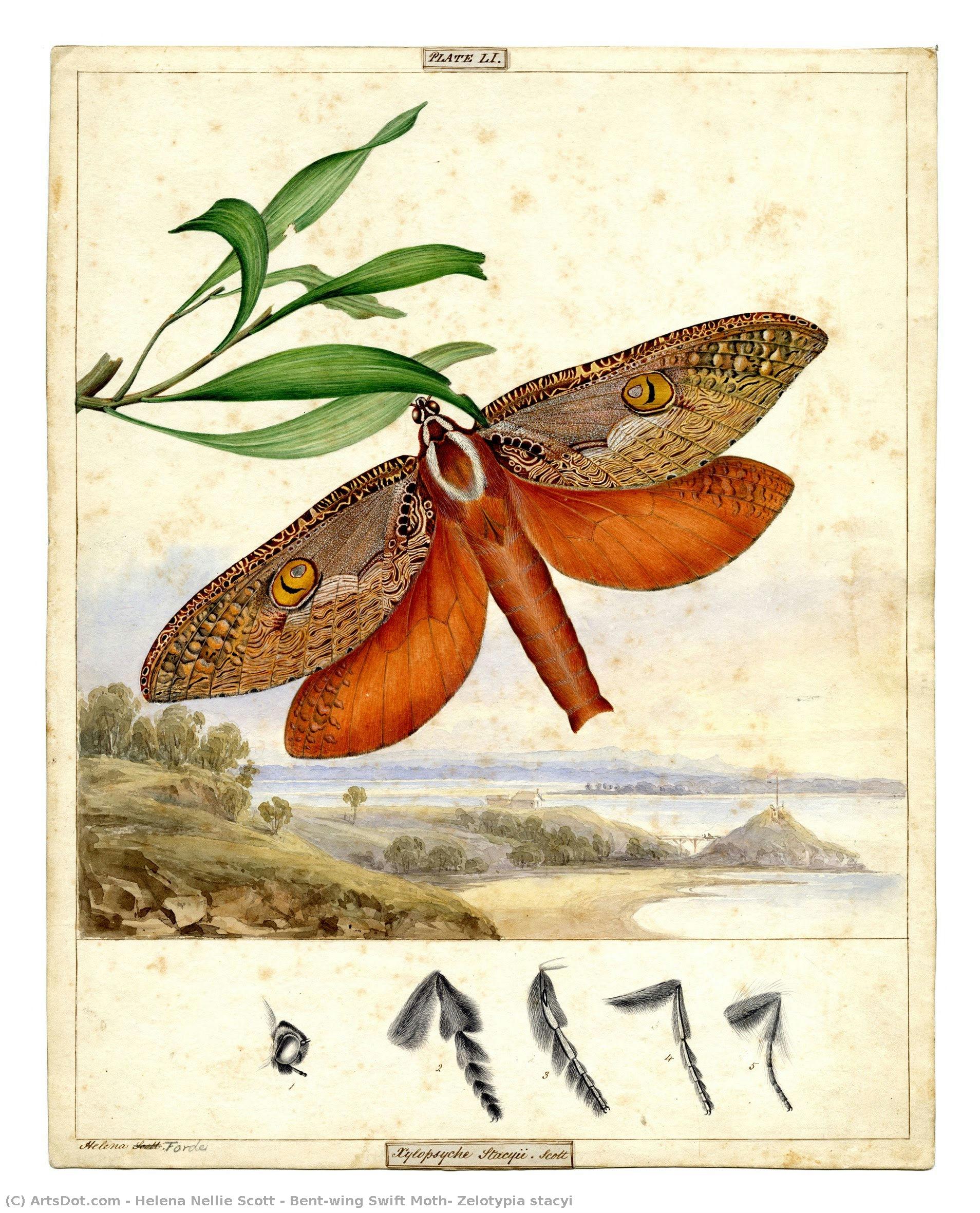
Helena Nellie Scott's 1864 illustration of the Bent-wing Swift Moth, *Zeotypia stacyi*, is more than just a scientific depiction; it’s a window into a bygone era of meticulous observation and artistic dedication. This exquisite botanical artwork, rescued from an unpublished manuscript intended for Alexander Walker Scott’s “Australian Lepidoptera and Their Transformations,” captures the essence of a remarkable entomologist's daughter and her profound connection to the natural world. The image isn’t merely a rendering of an insect; it’s a testament to the Victorian fascination with classification, taxonomy, and the beauty hidden within the smallest details of Australian fauna.
The illustration immediately draws the eye with its remarkably detailed portrayal of the moth itself. Each scale is painstakingly rendered, suggesting a subtle shimmer and texture that belies the fragility of the creature. The intricate veins of the wings are not simply lines but carefully shaded to convey depth and form, while the delicate antennae and legs are depicted with an almost sculptural precision. Beneath the magnificent moth, a larval stage—a plump caterpillar clinging to a leaf—provides crucial context, illustrating the complete life cycle that Scott so diligently documented. The background landscape, a hazy coastal scene punctuated by a recognizable view of Port Macquarie Harbour (attributed to Captain Perry), subtly anchors the scientific study within its geographical and historical setting.
A Style Rooted in Scientific Precision
Scott’s artistic style is distinctly reminiscent of 18th and early 19th-century scientific illustrations—a period characterized by a commitment to accuracy and an avoidance of overt emotional expression. The composition is vertically oriented, prioritizing clarity and legibility. Lines are precise and carefully drawn, defining shapes with unwavering confidence. The use of hatching and cross-hatching creates subtle shading and depth, lending a sense of volume to the moth’s wings and body. This deliberate restraint in color—a muted palette dominated by browns, grays, and ochres—further emphasizes the illustration's scientific purpose, prioritizing observation over artistic embellishment.
The layering technique employed is particularly noteworthy. Scott doesn’t simply paint the moth; she builds it up through multiple washes of watercolor or ink, creating a sense of tactile richness. This meticulous approach mirrors the painstaking process of collecting and preserving specimens—a reflection of Scott's own dedication to her father’s research. The slightly aged appearance of the image – a subtle discoloration and softened edges – speaks volumes about its historical context, hinting at years spent tucked away in archives and collections.
The Legacy of a Pioneering Artist
Helena Nellie Scott’s story is one of quiet determination and remarkable achievement. Born in Sydney in 1832, she defied the limitations placed upon women artists during her time, carving out a niche for herself as a leading naturalist illustrator. Her upbringing within a family deeply immersed in entomology—her father was a renowned scientist—provided her with unparalleled access to knowledge and inspiration. The Scott sisters’ work, particularly their detailed depictions of Australian moths and butterflies, played a crucial role in advancing scientific understanding of the region's biodiversity.
Further research reveals that Scott’s illustrations were not merely decorative; they served as vital tools for identification and documentation. Her meticulous notes and annotations—often written in Latin—provide valuable insights into the species she depicted, while her correspondence with other naturalists highlights her commitment to sharing her knowledge. Today, her legacy endures through reproductions like this one, offering a glimpse into the world of early Australian scientific art and the remarkable dedication of a woman who dared to pursue her passion amidst societal constraints.
Symbolism and Interpretation
Beyond its technical merits, the Bent-wing Swift Moth itself carries symbolic weight. Moths have long been associated with transformation, mystery, and the hidden realms of the subconscious—qualities that resonate deeply within Scott’s artwork. The “bent wing” in the species' name suggests a deviation from the norm, perhaps representing an individual spirit or a unique perspective. The moth’s nocturnal habits further enhance its enigmatic aura, inviting viewers to contemplate the unseen wonders of the natural world.
The inclusion of the coastal landscape—a recognizable view of Port Macquarie Harbour—adds another layer of meaning. It anchors the scientific study within its geographical and historical context, reminding us that even the most minute details of nature are interconnected with broader ecological and cultural narratives. Scott’s illustration is therefore not simply a depiction of an insect; it's a celebration of Australian biodiversity, a testament to human curiosity, and a poignant reminder of the enduring power of observation.