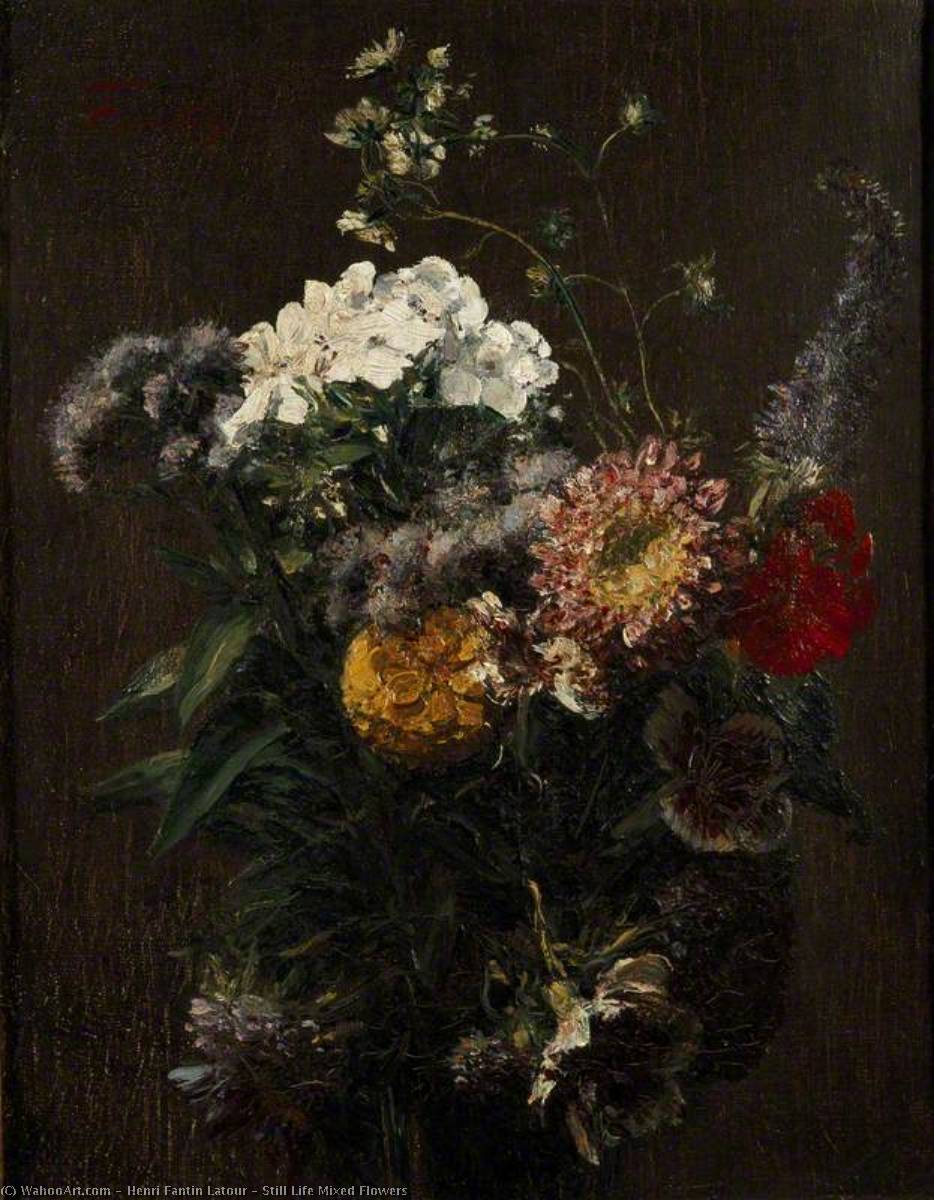
A Delicate Symphony of Color and Form: Exploring Henri Fantin-Latour’s “Still Life Mixed Flowers”
Henri Fantin-Latour's "Still Life Mixed Flowers," completed in 1887, stands as a quintessential embodiment of Realism within the broader artistic landscape of its time. More than merely depicting flowers—a subject favored by artists throughout history—Fantin-Latour elevates it to an exploration of beauty itself, capturing not just what is seen but also conveying a profound sense of emotion and contemplation. The painting resides in the Ashmolean Museum of Art and Archaeology in Oxford, United Kingdom, measuring 23 x 19 cm and executed with meticulous precision on canvas using oil paints.
Fantin-Latour’s artistic journey began under the tutelage of Horace Lecoq de Boisbaudran at the École des Beaux-Arts, where he championed a revolutionary approach to drawing—one that prioritized observation from memory over slavish imitation of masterworks. This formative influence instilled in him an unwavering commitment to capturing the essence of his subjects with remarkable accuracy and subtlety. He spent considerable time studying Old Masters at the Louvre, absorbing their techniques and compositional strategies, demonstrating a dedication to artistic excellence that would permeate his entire oeuvre.
The composition itself is deceptively simple: a vase overflowing with an assortment of blossoms—primarily white roses interspersed with vibrant red blooms—dominates the canvas. Fantin-Latour’s masterful handling of light and shadow imbues the painting with depth and dimensionality, guiding the viewer's gaze across the surface and highlighting the intricate textures of each petal and leaf. The dark background serves to accentuate the luminous colors of the flowers, creating a visual harmony that is both aesthetically pleasing and intellectually stimulating.
Beyond its formal qualities, “Still Life Mixed Flowers” resonates deeply with symbolic meaning. White roses traditionally represent purity and innocence, while red blossoms symbolize passion and vitality—elements skillfully interwoven within the floral arrangement. Fantin-Latour’s deliberate choice of color palette reflects a broader trend toward Impressionistic influences during his era, signaling a move away from academic conventions towards capturing fleeting moments of sensory experience. The painting invites viewers to consider not just what is seen but also what it evokes – a quiet appreciation for the ephemeral beauty of nature and its capacity to inspire contemplation.
Fantin-Latour’s unwavering dedication to detail—evident in every brushstroke—is testament to his artistic vision. He meticulously rendered each flower with painstaking precision, capturing its form, color, and texture with breathtaking realism. This technique aligns perfectly with the principles of Realism, which sought to depict subjects truthfully without embellishment or idealization. The resulting artwork is a timeless masterpiece that continues to captivate audiences today, securing Fantin-Latour’s place as one of the most influential painters of his generation.
- Artist: Henri Fantin-Latour
- Born Year: 1836
- Death Year: 1904
- Birth City: Grenoble
- Birth Country: France
- Location: Ashmolean Museum of Art and Archaeology, Oxford
- Dimensions: 23 x 19 cm
- Medium: Oil on Canvas